-
Title
-
What's Under the Mask/ Polska Sztuka Ludowa - Konteksty 2014 Special Issue
-
Description
-
Polska Sztuka Ludowa - Konteksty 2014 Special Issue s.361-364
-
Creator
-
Sznajderman, Monika
-
Date
-
2014
-
Format
-
application/pdf
-
Identifier
-
oai:cyfrowaetnografia.pl:6141
-
Language
-
ang
-
Publisher
-
Instytut Sztuki PAN
-
Relation
-
oai:cyfrowaetnografia.pl:publication:6570
-
Rights
-
Licencja PIA
-
Subject
-
anthropology of film
-
Type
-
czas.
-
Text
-
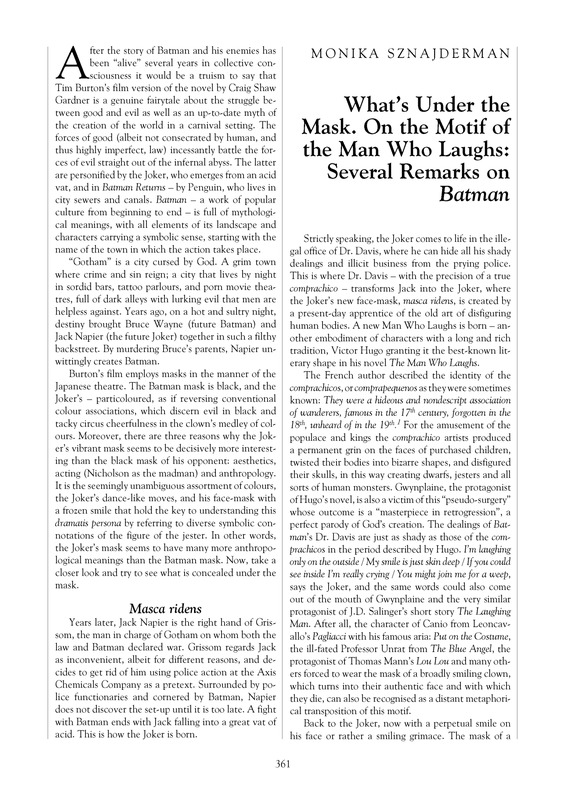
A
fter the story of Batman and his enemies has
been “alive” several years in collective con
sciousness it would be a truism to say that
Tim Burton’s film version of the novel by Craig Shaw
Gardner is a genuine fairytale about the struggle be
tween good and evil as well as an up-to-date myth of
the creation of the world in a carnival setting. The
forces of good (albeit not consecrated by human, and
thus highly imperfect, law) incessantly battle the for
ces of evil straight out of the infernal abyss. The latter
are personified by the Joker, who emerges from an acid
vat, and in Batman Returns - by Penguin, who lives in
city sewers and canals. Batman - a work of popular
culture from beginning to end - is full of mythologi
cal meanings, with all elements of its landscape and
characters carrying a symbolic sense, starting with the
name of the town in which the action takes place.
“Gotham” is a city cursed by God. A grim town
where crime and sin reign; a city that lives by night
in sordid bars, tattoo parlours, and porn movie thea
tres, full of dark alleys with lurking evil that men are
helpless against. Years ago, on a hot and sultry night,
destiny brought Bruce Wayne (future Batman) and
Jack Napier (the future Joker) together in such a filthy
backstreet. By murdering Bruce’s parents, Napier un
wittingly creates Batman.
Burton’s film employs masks in the manner of the
Japanese theatre. The Batman mask is black, and the
Joker’s - particoloured, as if reversing conventional
colour associations, which discern evil in black and
tacky circus cheerfulness in the clown’s medley of col
ours. Moreover, there are three reasons why the Jok
er’s vibrant mask seems to be decisively more interest
ing than the black mask of his opponent: aesthetics,
acting (Nicholson as the madman) and anthropology.
It is the seemingly unambiguous assortment of colours,
the Joker’s dance-like moves, and his face-mask with
a frozen smile that hold the key to understanding this
dramatis persona by referring to diverse symbolic con
notations of the figure of the jester. In other words,
the Joker’s mask seems to have many more anthropo
logical meanings than the Batman mask. Now, take a
closer look and try to see what is concealed under the
mask.
Masca ridens
Years later, Jack Napier is the right hand of Gris
som, the man in charge of Gotham on whom both the
law and Batman declared war. Grissom regards Jack
as inconvenient, albeit for different reasons, and de
cides to get rid of him using police action at the Axis
Chemicals Company as a pretext. Surrounded by po
lice functionaries and cornered by Batman, Napier
does not discover the set-up until it is too late. A fight
with Batman ends with Jack falling into a great vat of
acid. This is how the Joker is born.
361
MONIKA
SZN AJD ERM AN
What’s Under the
Mask. On the Motif of
the Man Who Laughs:
Several Remarks on
B atm an
Strictly speaking, the Joker comes to life in the ille
gal office of Dr. Davis, where he can hide all his shady
dealings and illicit business from the prying police.
This is where Dr. Davis - with the precision of a true
comprachico - transforms Jack into the Joker, where
the Joker’s new face-mask, masca ridens, is created by
a present-day apprentice of the old art of disfiguring
human bodies. A new Man Who Laughs is born - an
other embodiment of characters with a long and rich
tradition, Victor Hugo granting it the best-known lit
erary shape in his novel The Man Who Laughs.
The French author described the identity of the
comprachicos, or comprapequenos as they were sometimes
known: They were a hideous and nondescript association
of wanderers, famous in the 17th century, forgotten in the
18th, unheard of in the 19th.1 For the amusement of the
populace and kings the comprachico artists produced
a permanent grin on the faces of purchased children,
twisted their bodies into bizarre shapes, and disfigured
their skulls, in this way creating dwarfs, jesters and all
sorts of human monsters. Gwynplaine, the protagonist
of Hugo’s novel, is also a victim of this “pseudo-surgery”
whose outcome is a “masterpiece in retrogression” , a
perfect parody of God’s creation. The dealings of Bat
man’s Dr. Davis are just as shady as those of the com
prachicos in the period described by Hugo. I’m laughing
only on the outside / My smile is just skin deep / If you could
see inside I’m really crying / You might join me for a weep,
says the Joker, and the same words could also come
out of the mouth of Gwynplaine and the very similar
protagonist of J.D. Salinger’s short story The Laughing
Man. After all, the character of Canio from Leoncav
allo’s Pagliacci with his famous aria: Put on the Costume,
the ill-fated Professor Unrat from The Blue Angel, the
protagonist of Thomas Mann’s Lou Lou and many oth
ers forced to wear the mask of a broadly smiling clown,
which turns into their authentic face and with which
they die, can also be recognised as a distant metaphori
cal transposition of this motif.
Back to the Joker, now with a perpetual smile on
his face or rather a smiling grimace. The mask of a
�Monika Sznajderman • WHAT’S UNDER THE MASK. ON THE MOTIF OF THE MAN WHO LAUGHS: SEVERAL REMARKS ON BATM AN
clown has become his face. He must put a lot of ef
fort while putting on makeup to render chalk-white
skin and yellow hair the colour of a normal human
being. Focus for a minute on the motif of the wideopen laughing mouth responsible for the grotesque
features of the Man Who Laughs and placing him in
the realm of carnival reality. Mikhail Bakhtin saw the
wide “gaping” mouth as an open gate leading downwards
into the bodily underworld (...). This gaping mouth is re
lated to the image of swallowing, the most ancient symbol
of death and destruction.2 Bakhtin also drew attention
to the link between the smiling mask of a clown and
the mask of a devil:
(...) the mouth ( .t h e teeth and the gullet). These are
some of the central images of the popular-festive system.
The exaggeration of the mouth is the fundamental tradi
tional method of rendering external comic features, as pic
tured by comic masks, various “gay monsters” (...) devils
in diableries, and Lucifer himself.3 In other words, if we
are to believe Bakhtin, the motif of an open, laugh
ing, and glaringly enlarged mouth has to inspire as
sociations with the motif of carnival death, and in the
subtext of the clownish face-mask of the Man Who
Laughs we should always see - following the rules of
the symbolic world - the grotesquely contorted face
of a representative of the netherworld, even if in an
amusing version.
Murderous clown
I did not know bats came out in the daytime, the Joker
cries out to Batman. Just when murderous clowns leave
the circus, Batman replies. The Joker’s mask conceals,
in addition to declared anguish and sorrow, also con
tents referring to the significant cultural motif of the
sinister clown, the image of a jester conceived as per
sonified evil and a harbinger of death. The motif of the
murderous clown, popular in the literature and films
of mass culture, has a tradition of its own. Accord
ing to W. Willeford4 the connection between jester/
clown and death is not limited to the fact that this
particular dramatis persona becomes the victim of a
comic murder committed on stage (after which he is
immediately resurrected, confirming the existence of
a symbolic connection between the character of the
jester and immortality). A jester is also someone who
dispenses death, who nonchalantly distributes it, a
supreme judge d rebours who passes final sentences
and avenges injustice. As an ominous killer-avenger
the jester is a figure of chaos, anarchy, and destruc
tion toppling all sanctioned order; he is a reversal of
the figure of God and His earthly representative, the
king. Such was the titular character of P. Lagerkvist’s
The Dwarf or Barkilphedro, the evil jester, in The Man
Who Laughs. Hop-Frog from E.A. Poe’s short story is
another punisher. Among modern examples mention
is due, without searching too long, to Penguin in Bat
362
man Returns, the legendary “man from the sewers” and
boss of the criminal Red Triangle Circus Gang that
operates only at night. In It, a novel by Stephen King
adapted by Tommy Lee Wallace into a movie under
the same title, evil inhabiting the city is personified
by a circus clown with orange hair and a bright red
and broadly smiling mouth, carrying a bunch of col
ourful balloons. Alex, the character in A. Burgess’ A
Clockwork Orange, whose film version was directed by
Stanley Kubrick, also kills while wearing the mask of a
circus clown and moves, similar to Joker, as if he were
prancing.
The motifs to which the substance concealed by
the Joker’s masca ridens refers - the image of a jester
as a figure of evil, mayhem, and ruin, together with
the motif of his connection with death, resembling the
relationship between the figure of the jester/clown and
the demonic forces of the netherworld - are all wor
thy of a separate analysis. Here, I managed to sketch a
pertinent outline.
Commence au Festival! or fragments of
the myth of creation
Time for a deeper glance under the mask and for
a search for the next stratum of the myth. The very
essence of the activities of the Joker-the murderous
clown involves staging a carnival, taking the world
back to a state of the primal chaos that preceded its
creation. Now begins the proper battle between Bat
man and his nemesis; a battle for the new order, which
Batman ultimately wins. A t this stage, without delving
into the future, we shall remain in the carnival phase
to analyse the nature of Joker’s demiurgic deeds.
A creation himself, the Joker keeps on creating.
Thanks to a product known as Smylex he makes new
People Who Laugh; they are born and die at the same
moment, but with a smile on their faces. He has merely
replaced the craft of the comprachicos with advanced
chemistry.
The carnival of death continues. The city, in its fes
tive debauchery, becomes immersed in crime and anar
chy; death, as if in a condensed memory of all plagues,
coincides with laughter. It is finally time for the Joker’s
parade, when he appoints himself the new founding fa
ther of the city, which at that very moment becomes
imago mundi, a symbolic image of the world. Spotlights
are arranged on stage, followed by enormous deadly
Smylex-filled balloons and, finally, a platform featuring
a throne. I am prepared to rule the world, cries the Joker,
a world that after that night was supposed to never
stop laughing. A moment later the sky becomes filled
with swirling dollar bills, millions of dollars, the great
est abundance the city has ever experienced. Gotham
succumbs to chaos. New times are ahead.
Let us repeat: for all cultural anthropologists, eve
ryone interested in myths, it is clear that the carnival
�Monika Sznajderman • WHAT’S UNDER THE MASK. ON THE MOTIF OF THE MAN WHO LAUGHS: SEVERAL REMARKS ON BATM AN
fashioned by the Joker - a riot of lights, debauchery,
anarchy, laughter and death - symbolically reverts the
world to the time of its beginnings, after which a new
order, a new creation has to follow.
What precisely is this creation? The Joker, with Luciferian pride, dreams about divine prerogatives, which
deprive all his gestures of meaning and render them
mere parodies of God’s demiurgic gestures. After all,
the Man Who Laughs is nothing more than a parody
of God’s creation. It was quite a science —what one can
image as the antithesis of orthopedy, wrote Hugo. Where
God had put a look, their art put a squint; where God had
made harmony, they made discord; where God had made
the perfect picture, they re-established the sketch.5 What
kind of demiurgic creation is this supposed to be if an
unsuccessful, grotesque “sketch” becomes the demi
urge? The demiurgic powers of the Joker, a monstrous
masterpiece in retrogression, as the French writer called
this form of creation, would be creation h rebours and
his every creative gesture - a parody of creation. A
characteristic quality of the clownish dissonance of
Batman’s opponent, expressed primarily by his gaudy
attire and deformed features, also involves an element
of “curvature” present in the very etymology of the
term “jester” in Indo-European languages. Obviously
the figure of the jester is connected with the motif of
straying, erring, lunacy, temptation, traversing the
wrong paths along the by-ways of truth, norms, and
rules. By way of contrast, in the myth of the ruler as a
demiurge the particularly striking motif is that of sim
plicity conceived as the foundation of both physical
and ethical order. After all, it was not without reason
that when discussing how Peter I designed his town
Josif Brodski drew attention to the fact that the Eng
lish word “ruler” describes both a person who governs
and a tool used for measuring and drawing straight
lines. Rulers, as God’s appointed on Earth, always cre
ate by using straight lines. The demiurgic creation of a
clown, on the other hand, is a derivative of shadiness,
lies, and perfidy; in the sphere of symbols it is synony
mous with losing one’s way. Krzysztof Dorosz, follow
ing the example of Denis de Rougement, described
such creation steered by the urge to gain divine pre
rogatives as: a metaphysical "shortcut” on the road to di
vinity.6 It is common knowledge that those who take
short cuts usually get lost.
A t this point we should move on to the last mythi
cal theme found under the Joker’s mask; the Prometh
eus myth, whose distant transposition is to be discov
ered in the story of the Man Who Laughs.
The Joker as Prometheus
The drama of divine creation has always included
attempts at bringing down the established order, and
members of this enormous opposition, to quote Maria
Janion, i.e. Prometheus, Tantalus, Ixion, and Sisyphus
in Greek culture or fallen angels in the Cabalistic tra
dition often appear to be civilisers. Nevertheless, only
in the ancient account - in the lost ending of Aeschy
lus’ tragedy and in Hesiod - did the Prometheus myth
feature a final reconciliation between the hero and the
gods. In all cases, attempts at demiurgic creation after
creation, even if inspired by the welfare of humanity,
generate a mythological scenario of questioning divine
decrees; at a certain level this is a scenario analogous
to the one of Batman, a contemporary mythical tale of
creation. Even if the wellbeing of men, cited both by
Prometheus and fallen angels to justify their actions
(There is a surprising similarity between rebellious angels
and Prometheus, the Greek contester of the gods1), is a
relative concept, the Joker’s ironic declarations are
even more dubious. In his essay: Faust współczesny czyli
de pacto hominis politici cum diabolo, Krzysztof Dorosz
situated the Prometheus myth among the sources of
the myth of Faust - from the Renaissance Faust, who
sold his soul to the devil, to the contemporary Faust,
the social activist in communist mythology. The hu
manistic Marxist myth does not leave any doubts about the
saviour-like powers of the Greek titan. From a Christian
perspective, on the other hand, Prometheus has to be ul
timately considered some sort of a fallen angel and not a
saviour.8 In other words, regardless of his intentions
Prometheus becomes a usurper trying to breach gods’
contract with humans. Similarly to rebellious angels
- and the Joker - he personifies the mythological fig
ure of the Enemy. The pride and disobedience of the
fallen angels were punished by locking them within a
circle of darkness, chaining them to a black mountain,
and pronouncing eternal damnation. Prometheus was
sentenced to being chained to a rock in the Caucasus
and finally, as in Kafka’s short story, to merging with
the rock, forgotten and losing the very reason for his
existence. Salinger’s Laughing Man dies in a compa
rable way, tied with barbed wire to a tree, while the
Joker - another fallen angel - ends his life after one
more fall.
The fire stolen from the gods by the Greek hero
is essentially the same as the teachings passed on to
men by archons: the manufacture of gold and silver
artefacts, knowledge about stars and the moon, the art
of predicting the future ; it is thus identical to the ironic
promise of eternal happiness and smile made by the
Joker to the residents of Gotham. Denis de Rougement
called these gifts and promises a “short-cut" on the road
to divinity, inspired by the desire to equal the gods and
idolize man. According to Dorosz, this is why fire stolen
from the gods, the apple picked from the tree of the knowl
edge of good and evil, the mystery of creation seized by the
fallen angels in a Cabalistic legend, the Tower of Babel
and the magic revealed by Faust in return for renouncing
faith are all examples of a metaphysical utopia, a perpetu
ally repeated attempt at circumventing the human condi
363
�Monika Sznajderman • WHAT’S UNDER THE MASK. ON THE MOTIF OF THE MAN WHO LAUGHS: SEVERAL REMARKS ON BATM AN
tion, storming the heavens and taking possession of God.
It follows from our reasoning that such an endeavour can
not succeed without the help of demonic forces providing
man with a specific means of elevation —magic.9 The Pro
methean fire, Dorosz concluded, is an attribute of homo
magus and not of Providence, while black magic, the
attribute of both the Greek hero and the fallen angels
from the Book of Enoch, is the prevailing feature and
mechanism of Promethean and angelic gifts intended
or mankind. Dorosz believes that the rebellious black
magic practitioners from Atlantis can be the acknowl
edged prototype of Prometheus, whose descendant is
the Renaissance figure of Doctor Faustus, whose story
brought forth the pact with the dark forces, implicite in
cluded in the Prometheus myth.10 Homo magus, a con
temporary alchemist - how else would you describe the
Joker, the chemist-inventor, whose amazing products
are to make people die smiling and guarantee him the
highest, divine prerogatives in this paradise d. rebours?
To avoid rendering references to the Prometheus
myth overly arbitrary here is a fragment of Maria Janion’s reflections on Gwynplaine. In the essay: Maska
Maski. Ontologiczne nieszczęście Człowieka Śmiechu
she too compared the protagonist of Hugo’s novel to
the Greek titan. He is —in the symbolical sphere of the
novel —a titanic figure, a fallen giant, a God of not what
is above but what is below, a God of the abyss of poverty.11 Naturally, there are certain differences. Contrary
to the Joker, Gwynplaine is good and feels authentic
pain under his mask-face of a Monster. His face dis
guises (or rather expresses) suffering, while the Joker’s
smile reveals madness and evil. Nevertheless, remain
ing, as Janion did, at the symbolic level of the film and
novel, the Joker - in all his monstrosity - also has to
be considered God’s creature in reverse, the reverse of
beauty and, taking into consideration his Luciferian
intentions, the reverse of God. Since the Prometheus
myth is extensive, ambiguous and interpreted in differ
ent ways it should not come as a surprise that various
aspects may be stressed when comparing it to the myth
of the Man Who Laughs. Janion emphasised the titan
ic character of Gwynplaine branded with the suffering
of horrible ugliness12 his fate that of a cursed creature.
The link between Prometheus, his distant descendant,
Faustus, and the Joker - the feature in the latter’s story
that makes it possible to hear the distant echoes of the
Prometheus myth, is predominantly their opposition
against the order sanctioned by God and straying, tak
ing a mistaken "shortcut” on the path to divinity, reflect
ing the negation of an established canon of values. The
second tie is contact with the dark forces (to which the
clownish demonology of the Joker persona dramatis acts
as a symbolic key) and the application of magic (or sci
ence in service of magic) for the purpose of creating a
new order, a new philosophy, and a new art.
Fortuitously, Batman had better gadgets.
364
E n d n o te s
1
V. H u g o ,
Człowiek śmiechu,
W a rsz a w a 1 9 5 5 , v o l. I, p.
38.
2
M . B a k h tin , Twórczość Franciszka Rabelais’ego a kultura
ludowa średniowiecza i renesansu, K ra k ó w 1 9 7 5 , p. 4 4 6 .
3
Ib id em .
4
C f. W. W ille fo rd ,
5
V. H u g o , o p . c it., p. 3 9 .
6
K . D o ro sz , Faust współczesny czyli de pacto homini politici
cum diabolo, in : Maski Prometeusza. Eseje konserwatywne,
The Fool and his Sceptre. A Study in
Clowns and Their Audience, N o r th w e s te r n U n iv e r sity
P re ss 1 9 6 9 .
L o n d o n 1 9 8 9 , p. 28.
7
Ib id em , p. 27.
8
Ib id em , p. 22.
9
Ib id em , p. 28.
10
Ib id em , p. 29.
11
M.
Ja n io n ,
M ask a
Człowieka Śmiechu,
p. 4 0 6 .
12
Ib id em , p. 4 0 7 .
Maski. Ontologiczne nieszczęście
(in :) M a sk i, G d a ń s k 1 9 8 6 , v o l. II,
�