-
Title
-
Tradicomedy dell'arte, or Pierrotade à la Godard / Polska Sztuka Ludowa - Konteksty 2014 Special Issue
-
Description
-
Polska Sztuka Ludowa - Konteksty 2014 Special Issue s.269-276
-
Creator
-
Nadgrodkiewicz, Grzegorz
-
Date
-
2014
-
Format
-
application/pdf
-
Identifier
-
oai:cyfrowaetnografia.pl:6101
-
Language
-
ang
-
Publisher
-
Instytut Sztuki PAN
-
Relation
-
oai:cyfrowaetnografia.pl:publication:6529
-
Rights
-
Licencja PIA
-
Subject
-
anthropology of film
-
Type
-
czas.
-
Text
-
t is amazing how many cultural models, charac
ter types or masks can be used by an artist while
creating his work. It is just as interesting that this
enormous number of cultural models includes tho
se that are applied most frequently, and references
to which endow not only the given work but also its
author with virtuosity. Such a cultural model is the
mask. A t this stage it is necessary to transcend, albeit
not to the very end, the most trivial comprehension
of this term as part of a carnival costume concealing
the face. The mask conceived as a cultural model is
a specific symbol of the self, something that grants its
wearer a new being, a new identity, often demonic or
comical but always diametrically different from the
true self of the person hiding behind it. It was precisely
such a mask - helping to become a clown, a devil or
anyone else - that often inspired assorted artists, as
Mikhail Bakhtin noted in his essay: Characteristic here
I
is the artistic structuring of an image out of durable popu
lar masks —masks that had great influence on the novelistic
image of man during the most important stages of the no
vel’s development (...) 1. Such impact was exerted by the
mask not only on literature but to an equal or perhaps
even greater degree upon painting, photography or
film. Bakhtin stressed that a special sort of mask - the
folk mask2 - could have been chosen for assorted situ
ations, was capable of bearing merriment and tragedy,
and no plot could destroy it once and for all.
269
GRZEGORZ
NADGRODKIEWICZ
Tragicomedy delVarte ,
or Pierrotade a la
Godard
It is exactly from the tradition of the folk mask that
Harlequin, his “nephew” Pedrolino, and Pierrot, per
haps the best known of the three, originate. The lat
ter, a clown with a white powdered face and wearing
a white costume with a ruff, became one of the possibly
most widely recognised masks. It was Pierrot who was
rendered a symbol of mute, unexpressed and unful
filled love. Regarded as a tragic fool, he saddened and
entertained at the same time; first and foremost, he
inspired artists and apparently continues to do so up to
this day. The Pierrot character attained special place
in the cultural tradition of France, especially within
the range of the French pantomime. It was precisely
�Grzegorz Nadgrodkiewicz • T R A G IC O M E D Y D E L L A R T E , OR PIERROTADE À LA GODARD
French artists who most frequently resorted to the im
age of Pierrot, outfitted their protagonists with a set
of features ascribed to him, and endowed the reality
created by them with the traits of a world in which
the tragedy of the sad clown took place. What was the
source of the strong position of the white-faced clown
in French culture? Naturally, there is a reason why the
image of Pierrot affects artists, including Godard, to
such a degree. N ot by accident is Pierrot’s name not
just an ordinary diminutive of the French: Pierre.
The Pierrot dramatis persona descends, albeit not in
a straight line, from the seventeenth-century commedia
dell’arte , i.e. an artful or professional spectacle in which
clearly defined characters improvise their lines, em
bellishing them with comical lazzi - dialogue or action.
The core of each Italian comedy cast was composed of
two oldsters (Pantaloon and the Doctor), ladies and
lovers (Inamorati) and two zanni (e.g. Brighella and
Harlequin) - the most popular and characteristic for
the commedia dell’arte . The zanni were described by
various names, such as Harlequin, Trufaldino, Brighella, Buratino, or Pedrolino. Robert F. Storey in his book
Pierrot. A Critical History of a M ask derived from the
latter the name of the sad French clown: Pedrolino is
an “Italian equivalent" of Pierrot3. Storey cited several
other theories concerning Pierrot’s predecessor, but
he regarded the hypothesis associated with Pedrolino
as best justified and proposed the most extensive argu
ments in its favour. Storey attributed the introduction
of Pierrot into French literature to Molière, who in the
middle of the seventeenth century wrote and staged in
Paris the comedy Le Festin de pierre, in which one of
the protagonists was Pierrot - a mellow lover though
wily and witty4. This is the onset of Pierrot’s presence
in French drama, from which his image spread rap
idly to other domains of the arts. The early Pierrot
still possesses many features of the Italian Arlecchino.
Storey described him as l’homme spirituel5, but in time
French mentality and personality turned him into an
unhappy Pierrot. The colourful costume composed of
270
rhombi and worn by Harlequin became replaced by
a white billowing blouse and wide pantaloons. Gradu
ally, Pierrot assumed serious psychological features and
a variety of traits. Although he was most frequently
known as Pierrot, in art he appears just as frequently
as Harlequin, his less popular synonym. According
to Storey, despite the fact that Pierrot underwent
a change he is still simple-hearted, trustful and inde
pendent, and his love is still naive6. Pierrot constantly
offers proof of his Italian lineage, revealing ignorance
of the people surrounding him and in certain situa
tions even his stupidity.
With a thus shaped personality Pierrot no longer
fits into a single epoch but is above time. The poses
he assumes and the mask he puts on not only build his
image but become an outright symbol of a certain con
dition and state of spirit inclined towards sentimental
pessimism. For assorted artists Pierrot driven by pas
sion became an inspiring dramatis persona , a form that
for long has been full of contents; now it suffices to
add a "contemporary face” so that he might express all
that an artist might wish.
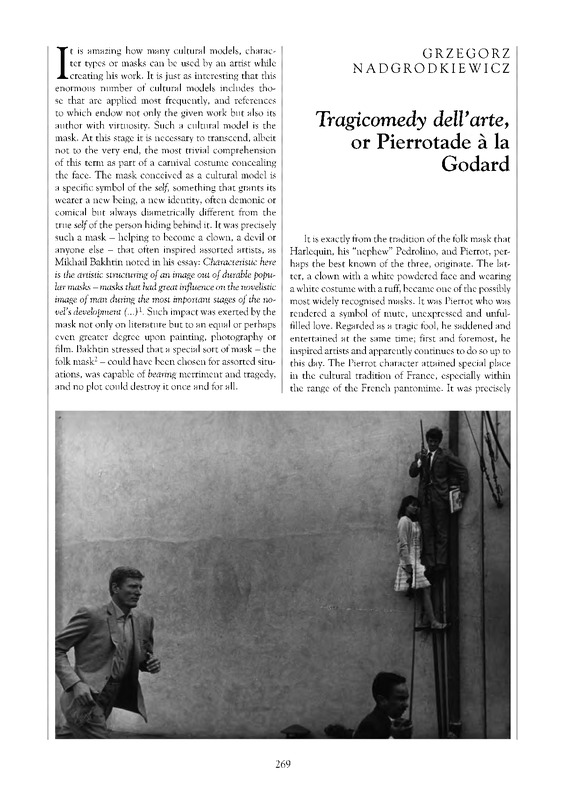
Artists who acted in this way include Jean-Luc
Godard with his film Pierrot le fou (1965). Taking into
consideration the original title it would be difficult to
seek a more direct suggestion. The director referred
not only to the image of the character, aware of the
extent to which it is a carrier of meanings, but also to
one of the features of Pierrot’s personality. Godard’s
Ferdinand not only turned into a tearful Pierrot but
also contains traits of the devious and clever Harle
quin. In the case of Ferdinand these are synonyms,
since he possesses as many countenances as the
number of the names of the zanni. Ferdinand is un
able to reveal his true self because he cannot take off
his mask - the role and its performer are merged into
a single complex character. Ferdinand is funny not only
as a result of what he does and says - he is also ec
centric. In other words, he is one of the contemporary
embodiments of Pierrot-Harlequin. Jean-Luc Godard
�Grzegorz Nadgrodkiewicz • T R A G IC O M E D Y D E L L A R T E , OR PIERROTADE A LA GODARD
applied an interesting trick of symbolically dressing his
lead protagonist to resemble the prime representative
of the French pantomime. The spectator may discover
the meaning of all the parallels between Ferdinand
and Pierrot by justifying the presence of this particular
artifice in Pierrot le fou with the assistance of a trans
textual motivation. Reference to the convention of
the commedia dell’arte (i.e. an assumption of the spec
tator’s previous experience) is necessary in order to be
27 1
able to perceive all the similarities and differences be
tween Godard’s lead protagonist and Pierrot.
Correspondence between Godard’s film and the
Pierrot tradition is realised upon several levels. A re
ference to this tradition is noticeable already in the
verbal stratum of the film - the m ost obvious example
being the title. W hen Ferdinand and M arianne be
come known as the lead protagonists there emerges
a successive parallelism - the girl, despite Ferdinand’s
�Grzegorz Nadgrodkiewicz • T R A G IC O M E D Y D E L E A R T E , OR PIERROTADE A LA GODARD
constant and failed protests, continues to call him
Pierrot. There comes to the fore yet another feature
of Ferdinand as Pierrot - he refuses to accept his new
name and his new and adverse - ultimately tragic fate.
The iconographic stratum of the film indicates
even more distinctly that Ferdinand actually is Pierrot.
Godard inserted snapshots of reproductions of paint
ings either in the direct vicinity of the photographed
Ferdinand or takes with Marianne, immediately fol
lowed by the figure of Ferdinand. The paintings bring
to mind assorted portrayals of Pierrot by Picasso, A u
gust Renoir or Henri Matisse. The most characteristic
and easiest to extract from the film is a reproduction of
Renoir’s Pierrot, with a small boy wearing the costume
of a clown. The director thus suggested Ferdinand’s
childish and naive nature matching the personality of
Pierrot.
Pierrott le fou refers to the Pierrot tradition also in
the construction of the protagonist. Ferdinand-Pierrot
steers his life in such a way that each encountered sur
prise proves to be more acrimonious than the previous
and all are tragicomic. The love that he encounters
is more bitter than sweet and has an inevitably tragic
end. The closing scenes stress the connection between
Ferdinand and Pierrot - a confirmation of his condi
tion of a tragic “fool” who perishes in an absurd man
ner.
Throughout the entire film Ferdinand reads or
carries a comic book with the curious title Les Pieds
Nickeles. Although none of its fragments presented
on screen actually display Pierrot, the poetic, shape
and colour scheme of the characters bring to mind the
appearance of clowns. Pierrot’s clumsy floundering in
a strange and sad world is the comic and simultaneously
tragic act of a clown. The fact that Ferdinand carries
and reads this particular comic book (in other words,
is somehow attached to it) suggests that his life too
can be treated as a clown’s frenzied performance.
A detailed description of the Ferdinand dramatis
persona is rendered possible by applying Arthur Sy
mons’ extraordinarily apt characteristic: Pierrot is one
of the types of our century, of the moment in which we live,
or of the moment, perhaps, out of which we are just pass
ing. Pierrot is passionate; but he does not believe in great
passions. He feels himself to be sickening with a fever, or
else perilously convalescent; for love is a disease, which he
is too weak to resist or endure. He has worn his heart on
his sleeve so long, that it has hardened in the cold air. (...)
He knows that he is condemned to be always in public,
that emotion would be supremely out of keeping with his
costume ( ...) . It is in this way that the scheme of the
Harlequin character is realised in Ferdinand’s life. His
love for Marianne is unhappy and by no means pure
because it is smothered by jealousy (this is the rea
son why he shoots her). Despite the turbulent course
272
of their relationship it is difficult to believe in great
passion. The reason lies in the fact that Ferdinand
becomes learned, perverse, intellectualising his pleasures,
brutalising his intellect; his mournful contemplation of
things becoming a kind of grotesque joy8.
Why then does the spectator not become repulsed
by a protagonist who complicates his fate only to ulti
mately commit an absurd suicide? This is because the
construction of the lead character in Pierrot le fou con
tains a certain dominating feature that justifies Ferdi
nand, i.e. a set of traits linking him with the tradition
of the Italian comedy. Ferdinand is not solely an up
-to-date version of the French Pierrot, and although
he has a multitude of traits resembling the latter the
prevailing ones connect him with the protagonist of
the commedia dell’arte . If we were to assume that Fer
dinand is one of the zanni then he cannot enact his
lazzi alone. A tempting hypothesis suggests that we
should treat the whole film by Jean-Luc Godard as
a sui generis emulation of the commedia dell’arte scheme.
Apparently, quite a number of arguments speak in fa
vour of accepting this hypothesis as an interpretation
-analytical key. This concept places emphasis on in
terpretation rather than on analysis indicating actual
relations within the film. Proving the compatibility of
the commedia dell’arte scheme with the structure of
Godard’s film will resemble interpretation rather than
methodical analysis.
The commedia dell’arte , whose characteristic fea
tures include exceptional force and durability, is one of
the few products of the theatre9, which after so many
centuries are capable of strongly affecting works with
lively dramaturgy10. Apparently, commedia dell’arte in
fluences not only the epic or the drama but with equal
success also film. Pierrot le fou seems to be a model
-like example of translating the scheme of the Italian
comedy into the language of film in an incompletely
pure form but with the preservation of its specific fea
tures while, at the same time, reducing the comedy
aspects. One would like to say that in this version we
are dealing with a specific tragicomedy dell’arte . Such
a description would be justified in situating Godard’s
work within a given national tradition. The French,
welcoming Italian actors of the commedia dell’arte ,
demanded that the performances be given at least
a pseudo-tragic overtone. w h en they finally began to
continue the commedia dell’arte tradition, scenes main
tained in the tragic style became very popular. The sub
sequent tradition of Pierrot in France enforced, by the
very nature of things, tragedy or outright tragicomedy
upon artists who referred to the mask of a clown with
a white-powdered countenance.
The core of Godard’s tragicomedy dell’arte , naturally
maintained in the mode of the Italian comedy, are the
zanni - the spiritus movens of action. The text of Pierrot
le fou provides numerous evidence that not only Ferdi
�Grzegorz Nadgrodkiewicz • T R A G IC o M E D Y D E L E A R T E , OR PIERROTADE A LA GODARD
nand but also Marianne (and in the second part of the
film decidedly the latter) stimulates the action of the
film. In the tragicomedy dell’arte conception Marianne
(applying her entire energy) will play a different part
and the mask of the zanni must be entrusted to a man.
The tragicomic zanni is thus, obviously, Ferdinand.
As the lead protagonist of the film he simultaneously
combines the function of two zanni, since as Pierrot
he comprises a peculiar combination of astuteness
and stupidity. He delights in cheating others, but himself
is easily cheated11. Harlequin-Pierrot can become the
axis of the plot (when he drives Marianne home and
inaugurates their romance), but at other times he re
ceives only lashes and blows (e.g. when two gangsters
try to drown him). Upon yet other occasions he tends
to reveal the diabolical features of his ancestor, Har
lequin (when he kills his beloved), but can also be the
naive Pierrot (when he believes Marianne’s assurances
about her love for him, while she casts a conspiratorial
glance at the audience). He is also a servant, as befits
the zanni character, when without protest he allows
Marianne to embroil him into smuggling weapons. His
servility is visible in the film’s opening scenes show
ing him as the “nice” son-in-law of Monsieur Espresso,
forced to take part in receptions. Within the context
of this argument it becomes significant that both his
wife and mother-in-law are Italian (their pretentious
surname easily brings to mind Italy). Godard’s Pierrot,
the son-in-law of the Espressos, thus remains within
the range of the impact of Italian culture and the Har
lequin tradition. In other words, Ferdinand-Pierrot is
also a clown and a jester, increasingly involved in gro
tesque situations and entertaining the spectator, while
at the same time unable to escape the enchanted cir
cle of self-propelling absurdities.
Commedia dell’arte was constructed out of intrigues
devised by the zanni and the small deceits planned by
their female lovers - peasants or town dwellers known
in the tradition of the commedia dell’arte as soubrettes.
As a rule, they were housemaids and the multiplicity
of their names equalled that of Harlequin (e.g. Smeraldina, Arlecchina, Franceschina). The most popular
was Columbine, who was in love with Harlequin or
loved by him. Here is her description by Konstanty
Miklaszewski: She was a bonnie, comely and glib country
lass; fearing nothing, she treated her masters with license,
at times even with impudence, reacting immediately with
word and gesture; fit and supple, she was even capable of
striking a man12.
Such a likeness immediately brings to mind
Godard’s Marianne, a baby-sitter (she takes care of
children while Ferdinand and his wife go to a party at
the Espressos). As a character out of Godard’s tragi
comedy dell’arte she too fits within the limits of the
comic and tragic world and in no way is worse than
columbine when she assaults a man at a gas station.
273
Nor can we negate Marianne’s physical prowess (watch
her on a beach dancing together with members of her
“brother” Fred’s ballet company). Marianne certainly
feels more at home in the tragicomic world than does
Ferdinand, although she too experiences grotesque
and, at the same time, tragic situations, their end be
ing the moment of her death. Bold, ruthless and fear
less, Marianne takes part in gun smuggling although
she becomes emotionally involved; her treatment of
Pierrot, to whom she is unfaithful, is outright cynical.
Her language sparkles with brilliant ripostes. A t the
same time, she is unable to overcome the sui generis
destiny looming over the fate she shares with Ferdi
nand. Although Marianne seems to be courageous,
their joint journey towards death contains moments
of weakness (characteristically, while together with
Ferdinand on an island, she cries out: What am I to do?
I don’t know what to do! ).
Marianne also turns out to be similar (even if only
due to her name) to a character in Les Originaux,
a play by Houdart de la Motte13. Marinette, the hero
ine of this drama written in the spirit of the comme
dia dell’arte , is the object of Pierrot’s unhappy love
and just like Godard’s Marianne pushes the miserable
clown to the edge of ultimate despair; helpless and
distressed, he poisons her and immediately afterwards
himself. Is this scenario of events identical to the fi
nale of Godard’s film? The historical transformation
of the commedia dell’arte is the reason why the Ital
ian housemaid differs from her French successor, the
French soubrette. France (...) refined the early rough
Colombina into the dainty Columbine14 - wrote Allardyce Nicoll in World Drama. The French soubrette
has become more sophisticated and elegant, wiser and
wittier. She had, therefore, undergone a certain evo
lution, experienced also by Marianne in Pierrot le fou .
The opening sequences introduce us to a meek girl
who in the course of her acquaintance with Ferdinand
starts showing her true face. True, the evolution of
Columbine is one from vulgarity to finesse, while in
the case of Marianne it runs an opposite course, from
calmness and subtlety (the conversation held in a car
about life that is not a novel) to cynicism and hypoc
risy (the glance at the camera during the stay on an
island, betraying her true feelings), but it is the very
fact of experiencing a transformation and becoming
someone else that is essential.
Just as the Italian comedy so the tragicomedy dell’arte is
a sui generis masquerade. The assumption of masks and the
constant changing of the protagonists’ names comprise
a curious ritual of becoming immersed in mystery and
altering identity. columbine too takes part in this ritual
- first she is Pasquella, then Pierette, while upon another
occasion she becomes Ricciolina. Similar conversions of
identity, although rather in the metaphorical sense, are
experienced by Godard’s Marianne when Ferdinand calls
�Grzegorz Nadgrodkiewicz • T R A G IC O M E D Y D E L L A R T E , OR PIERROTADE À LA GODARD
her by using the names of the female characters in a book
he is currently reading: Marianne becomes Cassandra or
Virginia. Her new name always predicts danger and is an
ominous spell whose victims ultimately include Pierrot.
Here is another parallel between Columbine and Mar
ianne - their fondness for changing costumes. Marianne
does so with genuine expertise, very often, and always
imperceptibly for the spectator. Nicoll noted that Colum
bine had plenty of clothes, beginning with a housemaid’s
casual attire and ending with a stunning white dress
known from pantomime15. Finally, both women share an
outright tragic love for the hapless Pierrot.
The Godardian tragicomedy dell’arte is, however,
not merely a configuration of mysterious masks and
complicated personalities but living people enacting
their lazzi. Fleeing from Paris, the tragicomic couple,
Marianne and Pierrot, incessantly takes part in as
sorted comic episodes. Just like the protagonists of
the true commedia dell’arte they constantly “stage” for
the spectator assorted images. Take the example of
the scene at a petrol station, with both demonstrating
grotesque bravura, the scene enacted in a port - a po
litically engagée story of a Vietnamese woman and an
American man, or, finally, the sensually danced and
performed song about the fate-line and the thigh-line
(Ma ligne de chance, ta ligne de hanche). The lazzi col
lection includes additional takes in which Pierrot dis
plays assorted facial expressions (the cigarette smoked
in Marianne’s Parisian home or the face of an old man
speaking about the necessity of describing la vie toute
274
seule). Naturally, this is a direct reference to the tradi
tion of Pierrot as a pantomime actor and thus to lazzi
enacted by Pedrolino16. Lazzi presented by Marianne
and Ferdinand obviously feature a comic trace derived
directly from the commedia dell’arte albeit always ac
companied by tragic overtones. Each scene in which
they take part intensifies the tangle of ill-fated cir
cumstances, thus creating a situation without a solu
tion. Escaping from Paris they become involved in car
thefts, shoot-outs, gun smuggling and unhappy love,
which becomes the reason for their ultimate tragedy.
The commedia dell’arte tradition entails clever say
ings (bons mots) and jokes. Both Pierrot and Marianne
are skilful adversaries in verbal duels and witty tete-a
-tetes. They are also capable of conducting serious
conversation (such as the one on the island, when they
discuss their life needs). Even stronger than via the
bons mots they are linked with the commedia dell’arte
by eroticism, which in the film is realised more in the
verbal stratum than the visual one. Riding in a car,
Marianne tells Ferdinand: I am kissing you all over. On
a moonlit beach she requests: Let’s make love. Pierrot,
enthralled by her body, sings: T a ligne de hanche. Their
words appear to be desultory but they contain an
immense emotional load. Mutual erotic fascination
can be depicted by citing Konstanty Miklaszewski’s
description of the erotic element in the commedia
dell’arte : Cult of the body, passionate eroticism, monstrous
entanglement of dirty intrigues, pandering, adultery, jokes,
expressions and gestures more than ambiguous —such is
�Grzegorz Nadgrodkiewicz • T R A G IC O M E D Y D E L E A R T E , OR PIERROTADE A LA GODARD
the indecency of the commedia dell’arte 17. This was the
appearance of a world revealing its affiliation with
Godard’s world of the tragicomedy dell’arte, full of dis
honest gangster business affairs, false love and a genu
ine imbroglio of human destiny.
Commedia dell’arte , known also as commedia popolare , was intended mainly for a wide audience composed
of commoners. It was compelled, therefore, to embark
upon assorted issues of interest to this particular social
stratum. Nonetheless, numerous features held dear by
the public were ridiculed as befits a comedy (e.g. the
lascivious behaviour of the soubrettes or the brutality
of certain zanni). In a similar manner, the tragicomedy
dell’arte mocked the mass culture of the 1960s (by way
of example, the colourised takes in the scene of the
party held by the Espressos deride the guests’ captiva
tion with pop culture). Godard, however, did not al
low his tragicomedy to reach a member of the audience
in such a facile way as the commedia dell’arte did. It is
much more difficult to detect more profound meanings
in his text but elements subjected by the director to
a negative evaluation can be discerned rather easily.
Commedia dell’arte18 is a professional, well-crafted
comedy known also as commedia all’improvviso, a the
atrical genre whose characteristic feature is improvisa
tion of the text. Godard’s tragicomedy dell’arte is also
somewhat all’improvviso. Naturally, improvisation is the
domain of the actors - Marianne and Pierrot, whose
entire journey from Paris to the south of France is a se
quence of improvised incidents and situations. Talking
with each other they seem to be playing a curious game
intent rather on the aesthetic effect of the statements
than on attaining any sort of understanding. The dia
logues thus resemble witty and impromptu questions
and answers rather than factual conversation, excel
lently illustrated by a fragment in which Marianne
and Pierrot are sailing in a boat and discussing politics.
Marianne starts calculating the length of human life
into the number of the seconds it contains. Although
her numerical tirade possesses certain charm it does
not help the conversation to make any progress. Their
curious behaviour, those tragicomic lazzi that are the
product of an impulse, is also improvised. Situations
when both protagonists appear as actors seem to be en
tirely devoid of any sort of rational premises. The theft
of a Cadillac at a gas station and its subsequent drown
ing in the sea by Ferdinand are deeds dictated by some
sort of irrational stimuli, hastily improvised situations.
The protagonists of Godard’s Pierrot le fou are not
merely comedians in love. Pierrot as a zanni and Mar
ianne as a soubrette are also nimble and agile actors
in a tragicomedy dell’arte19. Writing about Harelquin
buffoonery Miklaszewski indirectly offered a character
istic of Ferdinand’s behaviour: His poses are composed
symmetrically, foolish but witty, vulgar but full of charm,
always strange and reflecting the state of the soul in accord
27 5
ance with the given situation and theme. Marianne vel Co
lumbine - Miklaszewski wrote further on - is lively and
merry, implike and limber, with a lissom body in constant
motion20. Marianne and Ferdinand continuously prove
how much they match the protagonists of the commedia
dell’arte. Every now and then Pierrot leaps like an acro
bat from trees or cliffs, sings and even dances with Mar
ianne, as in the scene when singing M a ligne de chance,
ta ligne de hanche they execute a mock pas de deux. They
are perfect for the parts of Columbine and Harlequin,
who - to travesty Nicoll - are bouncing on a stage like
a spring and dodging with extravagant gesture21.
In the tragicomedy dell’arte Pierrot, heir of the Ren
aissance Pedrolino, becomes a character endowed with
truly Romantic features. Storey calls him a fallen angel22,
someone who suffers from inner unrest, succumbs to
Romantic melancholy, experiences a spiritual rent,
and is doomed. Godard’s Ferdinand is familiar with
such moods. The world in which he has found himself
endlessly provides him with reasons to feel torn apart
and to steer his fate towards an ultimate catastrophe.
Looking into the rear view mirror of his car he utters
the symptomatic words: ...I see the face of a man who’s
about to drive over a cliff at a hundred kilometers an hour.
His Romantic nature is also confirmed by a scene
in which together with Marianne he lies on a beach
bathed in moonlight. Harlequin and Pierrot also fre
quently pursued love affairs with their soubrettes in
moonlight or rendered it the theme of poetic meta
phors. Storey too mentioned this fact, thus simultane
ously confirming Pierrot’s Romantic nature23.
In Godard’s film, Ferdinand changes and evolves
just like Harlequin who in the commedia dell’arte be
comes Pierrot. From a passive husband attending
flashy receptions he becomes Pierrot - Marianne’s
mad lover. He is closer to Pierrot or Harlequin due to
the fact that he writes and turns into a tragicomic au
thor whose diary describes his equally tragicomic life.
In this manner he starts to resemble Pierrot as a poet
from a French children’s song24.
Finally, yet another similarity between the Italian
comedy and the tragicomedy dell’arte realised, however,
not within the diegesis of the film but due to the spe
cific function fulfilled by the director, Jean-Luc Godard,
who in the context of the tragicomedy dell’arte became its
initiator and director performing the part of the concertatore supervising the play. In this capacity Godard also
proposed the scenario, in which, according to Nicoll, he
sketched the plot and determined its climax25. First and
foremost, Godard was the author of the screenplay to
Pierrot le fou (borrowing only little from a novel by Lionel
White). We are entitled to assume that the scenario was
not particularly detailed since numerous scenes appear
to be improvised (just like the lazzi in commedia dell’arte,
barely marked in the scenario). Moreover, Godard-concertatore took care that the key scenes were sufficiently
�Grzegorz Nadgrodkiewicz • T R A G IC O M E D Y D E L L A R T E , OR PIERROTADE À LA GODARD
accentuated so that eventually they could transmit
meanings granted by the director (in the same way the
concertatore distinguished elements of the plot).
Ferdinand-Pierrot is no longer a mere protagonist of
the tragicomedy dell’arte. As a comedian, he becomes the
participant of events transpiring in a strange and gro
tesque world, which Storey described as le monde pierrotique26. Pierrot strides a world that is recalcitrant and bi
zarre27. This is also the way Ferdinand behaves when he
begins to live as if in an adventure story. His entire activity
seems to stem from a curious (although probably uncon
scious) need to fill the surrounding world with original
events and words. This specific horror vacui is the reason
why the essence of the acts carried out by Ferdinand
-Pierrot - all those thefts, assaults, heists and murders - is
a multiplication of a clown’s jokes. Ferdinand’s journey
to the south of France constantly supplies him with new
opportunities for performing lazzi. His conduct assumes
clownish features. When it produces only laughter it
becomes a clown’s performance; moments later it is an
ordinary masquerade (the theatrical scene enacted in
a port by Ferdinand and Marianne wearing Vietnamese
and American costumes). As a rule, however, Ferdi
nand proves to be the protagonist of a Harlequinade,
a comical and tragic, grotesque and ironic Pierrotade a la
Godard. Pierrot envisaged by Jean-Luc Godard proves to
be the servant of Death28 (he kills Marianne), but also
its victim (after all, he too will soon die). He is naive and
pitiful, embroiled in a sequence of tragicomic situations
crowned by his absurd demise. The Pierrotade in which
he participates or rather which he creates possesses
a specific Godardesque character. After all, not always
did Pierrot’s sad adventures end in his death. Pierrot le
fou produces such a tangle of various circumstances that
the only possible conclusion of the main protagonist’s
story proves to be his death (just as in classical tragedy).
This is why the Pierrotade constructed by Ferdinand is
a Pierrotade a la Godard - it runs its course and ends in
accordance with the poetic of this director’s films.
Finally, here is Mikhail Bakhtin: Popular masks (...)
never perish: not a single plot in Atellan, Italian or Italian
ized French comedies provides for, or could ever provide for,
the actual death of a Maccus, a Pulcinello or a Harlequin.
However, one frequently witnesses their fictive comic deaths
(with subsequent resurrections). These are heroes of free im
provisation and not heroes of tradition, heroes of a life proc
ess that is imperishable and forever renewing itself, forever
contemporary —these are not heroes of an absolute past29.
Endnotes
1 Mikhail Bakhtin, Epic and Novel, in: idem, The Dialogic
Imagination, ed. Michael Holquist, transl. Caryl Emmerson,
Michael Holquist, Austin - London 1981, p. 36.
2 Ibidem.
3 Robert F. Storey, Pierrot. A Critical History of a Mask,
Princeton 1978, p. 15.
4 Cf. ibidem, p. 17.
276
5
6
7
8
9
10
11
12
13
14
15
16
17
18
19
20
21
22
23
24
25
26
27
28
29
Ibidem, p. 114.
Cf. ibidem, p. 22.
Arthur Symons, Aubrey Beardsley, London 1898, pp.
20-21.
Ibidem, p. 21.
The use of the expression "product of the theatre” is
intentional since commedia dell’arte is not drama sensu
stricto and a written play but rather the product of the
actor, the costume designer or the stage machinist.
Cf. Julian Lewański, O komedii żywej, introduction to:
Konstanty Miklaszewski, Komedia dell’arte, czyli teatr
komediantów włoskich XVI, XVII, XVIII wieku, transl.
Sława and Michał Browińscy, Wrocław 1961, p. 5.
Allardyce Nicoll, The World of Harlequin: A Critical
Study of the Commedia Dell’Arte, Cambridge 1963, p. 84.
Cf. also: Allardyce Nicoll, The Development of the
Theatre: A Study of Theatrical Art from the Beginnings to
the Present Day, New York 1927, p. 108.
Konstanty Miklaszewski, op. cit., pp. 51-53.
Example after: Robert F. Storey, op. cit., p. 27.
Allardyce Nicoll, World Drama: From Aeschylus to
Anouilh, New York 1961, p. 197.
Allardyce Nicoll, The Development of the Theatre, op.
cit., p. 107.
Robert F. Storey, op. cit., p. 25.
Konstanty Miklaszewski, op. cit., p. 81.
Arte in Italian means not only art but also: skill, profes
sion, handiwork.
Cf. Konstanty Miklaszewski, op. cit., p. 110.
Ibidem, p. 116.
Cf. Allardyce Nicoll, The Development of the Theatre, op.
cit., p. 108.
Ange déchu.
Storey listed titles and quotes from books confirming
Pierrot's condition as a Romantic fond of the mood of
a moonlit night (with a slight dose of irony), e.g. the title
of the play by Nolant de Fatouville: Arlequin, empereur
dans la lune (op. cit., p. 24) or the words of Pierrot from
another drama: I could never be such a fool as to agree that
the moon is a world. The moon, the moon! Morbleu! And
the moon no bigger than an omelette of eight eggs! (op. cit.,
p. 25).
The lyrics of this song depict a sad and despondent
clown-poet:
Au clair de la lune
Mon ami Pierrot
Prête-moi ta plume
Pour écrire un mot.
Ma chandelle est morte
Je n’ai plus de feu.
Ouvre-moi ta porte
Pour l'amour de Dieu.
Cf. Allardyce Nicoll, The Development of the Theatre, op.
cit., p. 105. Cf. also: Guy Braucourt, “Pierrot le fou” ou les
héros de Jean-Luc Godard, “Etudes cinématographiques”
1967, vol. 57-61, no. 59; Konrad Eberhardt, Jean-Luc
Godard, Warszawa 1970.
Robert F. Storey, op. cit., p. 73.
Cf. ibidem.
Robert F. Storey suggested this function was also fulfilled
by Pierrot by referring to the title of Champfleury's
Pierrot, valet de la Mort (op. cit., p. 114).
Mikhail Bakhtin, op. cit., p. 36.
�