Summary of articles; Noty o autorach / Polska Sztuka Ludowa - Konteksty 1996 t.50 z.1-2
Item
-
Title
-
Summary of articles; Noty o autorach / Polska Sztuka Ludowa - Konteksty 1996 t.50 z.1-2
-
Description
-
Polska Sztuka Ludowa - Konteksty 1996 t.50 z.1-2, s.159-160
-
Date
-
1996
-
Format
-
application/pdf
-
Identifier
-
oai:cyfrowaetnografia.pl:2382
-
Language
-
pol.
-
Publisher
-
Instytut Sztuki PAN
-
Relation
-
oai:cyfrowaetnografia.pl:publication:2563
-
Text
-
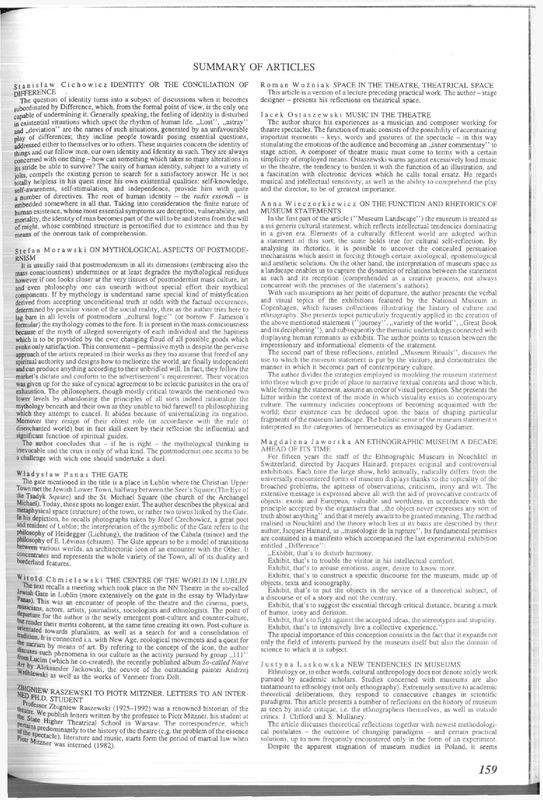
S U M M A R Y OF ARTICLES
Stanisław
C i c h o w i c z IDENTITY OR T H E CONCILIATION O F
DIFFERENCE
The question of identity turns into a subject of discussions when it becomes
subordinated by Difference, which, from the formal point of view, is the only one
capable of undermining it. Generally speaking, the feeling of identity is disturbed
in existential situations which upset the rhythm of human life. „Lost", „astray"
and ..deviation" are the names of such situations, generated by an unfavourable
play of differences; they incline people towards posing essential questions,
addressed either to themselves or to others. These inquiries concern the identity of
things and our fellow men, our own identity and Identity as such. They are always
concerned with one thing - how can something which takes so many alterations in
its stride be able to survive? The unity of human identity, subject to a variety of
jolts, compels the existing person to search for a satisfactory answer. He is not
totally helpless in his quest since his own existential qualities: self-knowledge,
self-awareness, self-stimulation, and independence, provide him with quite
a number of directives. The root of human identity - the radix essendi - is
embedded somewhere in all that. Taking into consideration the finite nature of
human existence, whose most essential symptoms are deception, vulnerability, and
mortality, the identity of man becomes part of the will to be and stems from the will
of might, whose combined structure is personified due to existence and thus by
means of the onerous task of comprehension.
S t e f a n M o r a w s k i ON M Y T H O L O G I C A L ASPECTS OF POSTMODE
RNISM
It is usually said that postmodernism in all its dimensions (embracing also the
mass consciousness) undermines or at least degrades the mythological residues
however if one looks closer at the very tissues of postmodernist mass culture, art
and even philosophy one can unearth without special effort their mythical
components. If by mythology is understand same special kind of mistyfication
derived from accepting unconditional truth at odds with the factual occurences,
determined by peculiar vision of the social reality, then as the author tries here to
lag bare in all levels of postmodern ..cultural logic" (or borrow F. Jameson's
formular) the mythology comes to the fore. It is present in the mass consciousness
because of the myth of alleged sovereignty of each individual and the hapiness
which is to be provided by the ever changing floud of all possible goods which
evoke only satisfaction. This consumenst - permissive myth is despite the perverse
approach of the artists repeated in their works as they too assume that freed of any
spiritual authority and designs how to meliorize the world, are finally independent
andean produce anything according to their unbridled will. In fact, they follow the
market's dictate and conform to the advertisement's requirement. Their vocation
was given up for the sake of cynical agreement to be eclectic parasites in the era of
exhaustion. The philosophers, though mostly critical towards the mentioned two
lower levels by abandoning the principles of all sorts indeed rationalize the
mythology beneath and their own as they unable to bid farewell to philosophizing
which they attempt to cancel. It abides because of universalizing its negation.
Moreover they resign of their elitest role (in accordance with the rule of
disenchanted world) but in fact skill exert by their reflecion the influential and
significant function of spiritual guides.
The author concludes that - if he is right - the mythological thinking is
irrevocable and the crux is only of what kind. The postmodernist one seems to be
a challenge with wich one should undertake a duel.
W ł a d y s ł a w P a n a s THE GATE
The gate mentioned in the title is a place in Lublin where the Christian Upper
Town met the Jewish Lower Town, halfway between the Seer's Square (The Eye of
the Tsadyk Square) and the St. Michael Square (the church of the Archangel
Michael). Today, those spots no longer exist. The author describes the physical and
metaphysical space (structure) of the town, or rather two towns linked by the Gate.
In his depiction, he recalls photographs taken by Józef Czechowicz, a great poet
and resident of Lublin; the interpretation of the symbolic of the Gate refers to the
philosophy of Heidegger (Lichtung), the tradition of the Cabala (tsinor) and the
philosophy of E . Levinas (chiazm). The Gate appears to be a model of transitions
between various worlds, an architectonic icon of an encounter with the Other. It
concentrates and represents the whole variety of the Town, all of its duality and
borderland features.
w
J _ t o l d C h m i e l e w s k i T H E C E N T R E O F T H E W O R L D IN L U B L I N
the text recalls a meeting which took place in the NN Theatre in the so-called
ewish Gate in Lublin (more extensively on the gate in the essay by Władysław
anas). This was an encounter of people of the theatre and the cinema, poets,
usicians, actors, artists, journalists, sociologists and ethnologists. The point of
^ Parture for the author is the newly emergent post-culture and counter-culture,
d e r their merits coherent, at the same time creating its own. Post-culture is
towards pluralism, as well as a search for and a consolidation of
the ' °
'
' e d i.a. with New Age, ecological movements and a quest for