-
Title
-
Summary of articles / Polska Sztuka Ludowa - Konteksty 1992 t.46 z.1
-
Description
-
Polska Sztuka Ludowa - Konteksty 1992 t.46 z.1, s.64-65
-
Date
-
1992
-
Format
-
application/pdf
-
Identifier
-
oai:cyfrowaetnografia.pl:2740
-
Language
-
pol.
-
Publisher
-
Polski Instytut Sztuki
-
Relation
-
oai:cyfrowaetnografia.pl:publication:2936
-
Text
-
SUMMARY
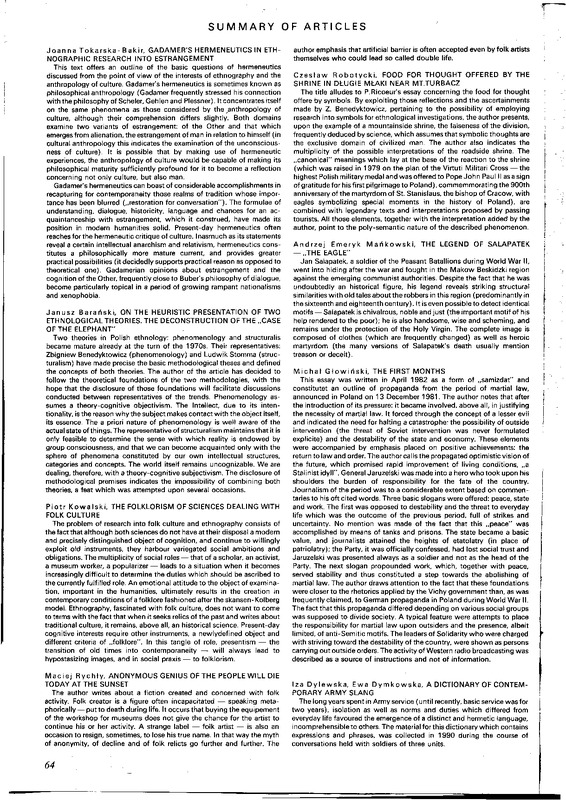
J o a n n a T o k a r s k a - B a k i r , GADAMER'S HERMENEUTICS IN ETH
NOGRAPHIC RESEARCH INTO ESTRANGEMENT
This text offers an outline of the basic questions of hermeneutics
discussed from the point of view of the interests of ethnography and the
anthropology of culture. Gadamer's hermeneutics is sometimes known as
philosophical anthropology (Gadamer frequently stressed his connection
with the philosophy of Scheler, Gehlen and Plessner). It concentrates itself
on the same phenomena as those considered by the ^anthropology of
culture, although their comprehension differs slightly. Both domains
examine two variants of estrangement: of the Other and that which
emerges from alienation, the estrangement of man in relation to himself (in
cultural anthropology this indicates the examination of the unconscious
ness of culture). It is possible that by making use of hermeneutic
experiences, the anthropology of culture would be capable of making its
philosophical maturity sufficiently profound for it to become a reflection
concerning not only culture, but also man.
Gadamer's hermeneutics can boast of considerable accomplishments in
recapturing for contemporaneity those realms of tradition whose impor
tance has been blurred (..restoration for conversation"). The formulae of
understanding, dialogue, historicity, language and chances for an ac
quaintanceship with estrangement, which it construed, have made its
position in modern humanities solid. Present-day hermeneutics often
reaches for the hermeneutic critique of culture. Inasmuch as its statements
reveal a certain intellectual anarchism and relativism, hermeneutics cons
titutes a philosophically more mature current, and provides greater
practical possibilities (it decidedly supports practical reason as opposed to
theoretical one). Gadamerian opinions about estrangement and the
cognition of the Other, frequently close to Buber's philosophy of dialogue,
become particularly topical in a period of growing rampant nationalisms
and xenophobia.
J a n u s z B a r a ń s k i , ON THE HEURISTIC PRESENTATION OF TWO
ETHNOLOGICAL THEORIES. THE DECONSTRUCTION OF THE „CASE
OF THE ELEPHANT"
Two theories in Polish ethnology: phenomenology and structuralis
became mature already at the turn of the 1970s. Their representatives:
Zbigniew Benedyktowicz (phenomenology) and Ludwik Stomma (struc
turalism) have made precise the basic methodological theses and defined
the concepts of both theories. The author of the article has decided to
follow the theoretical foundations of the two methodologies, with the
hope that the disclosure of those foundations will facilitate discussions
conducted between representatives of the trends. Phenomenology as
sumes a theory-cognitive objectivism. The Intellect, due to its inten
tionally, is the reason why the subject makes contact with the object itself,
its essence. The a priori nature of phenomenology is well aware of the
actual state of things. The representative of structuralism maintains that it is
only feasible to determine the sense with which reality is endowed by
group consciousness, and that we can become acquainted only with the
sphere of phenomena constituted by our own intellectual structures,
categories and concepts. The world itself remains uncognizable. We are
dealing, therefore, with a theory-cognitive subjectivism. The disclosure of
methodological premises indicates the impossibility of combining both
theories, a feat which was attempted upon several occasions.
OF
ARTICLES
author emphasis that artificial barrier is often accepted even by folk artists
themselves who could lead so called double life.
C z e s ł a w R o b o t y c k i , FOOD FOR THOUGHT OFFERED BY THE
SHRINE IN DŁUGIE MŁAKI NEAR MT.TURBACZ
The title alludes to P.Ricoeur's essay concerning the food for thought
offere by symbols. By exploiting those reflections and the ascertainments
made by Z. Benedyktowicz, pertaining to the possibility of employing
research into symbols for ethnological investigations, the author presents,
upon the example of a mountainside shrine, the falseness of the division,
frequently deduced by science, which assumes that symbolic thoughts are
the exclusive domain of civilized man. The author also indicates the
multiplicity of the possible interpretations of the roadside shrine. The
..canonical" meanings which lay at the base of the reaction to the shrine
(which was raised in 1979 on the plan of the Virtuti Militari Cross — the
highest Polish military medal and was offered to Pope John Paul II as a sign
of gratitude for his first pilgrimage to Poland), commemmorating the 900th
anniversary of the martyrdom of St. Stanislaus, the bishop of Cracow, with
eagles symbolizing special moments in the history of Poland), are
combined with legendary texts and interpretations proposed by passing
tourists. All those elements, together with the interpretation added by the
author, point to the poly-semantic nature of the described phenomenon.
A n d r z e j E m e r y k M a ń k o w s k i , THE LEGEND OF SALAPATEK
— „THE EAGLE"
Jan Salapatek, a soldier of the Peasant Batallions during World War II,
went into hiding after the war and fought in the Maków Beskidzki region
against the emerging communist authorities. Despite the fact that he was
undoubtedly an historical figure, his legend reveals striking structural
similarities with old tales about the robbers in this region (predominantly in
the sixteenth and eighteenth century). It is even possible to detect identical
motifs — Salapatek is chivalrous, noble and just (the important motif of his
help rendered to the poor): he is also handsome, wise and scheming, and
remains under the protection of the Holy Virgin. The complete image is
composed of clothes (which are frequently changed) as well as heroic
martyrdom (the many versions of Salapatek's death usually mention
treason or deceit).
P i o t r K o w a l s k i , THE FOLKLORISM OF SCIENCES DEALING WITH
FOLK CULTURE
The problem of research into folk culture and ethnography consists of
the fact that although both sciences do not have at their disposal a modern
and precisely distinguished object of cognition, and continue to willingly
exploit old instruments, they harbour variegated social ambitions and
obligations. The multiplicity of social roles — that of a scholar, an activist,
a museum worker, a popularizer — leads to a situation when it becomes
increasingly difficult to determine the duties which should be ascribed to
the currently fulfilled role. An emotional attitude to the object of examina
tion, important in the humanities, ultimately results in the creation in
contemporary conditions of a folklore fashioned after the skansen- Kolberg
model. Ethnography, fascinated with folk culture, does not want to come
to terms with the fact that when it seeks relics of the past and writes about
traditional culture, it remains, above all, an historical science. Present-day
cognitive interests require other instruments, a newlydefined object and
different criteria of ..folklore". In this tangle of role, presentism — the
transition of old times into contemporaneity — will always lead to
hypostasizing images, and in social praxis — to folklorism.
M i c h a ł G ł o w i ń s k i , THE FIRST MONTHS
This essay was written in April 1982 as a form of „samizdat" and
constitutet an outline of propaganda from the period of martial law,
announced in Poland on 13 December 1981. The author notes that after
the introduction of its pressure: it became involved, above all, in justifying
the necessity of martial law. It forced through the concept of a lesser evil
and indicated the need for halting a catastrophe: the possibility of outside
intervention (the threat of Soviet intervention was never formulated
explicite) and the destability of the state and economy. These elements
were accompanied by emphasis placed on positive achievements: the
return to law and order. The author calls the propagated optimistic vision of
the future, which promised rapid improvement of living conditions, „a
Stalinist idyll". General Jaruzelski was made into a hero who took upon his
shoulders the burden of responsibility for the fate of the country.
Journalism of the period was to a considerable extent based on commen
taries to his oft cited words. Three basic slogans were offered: peace, state
and work. The first was opposed to destability and the threat to everyday
life which was the outcome of the previous period, full of strikes and
uncertainty. No mention was made of the fact that this „peace" was
accomplished by means of tanks and prisons. The state became a basic
value, and journalists attained the heights of etatolatry (in place of
patriolatry); the Party, it was officially confessed, had lost social trust and
Jaruzelski was presented always as a soldier and not as the head of the
Party. The next slogan propounded work, which, together with peace,
served stability and thus constituted a step towards the abolishing of
martial law. The author draws attention to the fact that these foundations
were closer to the rhetorics applied by the Vichy government than, as was
frequently claimed, to German propaganda in Poland during World War II.
The fact that this propaganda differed depending on various social groups
was supposed to divide society. A typical feature were attempts to place
the responsibility for martial law upon outsiders and the presence, albeit
limited, of anti-Semitic motifs. The leaders of Solidarity who were charged
with striving toward the destability of the country, were shown as persons
carrying out outside orders. The activity of Western radio broadcasting was
described as a source of instructions and not of information.
M a c i e j R y c h ł y , ANONYMOUS GENIUS OF THE PEOPLE WILL DIE
TODAY AT THE SUNSET
The author writes about a fiction created and concerned with folk
activity. Folk creator is a figure often incapacitated — speaking meta
phorically — put to death during life. It occurs that buying the équipement
of the workshop for museums does not give the chance for the artist to
continue his or her activity. A strange label — folk artist — is also an
occasion to resign, sometimes, to lose his true name. In that way the myth
of anonymity, of decline and of folk relicts go further and further. The
Iza D y l e w s k a , E w a D y m k o w s k a , A DICTIONARY OF CONTEM
PORARY ARMY SLANG
The long years spent in Army service (until recently, basic service was for
two years), isolation as well as norms and duties which differed from
everyday life favoured the emergence of a distinct and hermetic language,
incomprehensible to others. The material for this dictionary which contains
expressions and phrases, was collected in 1990 during the course of
conversations held with soldiers of three units.
64
�WARUNKI
PRENUMERATY
1. W p ł a t y na prenumeraturę p r o w a d z o n ą przez „ R u c h " p r z y j m o w a n e są na okresy k w a r t a l n e
2. Cena prenumeraty k r a j o w e j na II k w a r t a ł 1 9 9 2 r. w y n o s i 8 0 0 0 zł; p o d w ó j n y numer (III i IV k w a r t a ł ) — 1 6 0 0 0 zl.
Prenumerata ze zleceniem d o s t a w y za granicę jest o 1 0 0 % wyższa o d k r a j o w e j .
3. W p ł a t y na prenumeratę przyjmują:
— na teren kraju —
j e d n o s t k i k o l p o r t a ż o w e „ R u c h " i urzędy p o c z t o w e w ł a ś c i w e dla miejsca zamieszkania lub
— na zagranicę —
Zakład Kolportażu Prasy i W y d a w n i c t w 0 0 - 9 5 8 W a r s z a w a , k o n t o PBK, X I I I Oddział W - w a
siedziby prenumeratora
370044-1195-139-11
4. D o s t a w a z a m ó w i o n e j prasy następuje:
— przez j e d n o s t k i k o l p o r t a ż o w e „ R u c h " — w s p o s ó b u z g o d n i o n y z z a m a w i a j ą c y m ,
— przez urzędy p o c z t o w e — pocztą z w y k ł ą na w s k a z a n y adres, w ramach o p ł a c o n e j prenumeraty z w y j ą t k i e m zlecenia
d o s t a w y na zagranicę pocztą lotniczą d o o d b i o r c y zagranicznego, której koszt w pełni p o k r y w a prenumerator.
5. T e r m i n y p r z y j m o w a n i a p r e n u m e r a t y na kraj i zagranicę — d o 2 0 XI na I k w a r t a ł roku następnego, d o 2 0 II — na II
kwartał, d o 2 0 V na III kwartał, d o 2 0 V I I I na IV kwartał.
Prenumeratę,,Polskiej Sztuki L u d o w e j " p r o w a d z i także firma A M O S , W a r s z a w a , u l . Szenwalda 1 . W p ł a t y na okresy
p ó ł r o c z n e ( 2 n u m e r y ) , roczne p r z y j m o w a n e są n o n - s t o p , a d o k o n a n e na miesiąc przed ukazaniem się k o l e j n e g o numeru
g w a r a n t u j ą j e g o o t r z y m a n i e z d o s t a w ą d o d o m u , miejsca pracy.
O b e c n a cena półrocznej p r e n u m e r a t y k r a j o w e j w y n o s i 16 0 0 0 zł. Prenumerata zagraniczna jest o 1 0 0 % droższa.
W p ł a t należy d o k o n y w a ć na k o n t o : A M O S , V I I I Oddział W a r s z a w a , nr 1 5 8 6 - 7 7 5 7 8 - 1 3 6 .
�