-
Title
-
Summary of articles / Polska Sztuka Ludowa - Konteksty 1997 t.51 z.1-2
-
Description
-
Polska Sztuka Ludowa - Konteksty 1997 t.51 z.1-2, s.226-228
-
Date
-
1997
-
Format
-
application/pdf
-
Identifier
-
oai:cyfrowaetnografia.pl:3483
-
Language
-
pol.
-
Publisher
-
Instytut Sztuki PAN
-
Relation
-
oai:cyfrowaetnografia.pl:publication:3706
-
Text
-
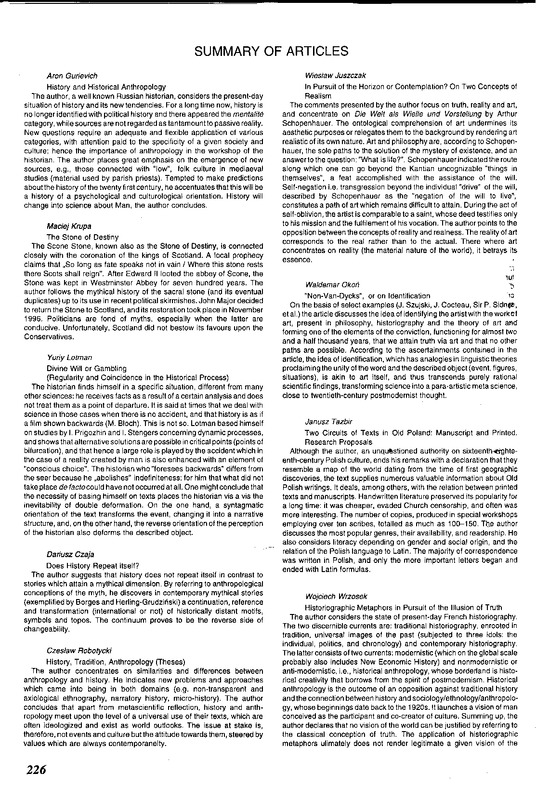
SUMMARY OF ARTICLES
Aron
Gurievich
History and Historical Anthropology
The author, a well known Russian historian, considers the present-day
situation of history and its new tendencies. For a long time now, history is
no longer identified with political history and there appeared the mentalité
category, while sources are not regarded as tantamount to passive reality.
New questions require an adequate and flexible application of various
categories, with attention paid to the specificity of a given society and
culture; hence the importance of anthropology in the workshop of the
historian. The author places great emphasis on the emergence of new
sources, e.g., those connected with "low", folk culture in mediaeval
studies (material used by parish priests). Tempted to make predictions
about the history of the twenty first century, he accentuates that this will be
a history of a psychological and culturological orientation. History will
change into science about Man, the author concludes.
Maciej Krupa
The Stone of Destiny
The Scone Stone, known also as the Stone of Destiny, is connected
closely with the coronation of the kings of Scotland. A local prophecy
claims that „So long as fate speaks not in vain / Where this stone rests
there Scots shall reign". After Edward II looted the abbey of Scone, the
Stone was kept in Westminster Abbey for seven hundred years. The
author follows the mythical history of the sacral stone (and its eventual
duplicates) up to its use in recent political skirmishes. John Major decided
to return the Stone to Scotland, and its restoration took place in November
1996. Politicians are fond of myths, especially when the latter are
conducive. Unfortunately, Scotland did not bestow its favours upon the
Conservatives.
Yuriy Lotman
Divine Will or Gambling
(Regularity and Coincidence in the Historical Process)
The historian finds himself in a specific situation, different from many
other sciences: he receives facts as a result of a certain analysis and does
not treat them as a point of departure. It is said at times that we deal with
science in those cases when there is no accident, and that history is as if
a film shown backwards (M. Bloch). This is not so. Lotman based himself
on studies by I. Prigozhin and I. Stengers concerning dynamic processes,
and shows that alternative solutions are possible in critical points (points of
bifurcation), and that hence a large role is played by the accident which in
the case of a reality created by man is also enhanced with an element of
"conscious choice". The historian who "foresees backwards" differs from
the seer because he ..abolishes" indefiniteness: for him that what did not
take place de factocould have not occurred at all. One might conclude that
the necessity of basing himself on texts places the historian vis a vis the
inevitability of double deformation. On the one hand, a syntagmatic
orientation of the text transforms the event, changing it into a narrative
structure, and, on the other hand, the reverse orientation of the perception
of the historian also deforms the described object.
Dariusz
Czaja
Does History Repeat itself?
The author suggests that history does not repeat itself in contrast to
stories which attain a mythical dimension. By referring to anthropological
conceptions of the myth, he discovers in contemporary mythical stories
(exemplified by Borges and Herling-Grudziński) a continuation, reference
and transformation (international or not) of historically distant motifs,
symbols and topos. The continuum proves to be the reverse side of
changeability.
Czesław
Robotycki
History, Tradition, Anthropology (Theses)
The author concentrates on similarities and differences between
anthropology and history. He indicates new problems and approaches
which came into being in both domains (e.g. non-transparent and
axiological ethnography, narratory history, micro-history). The author
concludes that apart from metascientific reflection, history and anth
ropology meet upon the level of a universal use of their texts, which are
often ideologized and exist as world outlooks. The issue at stake is,
therefore, not events and culture but the attitude towards them, steered by
values which are always contemporaneity.
226
Wiesław
Juszczak
In Pursuit of the Horizon or Contemplation? On Two Concepts of
Realism
The comments presented by the author focus on truth, reality and art,
and concentrate on Die Welt als Wielle und Vorstellung by Arthur
Schopenhauer. The ontological comprehension of art undermines its
aesthetic purposes or relegates them to the background by rendering art
realistic of its own nature. Art and philosophy are, according to Schopen
hauer, the sole paths to the solution of the mystery of existence, and an
answer to the question: "What is life?". Schopenhauer indicated the route
along which one can go beyond the Kantian uncognizable "things in
themselves", a feat accomplished with the assistance of the will.
Self-negation i.e. transgression beyond the individual "drive" of the will,
described by Schopenhauer as the "negation of the will to live",
constitutes a path of art which remains difficult to attain. During the act of
self-oblivion, the artist is comparable to a saint, whose deed testifies only
to his mission and the fulfilement of his vocation. The author points to the
opposition between the concepts of reality and realness. The reality of art
corresponds to the real rather than to the actual. There where art
concentrates on reality (the material nature of the world), it betrays its
essence.
Waldemar Okoń
^
"Non-Van-Dycks", or on Identification
is
On the basis of select examples (J. Szujski, J. Cocteau, Sir P. Sidnei',
et al.) the article discusses the idea of identifying the artist with the worksf
art, present in philosophy, historiography and the theory of art and
forming one of the elements of the conviction, functioning for almost two
and a half thousand years, that we attain truth via art and that no other
paths are possible. According to the ascertainments contained in the
article, the idea of identification, which has analogies in linguistic theories
proclaiming the unity of the word and the described object (event, figures,
situations), is akin to art itself, and thus transcends purely rational
scientific findings, transforming science into a para-artistic meta science,
close to twentieth-century postmodernist thought.
Janusz
Tazbir
Two Circuits of Texts in Old Poland: Manuscript and Printed.
Research Proposals
Although the author, an unquestioned authority on sixteenth-cnghteenth-century Polish culture, ends his remarks with a declaration that they
resemble a map of the world dating from the time of first geographic
discoveries, the text supplies numerous valuable information about Old
Polish writings. It deals, among others, with the relation between printed
texts and manuscripts. Handwritten literature preserved its popularity for
a long time: it was cheaper, evaded Church censorship, and often was
more interesting. The number of copies, produced in special workshops
employing over ten scribes, totalled as much as 100-150. Th,e author
discusses the most popular genres, their availability, and readership. He
also considers literacy depending on gender and social origin, and the
relation of the Polish language to Latin. The majority of correspondence
was written in Polish, and only the more important letters began and
ended with Latin formulas.
Wojciech
Wrzosek
Historiographie Metaphors in Pursuit of the Illusion of Truth
The author considers the state of present-day French historiography.
The two discernible currents are: traditional historiography, enrooted in
tradition, universal images of the past (subjected to three idols: the
individual, politics, and chronology) and contemporary historiography.
The latter consists of two currents: modernistic (which on the global scale
probably also includes New Economic History) and nonmodernistic or
anti-modernistic, i.e., historical anthropology, whose borderland is histo
rical creativity that borrows from the spirit of postmodernism. Historical
anthropology is the outcome of an opposition against traditional history
and the connection between history and sociology/ethnology/anthropolo
gy, whose beginnings date back to the 1920s. It launches a vision of man
conceived as the participant and co-creator of culture. Summing up, the
author declares that no vision of the world can be justified by referring to
the classical conception of truth. The application of historiographie
metaphors ulimately does not render legitimate a given vision of the
�world. Historiography can, at best, make use of the "Zeitgeist", and
persuade the readers to accept its metaphors; it will find it easier to do so if
the intepretations of the past, which it proposes, will remain in accordance
with the "sensitivity" to historical metaphors, present in collective thought.
Monika
Marcin Brocki
The H istory of I deas and Eth nology with in the Structure of the Stg n
The author concentrates attention on demonstrating the usefulness of
the ideas propounded by Michel Foucault for ethnology. Foucault is
interested primarily in the epistemoiogical chasm which he discovered
between the Renaissance and the Classic Age. This barrier in the manner
of thinking exists between the pre- and post- Carthesian paradigm ot
science. The matter at stake is the moment ot the transition from
prescier.tific to scientific thinking, and in particular a change in the
structure of the sign. Already earlier, Lévi-Strauss described mechanisms
ot thinking within the former order, while Foucault showed thatalthough an
absolute chasm divides the two orders, they incessantly intermingle.
Stefania
Peter
To Conserve Symbols
The article deals with the possibility of depicting the .difficult" reality of
the Holocaust and death camps, The discussed example is the campmuseum in Auschwitz-Oświęcim. The author describes the exhibition and
turns to the testimony of poetry. She concentrates on the controversial
display of the hair ot the victims, which produces shocked responses and
critical remarks. By following an anthropological trail, she indicates the
symbolic meaning of hair conceived as the metonymy of man and
accentuates the fact that no document speaks for itself, pointing to the
laconic nature of the information and interpretation stratum of the
exposition.
Janusz
active art which in European (and Russia) aesthetic thought has a long
tradition. The .total" ambitions ol Stalinist culture prove to be one of the
responses to the postulate of a .synthesis" (in life, art and religion),
present in art programmes from the beginning of the twentieth century.
Barański
Sznajderman
„There where God has not Completed His Work". A Sketch about
the King, the Jester and the New Demiurge
The essay begins with a reference to the theory proposed by Leszek
Kołakowski who declared that the entire history of human thought
contains a constant antagonism between the absolutist and anti-ab
solutist stand. The former i s represen te d by the priest, and the I alter — by
the jester. Both history and philosophy, however, have uninterruptedly
proved this theory wrong, and continue to do so. The jester, as shown by
the history ol culture, literature and the cinema, frequently dons the
costume of the dictator and m adman. Much too often, his illusory freedom
and heretical nature, tree from all ideology, become close to some sort of
a new orthodoxy, worse than its predecessor, or even to insanity. There
comes into being the figure of a demented and evil jester who wishes to
create the world anew and to impose his own rules. The „fool on the
throne" is no longer the opponent of absolutism and the spokesman of
a critical, skeptical, and all-questioning truth. He is deadly serious; the
truth which he enforces possesses the rank ot a dogma and calls for an
act of faith. Despite the entire mythologisation of the jester, both in
philosophical metaphor and in common thought, evermore frequently this
harbinger of the new expresses defeat.
Wiesław Szpilka
To Climb Mt. Giewont
A mountain expedition entails entering the region of the sacrum. Once
this was the case with treasure hunters and now is true for mountain
climbers. Guidebooks addressed to them are written in a hermetic
language, inaccessible to the profane, In his analysis ol the phenomenon
of mountain climbing, the author indicates its sacral and spiritual
elements. He dem onstrates th e Si g nifi cance of this „game" and, tu rn in g to
the film Schret aus Stein by Werner Herzog, writes: „Herzog forces his
heroes to pay a high price for plucking fruit off the tree of knowledge. He
condemns, however, only the one who wished to change the mountains
into a playing field and to reach the peak in front of a huge audience*.
The Historical-ideological Epos. Newspaper History in the Service
of the Martial Law Period
History is always rewritten — no one harbours any illusions, especially
in the wake of communism, that this view is incorrect. Similarly to all
totalitarian systems, communism compelled also this part of the social
universe to serve ideology, History written anew by a scholar differs,
however, from its counterpart devised by a politician and propagandist.
Maciej Krupa
The article under examination illustrates the fact that even a researcher
Stairway to HeavBn
can become a propagandist, and that the borderline between the
The author discusses the experiences of mountain climbers during
interpretation of history and its propaganda remains extremely fluid,
expeditions to the over 8000 meter Himalayan peaks ("Out of Body
especially when social life as a whole is based on ideology. In such cases,
Experience"). The feeling of alienness, conversations with the "Other"
the authorities apply history as their own means of legitimation.
(who does not exist in "reality"), lucidity, emancipation from the body, and
In reflections pursued by the humanities an awareness of the existence
the feeling of freedom are compared with experiences characteristic for
of the legitimising function of history is by no means new. The author
initiation. The analogies are striking.
indicates something more, namely, the essential aspect of the nature of
this mechanism. The interpretation of history and the process of its
„preparation" demonstrate features ot classical mythcreation and magical
Ludwik Stomma
thinking, accompanied by the whole indispensable rhetorical-logical
Nature: Culture
instrumentarium. We deal, therefore, with a metaphorical-metonimical
Upon the basis of numerous examples the author, once an ardent
transformation of suitable contents and meanings, serving an appropriate
structuralist, shows that the classification of a given product within the
valorisation of events, people or ideas; we also have examples of
universal opposition between nature and culture, which Lévi-Strauss
a synchronic levelling of the historical perspective or its prolongation,
endowed with an organic and objective meaning, is always based on our
depending on current requirements, as well as a su/
contagious
previous definition of such a product, and acts within a certain ideology
transference or sympathetic presupposition s wh ich equal the best accom
accepted by us; thus it remains a lautology and is devoid of objective
plish ments of the traditional magic of the word. Briefly, history appears to
meaning. In conclusion, the author wrote: „I cannot negate three things
be a plastic mass moulded by the propagandist. All these processes take
concerning Lévi-Strauss: that he was my teacher, that he shook the
place together with an inseparable axiological fou ndation and accordi ng to
foundations of ethnology, and that he remains a republican of the purest
the laws of the cosmology of participation.
Jacobin tradition".
generis
Wojciech
Tomasik
Totalitarian or Total? (Stalinist Culture in the Light of Contemporary
Studies)
The intention of this survey is to provide information about the prime
domains of interest, research methods, and interpretation styles occurring
in contemporary (Western) studies concerning socialist realism. Another
purpose i s to sh ow th at today soci al ist realism is percei ved differently th an
during the .Cold War: it is seen increasingly frequently as a phenomenon
stemming from Russian cultural tradition, connected with twentiethcentury currents in art. Attention is drawn to the fact that Stalinist art
(socialist realism) aimed at obliterating the boundary between artistic
activity and practical activity. Furthermore, Stalinism turned to the idea of
Grażyna
Kubica-Heller
An Interview with Helen Wayne-Maiinowska, daughter of Broni
sław Malinowski, and Michael Young, his Biographer
Bronisław Malinowski, the world renowned anthropologist, remains
rather little known in Poland; this is true especially tor his biography and
private life, Even his compl ete works have n ot been pu blished in hi s nati ve
land. In order to fill this gap, we present an article by Malinowski's
youngest daughter about the impact and significance of various women
upon his life and works, fragments of the correspondence between him
and his wife, and two interviews conducted by Grażyna Kubicka-Heller
with the daughter and biographer of the famous anthropologist. The
daughter talks about Malinowski as father and the reasons for her
227
�decision to study his life. M. Young describes the beginnings of his interest
in Malinowski as well as plans for a biography and a book dealing with
photographs by the eminent scholar.
Zbigniew
Benedyktowicz
„We were like two people swept toghether out of a shipwreck,
weren't we." The touch ol history. Letters and archives of
Malinowski.
This is an impression on The Story of a Marriage by Helen Wayne, and
also information abouta project of preparing polish edition of Malinowski's
Diaries and Letters of Malinowski and Elsie Masson. Autor suggests that
as it was in the case of A Diary in the Strict Sense of the Term, which were
poto on the shelf close to the Heart of Darkness by Conrad (cf. James
Clifford), may be as well The Story of the Marriage should be put close to
literature, memoires, not only to the history of Anthropology (for instance
close to the Letters by F. Kalka to Milena etc). What are a distinctions
between a history, literature, biography, diaries, letters and Anthropology?
- This is a problem the author deal with, remembering his meeting with
Helena Wayne and discussing the project of the polish edition of
Malinowskians archive.
Jacek
Olędzki
What? What for? Why? I Hear. The Terminological Experiences of
an Ethnologist in Murzynowo
For almost twenty years, the author has been conducting research in
Murzynowo near Plock, where he founded and directed a local museum.
This time, he devotes attention to terminological issues. Intrigued by the
differences between the expressions „why" and „what for", he noticed
that the residents of Murzynowo use the second one although the
first expression became universal in our daily life. The second expres
sion appears to be semantically superior since it draws attention
not to the, as a rule, obvious relation of cause and effect but to the
purposefulness of an undertaking. The author also analyses other
noteworthy examples.
Aleksander
Jackowski
On Art, Known under Different Names
The author, one ol the most renowned experts on amateur art in
Poland, shares his reflections — the outcome of many years devoted to
this form of art. Today, the phenomenon in question is re-evaluated due
to the changed attitude to otherness, connected with postmodernism.
The author also speaks about his .maturing" to this variety ol art, and
indicates differences between amateur art and Art Brut, the specificity of
relations between professionals and amateurs in East Europe, as well
as between folk and naif art. The latter occupied a domain whose
extremities are marked by folk art, and thus a communiuty, on the one
hand, and individual creation, a cry of despair, and expression, on the
other hand. The essence of Art Brut is an incessant return to the
beginning.
Jost Amman. Z serii siedmiu planet. (Kunstbüchlin)
228
�WARUNKI PRENUMERATY
1. Wpłaty na prenumeratę prowadzoną przez „Ruch" przyjmowane są na okresy kwartalne.
Cena prenumeraty wynosi 4 zł za numer. Prenumerata ze zleceniem dostawy za granicę jest o 100%
droższa.
Wpłaty na prenumeratę przyjmują:
- na teren kraju - jednostki kolportażowe „Ruch"; istnieje również możliwość prenumeraty „pod
opaską", Wpłaty od osób i instytucji z miejscowości, w których nie ma jednostek
kolportażu „Ruch" należy wnosić do Ruch SA Oddz. W-wa, ul. Towarowa 28,
konto jak niżej;
- na zagranicę - Zakład Kolportażu Prasy i Wydawnictw 00-958 Warszawa, konto PBK,
XIII Oddział W-wa 370044-1195-139-11.
Dostawa zamówionej prasy następuje:
- przez jednostki kolportażowe „Ruch" - w sposób uzgodniony z zamawiającym,
- przez urzędy pocztowe - pocztą zwykłą na wskazany adres, w ramach opłaconej prenumeraty
z. wyjątkiem zlecenia dostawy na zagranicę pocztą lotniczą do odbiorcy zagranicznego, której koszt
w pełni pokrywa prenumerator.
Terminy przyjmowania prenumeraty na kraj i zagranicę - do 20 XI na I kwartał roku następnego,
do 20 II - na II kwartał, do 20 V na III kwartał, do 20 VIII na IV kwartał.
2. Prenumeratę „Kontekstów" prowadzi także Firma AMOS, Warszawa, ul. Zuga 12, 01-806 Warszawa
(tel. 34 65 21). Wpłaty na okresy półroczne (dwa zeszyty lub jeden podwójny) i roczne przyjmowane są
na konto:
AMOS, VIII Oddział PKO Warszawa Nr 1586-77578-136.
3. Cena prenumeraty rocznej przez „Ruch" lub AMOS wynosi 16 zl. Prenumerata za półrocze: 8 zł;
numer pojedynczy 4 zł.
4. Zeszyły bieżące oraz niektóre dawne można kupować w Instytucie Sztuki PAN, Warszawa ul. Długa 28
(hall) lub tamże w Dziale Wydawnictw, tel. 31-32-71 w. 258. Sprzedaż także na rachunek, za
zaliczeniem pocztowym lub za gotówkę.
5. Prenumerata zapewnia otrzymanie pisma w cenie wyżej podanej, niezależnie od tego, o ile droższy
będzie w sprzedaży numer.
W y d a w n i c t w o Instytutu S z t u k i Polskiej A k a d e m i i N a u k publikuje k s i ą ż k i i czasopisma z z a k r e s u
sztuki, teatru, filmu, m u z y k i , folkloru
Stałą sprzedaż, książek i czasopism Wydawnictwa IS PAN, prowadzą następujące księgarnie:
Warszawa
Główna Księgarnia Naukowa im. Bolesława Prusa,
Krakowskie Przedmieście 7
Księgarnia ORPAN, Pałac Kultury i Nauki
Księgarnia Fundacji Pomocy Bibliotekom Polskim,
Marszałkowska 74
Księgarnia Ossolineum, Jaworzyńska 4
Księgarnia Uniwersytecka „Liber", ,
Krakowskie Przedmieście 24
Księgarnia w Centrum Sztuki Współczesnej, Pałac
Książąt Ujazdowskich
Księgarnia „ G r y f . Foksal 10
Księgarnia „Reprint", Krakowskie Przedmieście 71
Księgarnia „Odeon", Hoża 19 oraz pl. Unii Lubelskiej
Księgarnia Zamku Warszawskiego, Świętojańska 2
- „Harcfilm" Księgarnia Festiwalowa, al. Krasińskiego 34
(kino „Kijów")
- „Harcfilm". ul. Piłsudskiego 38
- Księgarnia Akademicka, ul. Anny 6
Księgarnia „Suszczyńska", pl. Wszystkich Świętych 7
- Księgarnia Naukowa .JHlefent", ul. Podwale 6
Lublin
- Księgarnia ORPAN, Pl. Mani Curie-Skłodowskiej 5
Łódź
- Księgarnia Ossolineum. Piotrkowska 181
Poznali
- Księgarnia Uniwersytecka, Zwierzyniecka 7
Wrocław
Białystok
- Księgarnia Ossolineum, Rynek 6
Księgarnia „Akcent". Kościuszki 4
Gdańsk
Księgarnia Ossolineum, Łagiewniki 56
Kraków
Antykwariat „Bibliofil", Szpitalna 19
„Harcłilm", Księgarnia Filmoznawcza. al. Krasińskiego 7
Ciągła sprzedkz hurtowa publikacji Wydawnictwa IS PAN prowadzi
Skład Księgarski „EWA"
ul. Rodziewiczówny 4, 45-951 Opole
tel. 374-28
Numer liczy 28,5 ark. druk.
Fotoskład: „Iskra"
ul. Krasińskiego 28a; tel. 39-90-83
Druk: mgr inż. Piotr Włodarski,
ul. Ksawerów 21; tel. 43-14-71 w. 240
Nakład 1200 egzemplarzy
�