-
Title
-
Summary of articles / Polska Sztuka Ludowa - Konteksty 1995 t.49 z.3-4
-
Description
-
Polska Sztuka Ludowa - Konteksty 1995 t.49 z.3-4, s.220-223
-
Date
-
1995
-
Format
-
application/pdf
-
Identifier
-
oai:cyfrowaetnografia.pl:2783
-
Language
-
pol.
-
Publisher
-
Instytut Sztuki PAN
-
Relation
-
oai:cyfrowaetnografia.pl:publication:2979
-
Text
-
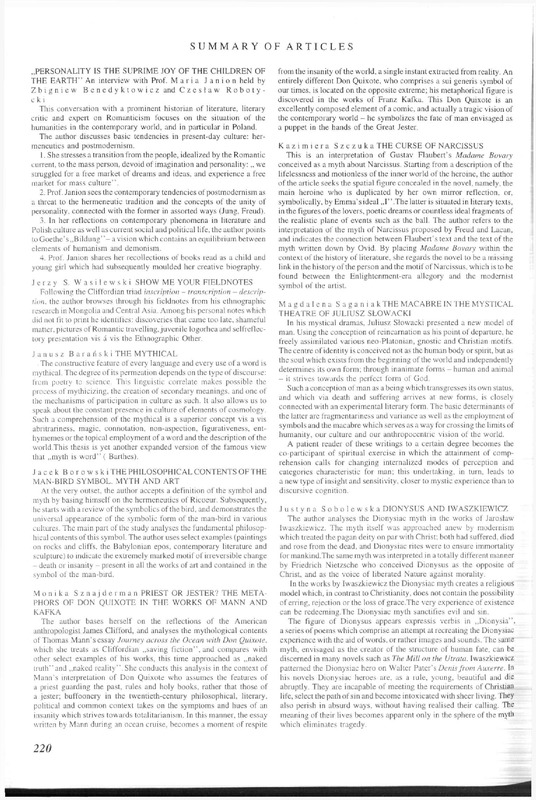
S U M M A R Y
O F
A R T I C L E S
. . P E R S O N A L I T Y IS T H E S U P R I M E J O Y O F T H E C H I L D R E N O F
from the insanity of the w o r l d , a single instant extracted from reality. A n
T H E E A R T H " A n interview with Prof. M a r i a
entirely different D o n Q u i x o t e , w h o comprises a sui generis symbol of
Z b i g n i e w
B e n e d y k t o w i c z
J a n i o n held by
and C z e s ł a w
Roboty
cki
discovered in the w o r k s of F r a n z K a f k a . T h i s D o n Quixote is an
T h i s conversation with a prominent historian of literature, literary
critic and expert on
R o m a n t i c i s m focuses on the situation of
the
author discusses basic tendencies
excellently c o m p o s e d element of a c o m i c , and actually a tragic vision of
the contemporary w o r l d - he s y m b o l i z e s the fate of man envisaged as
a puppet in the hands of the Great Jester.
humanities in the contemporary w o r l d , and in particular in Poland.
The
our times, is located on the opposite extreme; his metaphorical figure is
in present-day culture: her-
meneutics and postmodernism.
K a z i m i e r a
1. S h e stresses a transition from the people, idealized by (he R o m a n t i c
current, to the mass person, devoid of imagination and personality:.. we
This
S z c z u k a T H ECURSE O F NARCISSUS
is an interpretation
of G u s t a v F l a u b e r t ' s Madame
Bovary
c o n c e i v e d as a myth about N a r c i s s u s . Starting from a description of the
struggled for a free market of dreams and ideas, and experience a free
lifelessness and motionless of the inner w o r l d of the heroine, the author
market for mass c u l t u r e " .
of the article seeks the spatial figure concealed in the novel, namely, the
2. Prof. Janion sees the contemporary tendencies of postmodernism as
a threat to the hermeneutic tradition and the concepts of the unity of
main heroine w h o
is duplicated by her o w n
mirror reflection,
or,
s y m b o l i c a l l y , by E m m a ' s ideal „ I " . T h e latter is situated in literary texts,
personality, connected with the former in assorted w a y s (Jung, F r e u d ) .
in the figures of the lovers, poetic dreams or countless ideal fragments of
3. In her reflections on contemporary phenomena in literature and
the realistic plane of events such as the ball. T h e author refers to the
Polish culture as well as current social and political life, the author points
interpretation of the myth of N a r c i s s u s proposed by F r e u d and L a c a n ,
to G o e t h e ' s , . B i l d u n g " - a vision w h i c h contains an equilibrium between
and indicates the connection between F l a u b e r t ' s text and the text of the
myth written down by O v i d . B y placing Madame
elements of h u m a n i s m and d e m o n i s m .
4. Prof. Janion shares her recollections of books read as a c h i l d and
Bovary
within the
context of the history of literature, she regards the novel to be a missing
young girl w h i c h had subsequently moulded her creative biography.
link in the history of the person and the motif of Narcissus, w h i c h is to be
Jerzy
s y m b o l of the artist.
found
S. W a s i I e w s к i S H O W M E Y O U R
F o l l o w i n g the C l i f f o r d i a n triad inscription
FIELDNOTES
- transcription
-
between
the
Enlightenment-era
allegory
and the
modernist
descrip
tion, the author browses through his fieldnotes from his ethnographic
research in M o n g o l i a and Central A s i a . A m o n g his personal notes w h i c h
M a g d a 1 с n a S a g a n i а к T H E M A C A B R E IN T H E M Y S T I C A L
THEATRE O F JULIUSZ
SŁOWACKI
did not fit to print he identifies: discoveries that c a m e loo late, shameful
In his mystical dramas, J u l i u s z S ł o w a c k i presented a new model of
matter, pictures of R o m a n t i c travelling, j u v e n i l e logorhea and selfreflec-
man. U s i n g the conception of reincarnation as his point of departure, he
tory presentation vis a vis the Ethnographic Other.
freely assimilated various neo-Platonian, gnostic and Christian motifs.
Janusz
The centre of identity is c o n c e i v e d not as the human body or spirit, but as
B a r a ń s k i THE MYTHICAL
The constructive feature of every language and every use of a word is
mythical. T h e degree of its permeation depends on the type of discourse:
from poetry to science. T h i s linguistic correlate makes possible
the
process of m y t h i c i z i n g , the creation of secondary meanings, and one of
the m e c h a n i s m s of participation in culture as such. It also allows us to
speak about the constant presence in culture of elements of cosmology.
S u c h a comprehension of the mythical is a superior concept vis a vis
abritrariness, magic, connotation,
non-aspection,
figurativeness,
ent-
h y m e m e s or the topical employment of a word and the description of the
w o r l d . T h i s thesis is yet another expanded version of the famous v i e w
determines its o w n form; through inanimate forms - human and animal
- il strives towards the perfect form of G o d .
S u c h a conception of man as a being w h i c h transgresses its o w n status,
and
w h i c h v i a death and suffering
arrives at new forms, is closely
connected with an experimental literary form. T h e basic determinants of
the latter are fragmentariness and variance as w e l l as the employment of
symbols and the macabre w h i c h serves as a w a y for crossing the limits of
humanity, our culture and our anthropocentric vision of the world.
A patient reader of these writings to a certain degree becomes the
co-participant of spiritual exercise in w h i c h the attainment of comp
that ..myth is w o r d " ( B a r t h e s ) .
Jacek
the soul w h i c h exists from the beginning of the w o r l d and independently
rehension calls for changing
B o r o w s k i THE PHILOSOPHICAL CONTENTS O F THE
internalized modes of perception
and
categories characteristic for man; this undertaking, in turn, leads to
a new type of insight and sensitivity, closer to m y s t i c experience than to
MAN-BIRD SYMBOL. MYTH AND ART
At the very outset, (he author accepts a definition of the symbol and
discursive cognition.
myth by basing h i m s e l f on the hermeneutics of R i c o e u r . Subsequently,
he starts with a review of the s y m b o l i c s of the bird, and demonstrates the
universal appearance of the s y m b o l i c form of the man-bird in various
Justyna
The
S o b o l e w s k a
DIONYSUS AND IWASZKIEWICZ
author analyses the D i o n y s i a c myth in the w o r k s of J a r o s ł a w
cultures. T h e main part of the study analyses the fundamental philosop
I w a s z k i e w i c z . T h e myth itself w a s approached anew by modernism
hical contents of this s y m b o l . T h e author uses select examples (paintings
w h i c h treated the pagan deity on par with C h r i s t ; both had suffered, died
on rocks and cliffs, the B a b y l o n i a n epos, contemporary literature and
and rose from the dead, and D i o n y s i a c rites were to ensure immortality
sculpture) to indicate the extremely marked motif of irreversible change
for m a n k i n d . T h e same myth w a s interpreted in a totally different manner
- death or insanity - present in all the w o r k s of art and contained in the
by F r i e d r i c h N i e t z s c h e w h o c o n c e i v e d
symbol of the m a n - b u d .
C h r i s t , and as the voice of liberated Nature against morality.
D i o n y s u s as the opposite of
Monika
model w h i c h , in contrast to C h r i s t i a n i t y , does not contain the possibility
In the w o r k s by I w a s z k i e w i c z the D i o n y s i a c myth creates a religious
S z n a j d e r m a n PRIEST OR JESTER? T H E META
PHORS O F DON Q U I X O T E
IN T H E W O R K S
O F MANN
AND
The
of erring, rejection or the loss of g r a c c . T h e very experience of existence
can be r e d e e m i n g . T h e D i o n y s i a c myth sanctifies evil and sin.
KAFKA
author
bases
herself
on
the
reflections
of
the
American
The
figure of D i o n y s u s appears expressis verbis in „ D i o n y s i a " ,
anthropologist James C l i f f o r d , and analyses the mythological contents
a series o f p o e m s w h i c h comprise an attempt at recreating the Dionysiac
of T h o m a s M a n n ' s essay Journey
experience with the aid of words, or rather images and sounds. T h e same
across
the Ocean
with Don
Quixote.
w h i c h she treats as C l i f f o r d i a n ..saving f i c t i o n " , and compares with
myth, envisaged as the creator of the structure of human fate, c a n be
other select examples of his w o r k s , this time approached as ..naked
discerned in many novels such as The Mil! on the Utrata.
truth" and ,,naked r e a l i t y " . S h e conducts this analysis in the context of
patterned the D i o n y s i a c hero on W a l t e r Pater's Denis from
M a n n ' s interpretation o f D o n Quixote w h o assumes the features of
his novels D i o n y s i a c heroes are, as a rule, young, beautiful and die
a priest guarding the past, rules and holy books, rather that those of
abruptly. T h e y are incapable of meeting the requirements of Christian
a jester; buffoonery
philosophical, literary,
life, select the path of sin and b e c o m e intoxicated with sheer living. They
political and c o m m o n context takes on the symptoms and hues of an
also perish in absurd w a y s , without h a v i n g realised their calling. T h e
in the twentieth-century
Iwaszkiewicz
Auxerre.
insanity w h i c h strives towards totalitarianism. In this manner, the essay
meaning of their lives becomes apparent only in the sphere of the myth
written by M a n n during an ocean cruise, becomes a moment of respite
w h i c h eliminates tragedy.
220
In
�Aneta
P i e r z c h a ł a FAUST
SEDUCED
D u r i n g the first postwar decade, the role of literature was not
T h i s is an a n a l y s i s o f a scenario of seduction realized by M a n n ' s hero.
e x c l u s i v e l y passive, and in assorted w a y s it conducted the adaptation,
T h e author attempts to capture the w a y in w h i c h evil exists in the w o r l d
reinlerpretation and popularization o f new s y m b o l i c contents. A t the
depicted in Doctor
outset of the introduction of ..people's p o w e r " , l i t e r a t u r e found itself in
Faust.
S h e reveals the structure of signs w h i c h M a n n
e m p l o y e d in the construction o f the portrait of Satan.
W i e s ł a w
a dual situation. O n the one hand, it w a s supposed to h a v e been one of the
J u s z c z a k REALISM AND LITURGY. CONTOURS
O F R E A L I T Y I N T H E . . C O C K T A I L P A R T Y " B Y T . S. E L I O T
T . S. E l i o t is a poet-thinker, a poet-philosopher - hence his doctrine
must be reconstructed from his speech. H i s w o r k s (as in the case o f
R i l k e ' s poetry) c a n be treated as a place for revealing the truth. T h e
author of the article s h o w s h o w in his dramas the poet e m b a r k s upon the
difficult problem of the c r i s i s o f religion and philosophy; the latter is
c o n c e i v e d as ontology and not solely as the theory of cognition. A s
a point of departure w e
may
accept
E l i o t ' s statement
that
when
prime factors shaping the ideology imposed by totalitarianism, a new
s y m b o l i c paradigm; on the other hand, due to the impact of censorship, it
remained the constant object o f s y m b o l i c violence. T h i s was a period of
an adamant
struggle
for and
with
symbols,
as w e l l
as for their
subjugation.
After 1989 w e inherited a c o n v e n t i o n a l i z e d and highly fragmentarized s y m b o l i c paradigm of c o m m u n i s m w h i c h had lost its s y s t e m - l i k e
character and became a loosely knit collection of elements.
moment,
it functions
as the object of negation
A t the
and rejection. T h e
a complex of religious beliefs and practice is alive, d r a m a should strive
c o m p r o m i s e d and exploited system is being replaced by a new s y m b o l i c
towards r e a l i s m , but w h e n religious and moral models are unsteady, then
paradigm. Indubitably, this fact exerts a considerable influence
drama should turn to liturgy. R e a l i s m as envisaged by E l i o t consists of
contemporary literature, although it is m u c h too early to formulate
the deprivation of all appearances, and not o f the imitation of that what is
conclusions on this topic.
on
universally regarded as . . r e a l ' ' . R e a l i t y brings us to our knees and divests
us to the very end - it is the d o m a i n o f guilt, sin and forgiveness, and
G r a ż y n a
even the grace o f death. F r o m this point of v i e w , the daily w o r l d seems to
NIUS LOCI
be empty. T h e transition from such emptiness to fullness, the process of
becoming aware of the existence of complete reality - these are the
prime themes of E l i o t ' s dramas, and the tragedy of his heroes. In his
theatrical vision. E l i o t w i s h e s to attain universality, comprehended as
collective e x p e r i e n c i n g ; this is the reason w h y w e can speak about
liturgy ( a collective form of a cult).
Jadwiga
W a i s
B o r k o w s k a T H EWESTERN TERRITORIES: G E
T h e author d r a w s our attention to the fact that the most interesting
events in contemporary culture are taking place in the borderlands of
Poland.
T h e taming
assumption
of
the
of
the
Western
post G e r m a n
territories and the
heritage
constitute
interesting phenomenon; this process is testified both in publicistics and
the belles lettres (i.a. in: EE. by O l g a T o k a r c z u k , Hanemann
A L LM E A S U R E D - O N T H EA R T O F D Y I N G
symbolic
a particularly
C h w i n . and Traces
on the Sand
by Stefan
by M a r e k J a s t r z e b i e c - M o s a k o w s k i ) .
TODAY
Drama
Fragment
II by B e c k e t t is a masterly depiction of the decline
of the art of l i v i n g and d y i n g in our times. In comparison with the antique
D a r i u s z
C z a j a . . V E N I C E IS A W O M A N " O N
IMAGINATION
T h i s article is devoted to an anthropological interpretation of various
ars moriendi, contemporary man lives and dies in a void, painfully
literary portrayals of V e n i c e . In a surprisingly large number of texts the
lonely. T o all appearances, he functions normally but his senses grow
character of the town is depicted as distinctly feminine.
dull - he is no longer able to establish contact with the w o r l d : he looks
presented as a w o m a n not only in paintings ( V e r o n e s e ) but also in
V e n i c e is
but does not see. listens but does not hear. He begins acting in the
literary w o r k s . In collected texts (from B y r o n and P u s h k i n to B r o d s k y
stereotype manner of a m a c h i n e . F i n a l l y , he ceases experiencing pain.
and H e r l i n g - G r u d z i ń s k i ) the author e x a m i n e s assorted personifications
Iiis inner life withers and he is no longer able to maintain deeper bonds
of V e n i c e and its c o m p a r i s o n to a w o m a n . H e s h o w s the durability of this
with other people.
image and the multi-faceted nature of the feminine phantasm ( A p h
T h e s y m b o l i c of B e c k e t t ' s d r a m a contains the hope that, despite all
odds, w e are c o n s u m e d by a longing for inner transformation, and for
r e v i v i n g the ability to feel our o w n inner life.
Anna
rodite, V e n u s . Penelope, etc.).
In response to the question: w h y is V e n i c e a w o m a n . ' the author
rejects biological and p s y c h o l o g i c a l explanations, and turns towards
W i e e z o r k i e w i c z A PHILOSOPHER ON T H E ROAD
T h i s article deals with the topos of the j o u r n e y ( w a n d e r i n g , roaming,
etc.) in philosophical texts. B y paying attention to the discourse of
authors w h o had travelled, described their voyages in diaries, and used
the metaphor of travel in their philosophical w o r k s , it is possible to study
the existential, d i s c u r s i v e and instrumental d i m e n s i o n of travelling. In
a comprehension of culture by means of culture. H e expands
two
interpretational clues: linguistic - in the majority of E u r o p e a n languages
. . V e n i c e " is of the feminine gendre - and m y t h i c a l : feminine visions of
V e n i c e were enrooted in c o n v e n t i o n a l i z e d stereotypes,
well-embedded
in E u r o p e a n culture; in particular cases, h o w e v e r , they refer to the
ambiguous, paradoxical and . . l i v i n g " aspect o f the s y m b o l .
the last case, w e are c o n c e r n e d with the application of the figure of the
journey in order to express abstract ideas. M o r e o v e r , the metaphor of
L u d w i k
travel participates in the conceptualization of philosophical thought.
LOUIS D'OR(GUIDE -
S u c h premises can be deduced from philosophical discourse alone.
T h e author refers to Travel as Metaphor
S t o m m a
PARIS
FOR TWO
BOOK)
T h i s is a fragment of a guidebook
written by two Poles living in
F r a n c e : a journalist and an anthropologist. In their eighth excursion, the
G e o r g e s V a n D e n A b b e e l e in w h i c h diaries and travel notes have been
authors propose a visit to Montparnasse and its environs. T h e i r s is
treated as
a leisurely tour o f a neighbourhood full of legends and memories; our
to
the
theoretical
to Rousseau
L u d w i k
by
a supplement
from Montaigne
Lewin,
w o r k s by
Montaigne,
Descartes, Montesquie and R o u s s e a u . T h e purpose of the deconstruction
guides focus b a s i c a l l y on the once
of the metaphor of travel in p h i l o s o p h i c a l w o r k s conducted by G e o r g e s
Paris.
Van Den Abbeele
artistic life of this part of
is to disclose the determinants of philosophical
discourse. T h e topos o f travel b e c o m e s a factor w h i c h
determines
cognition, since it not only creates conditions for the latter (by travelling
W o j c i e c h
w e become familiar with the diversity of the w o r l d ) , but also supplies us
LOGICAL
ordinary
G ł o w i ń s k i
„POL1SH C O N T E M P O R A R Y
TURE..." AND SYMBOLIC PARADIGMS
J. B u r s z t a K U R T V O N N E G U T : A N A N T H R O P O
PORTRAIT
Anthropological reflection on culture does not exhaust itself in an
with a language required to describe the very nature of cognition.
M i c h a ł
flourishing
LITERA
description
and
a n a l y s i s , conducted
in
accordance
with
scientific criteria. It is also a sui generis metareflection on the human
species w h i c h inhabits assorted cultural niches. F u r t h e r m o r e , it is a quest
(1945-1995)
In the presented text the author deals with various relations and
for the element w h i c h unites h u m a n diversity. H e n c e , reflection of this
strategies of reaction w h i c h o c c u r r e d between Polish postwar literature
sort shares with literature a single feature - the concept of an intellectual
and the emergent s y m b o l i c s y s t e m . T h e fundamental elements w h i c h
j o u r n e y in the w o r l d of the non-obvious.
compelled literature to define itself v i s a vis the s y m b o l i c repertoire
included
two
communist
significant
ideology after
historical eaesurae:
the establishment
1945, and the change
sociopolitical system in 1989.
Affiliations between anthropology and literary creativity are demons
of
trated upon the e x a m p l e o f Kurt V o n n e g u t , famous man of letters and
of the prevailing
graduate of anthropology. T h e author traces anthropological motifs in
the literary T e r r a V o n n e g u t i a n a , created by h i m .
221
�R y s z a r d
C i a r k a THE HEAD AT THE BOTTOM OFTHE BED
K r z y s z t o f
OR P R O P A E D E U T I C O F E T N O G R A P N Y
T h i s j o c u l a r text is an attempt at a slightly caricaturist! description of
semiotic-structural
reflections
about
K u b i a k T H ESPEECH OF WRITTEN
WORDS
T h i s is a venture at tackling recollections and their written form.The
the dependence
between
author o f the article arrived at the c o n c l u s i o n that the specificity of
the
a manuscript and the colourful personality o f its author would be
arrangement o f the quilt and the speed with w h i c h one falls asleep.
best captured by a filmed
record. H e thus presents
a project for
a film about O t y l i a Z a c h u r a . resident o f a solitary mountain homestead,
W o j c i e c h
M i c h e r a T H E BOUGH O F AENEAS
and her childhood w a r t i m e r e m i n i s c e n c e s . T h e brief and strikingly
M e n o f antiquity universally believed that this fatal bough w a s the
authentic diary is cited in its entirety in the article, w h i c h is the basis
G o l d e n B o u g h w h i c h A e n e a s , obedient to the c o m m a n d s of S y b i l , broke
for a screenplay.
off on the e v e o f his dangerous journey to the land o f the dead - wrote
the birthdays o f assorted members of the Z a c h u r a family, and the
James F r a z e r 150 years ago in his Golden
by notes with the dates of
T h e author of the
most important events in the lives o f their children. T h i s element endows
article refers to this v i e w , and presents the mythical theme of travellers
the text with a characteristic . . b i b l i c a l " rhythm. It also shows Great
on their w a y to the other-world. H e deals with the existential dimension
History as seen by ordinary people, and ordinary people as a fragment of
of the journey, alluding to paintings and poetic visions. He also indicates
History.
the significance
o f the golden
bough
Bough.
It is supplemented
against
the backdrop o f the
symbolic of the holy tree, and depicts the connection between the
predecessors
of Aeneas
(in accordance
On
the , , S o - c a l l e d
Jackowski
with the texts by V i r g i l )
- T h e s e u s . P o l l u x . O r p h e u s and Heracles - with the myth about Jason
and
his expedition
in search
suggestions contained
for the G o l d e n
in a sixteenth-century
Fleece.
An
Following
album
So-called
Naive
Naive
Art
Art
by
Aleksander
by A l e k s a n d e r J a c k o w s k i w a s
published in 1995. T h e book, w h i c h contains 91 biogramm.es o f naive
a l c h e m i c a l w o r k , the
artists, met with a lively response. T h e r e v i e w s indicated the necessity
author examines the s y m b o l i c kinship o f this myth with the story o f
of
Heracles stealing apples from the garden o f the Hesperides. F i n a l l y , he
non-professional art, and the relation between high and low culture.
a
new
approach
to
such
problems
as
professional
and
interprets the mediaeval legend of the H o l y G r a i l , the B i b l i c a l story of
W e include a r e v i e w by H a n n а К i r c h n e r , T H E N I N E T Y S E C O N D
the flood, and the S u m e r i a n epos about G i l g a m e s h as well as a mythical
S I L H O U E T T E fragments o f r e v i e w s , w h i c h were presented in the
prop - the staff o f Hermes and A e s c u l a p i u s , entwined by serpents.
press, and an i n t e r v i e w h e l d b y Z b i g n i e w
with the author o f So-called
E w a
D ż u r a k
ELEMENTS
NATIVE
LITERATURE
A N D RITUAL.
IN C O N T E M P O R A R Y
WRITTEN
Benedyktowicz
art and the autobiography
Short
cuts.
TRADITIONAL
NOVELS
naive
BY
AMERICANS
Danuta
W a w i ł o w THEKLAN
EXPERIMENT
T h e typical feature o f the contemporary novel written by Native
T h e history o f K L A N - C l u b of A r t i s t i c a l l y Inexhaustible People - is
A m e r i c a n s is predominantly a combination of traditional and modern
brief. It w a s founded in 1992 by young people aged from thirteen to over
motifs, and a presentation of heroes balancing in a cultural void, situated
twenty. T h e basic K L A N f o r m u l a w a s . and is. the right to creativity
between cultures, and experiencing a feeling of alienation. T h e i r lot
- writing poems, d r a w i n g , m a k i n g m u s i c , sculpting little clay birds and
assumes the mythical dimension of a paradigmatic controversy between
soon. F o r some participants o f the experiment it constitutes a significant
good and evil. In an analysis of two novels: House
stage in their life, a lesson in imagination and creative love. T h e founder
Scott M o m a d a y and Ceremony
Made of Down by N .
by L e s l i e M a r m o n S i l k o . the author
shows how myth and ritual interfere into the texts and help the heroes to
overcome their complicated situation produced by the dissolution o f
and author o f this article discovered K L A N to be a source o f knowledge
about life, people, poetry and art.
K L A N , w h i c h exists not only in W a r s a w but also in other towns,
traditional culture.
comprises a group o f people sharing a philosophy of life and art.
W ł a d y s ł a w
Ewa
Ha s iо r ONPLEBEIAN ART
K o r u l s k a CHILDREN KNOCK ONDOORS O F STONE
T h e first contact with a poetic text is often d e c i s i v e for a child's
T h i s is an interview with W . H a s i o r hold by A l e k s a n d e r J a c k o w s k i .
T h e outstanding artist speaks about his collection of plebeian art
approach to poetry, a n d e a n stir or stifle his imagination. Polish language
- several thousand slides documenting the phenomenon in question as
school lessons offer an opportunity for a w a k e n i n g and stimulating the
well as the iconospherc of communist Poland.
c h i l d ' s sensitivity towards the w o r d . O n e o f the available methods is to
In his o w n w o r k s Hasior uses elements of folk, plebeian art: in the
select
examples,
he recognizes
authentic
longing
for beauty. B y
create possibilities for individual creativity, and to demonstrate the
c i r c u m s t a n c e s in w h i c h e v e r y o n e ' s ability o f articulating impressions
annulling ..aesthetic c r i t e r i a " and rejecting the notion o f kitsch, the artist
and emotions
draws particular attention to private worlds, separated by a picket fence,
creation, starts treating the poetic text as a natural mode o f expressing his
w h i c h offer their o w n vision o f beauty.
thoughts and feelings.
N O T Y
O
M a ł g o r z a t a B a r a n o w s k a poetka, krytyk i historyk literatury. A u t o
rka k s i ą ż e k : Pamiętnik
zja.
Ta jest
wasze
mistyczny.
życie.
Surrealistyczna
masowej
w: Problemy
i poe
Autorka wielu artykułów o w y o b r a ź n i
symbolicznej i kulturze masowej m i n . Pocztówka
źni
wyobraźnia
wiedzy
a kulturze
jako wyraz,
(Ossolineum
autorka d w ó c h t o m ó w poetyckich: Miasto.
Zamek
O g ł a s z a w „ T w ó r c z o ś c i " Prywatną
poezji.
historię
wyobra
w
1986).
Pirenejach.
A U T O R A C H
popularny z a r y s literatury p o z y t y w i s t y c z n e j Pozytywiści
i inni ( P W N )
oraz książkę p o ś w i ę c o n a p o w i e ś c i kobiecej ( o d Ż m i c h o w s k i e j do
Nałkowskiej) (IBL).
Jacek
Borowski
— absolwent
i p o g r a n i c z e m filozofii
IFiS
i antropologii.
U W . Zajmuje
s i ę estetyka
Pracuje w W y d a w n i c t w i e
Naukowym P W N .
W o j c i e c h J . B u r s z t a dr hab., profesor w Katedrze E t n o l o g i i U A M .
J a n u s z B a r a ń s k i etnograf, filozof, absolwent U J , doktorant w I n
stytucie Etnologii U J w K r a k o w i e . Z a j m u j e s i ę problemami ant
Autor m.in. K s i ą ż e k : Wymiary
antropologicznego
poznania
kultury
1992; Czytanie kultury. P i ę ć s z k i c ó w , 1995.
R o g e r C a i l l o i s etnolog, socjolog i filozof francuski, znany ze swoich
ropologii polityki i metodologia polityki.
Z b i g n i e w B e n e d y k t o w i c z antropolog kultury, redaktor „ K o n t e k s
t ó w " . K i e r o w n i k P r a c o w n i Antropologii
is activated. A c h i l d w h o has experienced the j o y of
Kultury. Filmu
i Sztuki
A u d i o w i z u a l n e j . Autor prac o w y o b r a ź n i s y m b o l i c z n e j i antropologii
s z e r o k i c h z a i n t e r e s o w a ń , r ó w n i e ż literaturą. W Polsce w y s z ł y d w a
zbiory j e g o t e k s t ó w Żywioł
i lad oraz Odpowiedzialność
i styl.
R y s z a r d C i a r k a etnolog, p r a c o w n i k Instytutu S z t u k i P A N , P r a c o w n i a
w s p ó ł c z e s n e j , m i n . k s i ą ż k i (z D a n u t a B e n e d y k t o w i c z ) Dom w trady
Antropologii K u l t u r y , F i l m u i S z t u k i A u d i o w i z u a l n e j . Z a j m u j e s i ę
cji
a n t r o p o l o g i ą w s p ó ł c z e s n o ś c i , autor w i e l u a r t y k u ł ó w
ludowej.
G r a ż y n a B o r k o w s k a - krytyk i historyk literatury, pracuje w I B L
P A N , w y d a l a Dialog
222
powieściowy
i jego
konteksty;
z ł o ż y ł a do druku
James
Clifford
profesor
antropologii,
wykładał
między
h i s t o r i ę ś w i a d o m o ś c i na U n i v e r s i t y o f C a l i f o r n i a , Santa C r u z
innymi
Autor
�