-
Title
-
Summary of articles / Polska Sztuka Ludowa - Konteksty 2001 t.55 z.1-4
-
Description
-
Polska Sztuka Ludowa - Konteksty 2001 t.55 z.1-4, s.562-568
-
Date
-
2001
-
Format
-
application/pdf
-
Identifier
-
oai:cyfrowaetnografia.pl:2900
-
Language
-
pol.
-
Publisher
-
Instytut Sztuki PAN
-
Relation
-
oai:cyfrowaetnografia.pl:publication:3096
-
Text
-
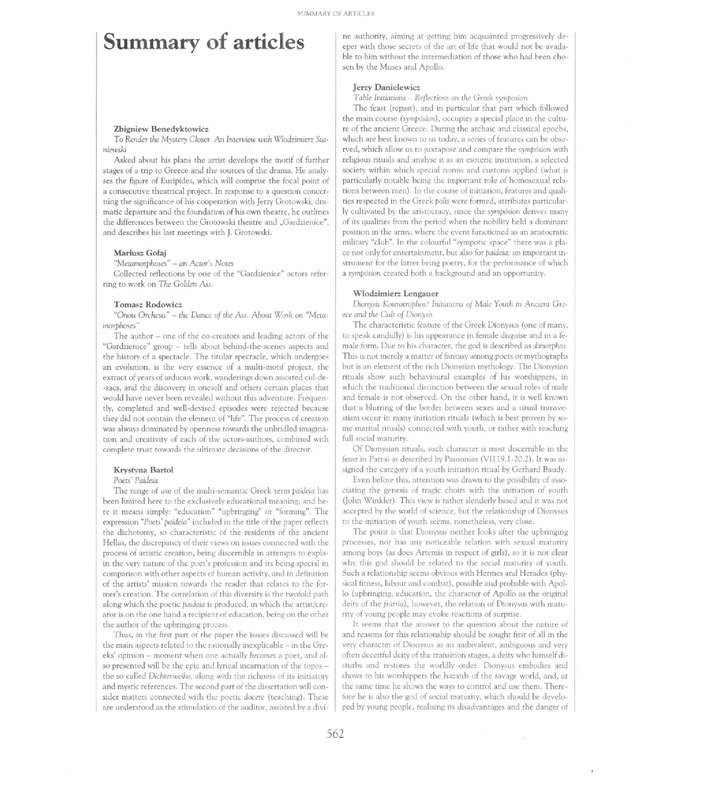
SUMMARY OF ARTICLES
Summary of articles
ne authority, aiming at getting h i m acquainted progressively deeper w i t h those secrets of the art of life that w o u l d n o t be available to h i m w i t h o u t the intermediation of those w h o had been chosen by the Muses and A p o l l o .
Jerzy D a n i e l e w i c z
Table Initiations
- Reflections on the Greek
symposton
T h e feast (repast), and i n particular that part w h i c h followed
the m a i n course (sympósion), occupies a special place i n the c u l t u Zbigniew
re of the ancient Greece. D u r i n g the archaic and classical epochs,
Benedyktowicz
To Render the Mystery Cbser.
An
Interview with
Wlodzimierz
niewslu
Sta- w h i c h are best k n o w n to us today, a series o f features can be observed, w h i c h allow us to juxtapose and compare the sympósion w n h
Asked about his plans the artist develops the m o t i f o f further
religious rituals and analyse i t as an esoteric i n s t i t u t i o n , a selected
stages of a trip to Greece and the sources o f the drama. H e analy-
society w i t h i n w h i c h special norms and customs applied (what is
ses the figure of Euripides, w h i c h w i l l comprise the focal p o i n t o f
particularly notable being the i m p o r t a n t role o f homosexual rela-
a consecutive theatrical project. I n response to a question concer-
tions between m e n ) . I n the course of i n i t i a t i o n , features and quali-
n i n g the significance of his cooperation w i t h Jerzy G r o t o w s k i , dra-
ties respected i n the Greek polis were formed, attributes particular-
matic departure and the f o u n d a t i o n o f his o w n theatre, he outlines
ly cultivated by the aristocracy, since the sympósion derives many
the differences between the Grotowski theatre and „Gardzienice",
o f its qualities from the period when the nobility held a d o m i n a n t
and describes his last meetings w i t h J. Grotowski.
position i n the army, where the event functioned as an anstocratic
m i l i t a n ' " c l u b " . I n the colourful "sympotic space" there was a place n o t o n l y for entertainment, but also for paideia; an i m p o r t a n t i n -
Mariusz G o l a j
''Memrnorphoses" - an Actor's
strument for the latter being poetry, for the performance of w h i c h
Notes
Collected reflections by one of the "Gardzienice" actors referring to work o n The Golden
a sympósion
created b o t h a background and an o p p o r t u n i t y .
Ass.
Wlodzimierz
Tomasz
Lengauer
Dionysis Kourotrophos!
Rodowkz
"Onou Orchests" - the Dance of the Ass. About Work on "Meta-
ece and the Cult of
Initiations
of Male Youth in Ancient
Gre-
Dionysis
T h e characteristic feature of the Greek Dionysus (one o f many,
morphoses"
T h e author - one of the co-creators and leading actors of the
to speak candidly) is his appearance i n female disguise and i n a fe-
"Gardzienice" group - tells about behind-the-scenes aspects and
male form. Due to his character, the god is described as dimorplius.
the history of a spectacle. T h e titular spectacle, w h i c h undergoes
T h i s is n o t merely a matter o f fantasy among poets or mythographs
an e v o l u t i o n , is the very essence o f a m u l t i - m o t i f project, the
but is an element of the rich Dionysian mythology. T h e Dionysian
extract of years o f arduous work, wanderings d o w n assorted cul-de¬
rituals show such behavioural examples o f his worshippers, i n
-sacs, and the discovery i n oneself and others certain places that
w h i c h the traditional distinction between the sexual roles o f male
would have never been revealed w i t h o u t this adventure. Frequen-
and female is n o t observed. O n the other h a n d , it is well k n o w n
tly, completed and well-devised episodes were rejected because
that a blurring of the border between sexes and a ritual transve-
they d i d n o t contain the element of " l i f e " . T h e process o f creation
stism occur i n many i n i t i a t i o n rituals ( w h i c h is best proven by so-
was always dominated by openness towards the unbridled imagina-
me marital rituals) connected w i t h y o u t h , or rather w i t h reaching
t i o n and creativity of each o f the actors-authors, combined w i t h
full social maturity.
complete trust towards the ultímate decisions o f the director.
O f Dionysian rituals, such character is most discernible i n the
feast i n Pattai as described by Pausanias ( V i l 19.1-20.2). I t was assigned the category of a y o u t h i n i t i a t i o n ritual by Gerhard Baudy.
Krystvna Battel
Even before this, a t t e n t i o n was d r a w n t o the possibility of asso-
Poets' Paideia
T h e range of use of die multi-semantic Greek term paideia has
ciating the genesis of tragic choirs w i t h the i n i t i a t i o n o f youth
been limited here to the exclusively educational meaning, and he-
Uohn W i n k l e r ) . T h i s view is rather slenderly based and i t was not
re i t means simply: " e d u c a t i o n " " u p b r i n g i n g " or " f o r m i n g " . T h e
accepted by the world o f science, but the relationship o f Dionysus
expression "Poets' paideia" included i n the title of the paper reflects
to the i n i t i a t i o n o f y o u t h seems, nonetheless, very close.
the dichotomy, so characteristic
of the residents of the ancient
T h e point is that Dionysus neither looks after the upbringing
Hellas, the discrepancy of their views on issues connected w i t h the
processes, nor has any noticeable relation w i t h sexual maturiry
process of artistic creation, being discernible i n attempts to expla-
among boys (as does A r t e m i s i n respect of girls), so i t is n o t clear
i n the very nature of the poet's profession and its being special in
why this god should be related to the social maturity of y o u t h .
comparison w i t h other aspects of h u m a n activity, and i n definition
Such a relationship seems obvious w i t h Hermes and Herades (phy-
o f the artists' mission towards the reader that relates to the for-
sical fitness, labour and combat), possible and probable w i t h A p o l -
mer's creation. T h e correlation of this diversity is the t w o f o l d path
lo (upbringing, education, the character o f A p o l l o as the original
along w h i c h the poetic paideia is produced, i n w h i c h the artist/cre-
deity of the fratría), however, the relation of Dionysus w i t h m a t u -
ator is on the one hand a recipient o f education, being on the other
rity o f young people may evoke reactions of surprise.
the author of the upbringing process.
It seems that the answer to the question about the nature o f
T h u s , i n the first part o f the paper the issues discussed will be
and reasons for this relationship should be sought first of all i n the
the m a i n aspects related to the rationally inexplicable - i n the Gre-
very character of Dionysus as an ambivalent, ambiguous and very
eks' o p i n i o n - m o m e n t w h e n one actually becomes a poet, and al-
often deceitful deity o f the transition stages, a deity w h o himself d i -
so presented w i l l be the epic and lyrical incarnation of the topos -
sturbs and restores the worldly order. Dionysus embodies
the so called Dichierweihe, along w i t h the richness of its initiatory
shows to his worshippers the hazards o f the savage w o r l d , and, at
and mystic references. T h e second part of the dissertation w i l l con-
the same time he shows the ways to c o n t r o l and use t h e m . There-
sider matters connected w i t h the poetic docere (teaching). These
fore he is also the god of social maturity, w h i c h should be develo-
are understood as the stimulation o f the auditor, assisted by a d i v i -
ped by young people, realising its disadvantages and the danger of
562
and
�SUMMARY OF ARTICLES
the stale i n w h i c h its basis can become weakened. Thus, Dionysian
and the Odyssey). T h e authot also ponders whether and to what
rituals may also symbolise the p a t h young people follow appro¬
extent i t w o u l d be sensible to speak about spirituality i n O l d Gre¬
aching maturity, and how through the ritual distortion of n o r m a l i -
ek music considering that the modern division i n t o material and
ty they may affirm its televance. A l s o i n this way Dyonisus may be
spiritual values has little i n c o m m o n w i t h Greek mentality, and
considered a deity of kourotrophos type.
bluts the perception of its specificity.
Lech T n c i o n k o w s k i
The Demeter Mysteries
Lesrek K o l a n k i e w i c z
m Attica (The Lykomidai Rituals m Phyla
- between Initiation and Mystery)
Polish Spectacles and the Religion of
Dionysus
T h e problems broached i n the text are situated along the bor-
A n c i e n t authors frequently mentioned the mysteries w h i c h t o -
derline between religious studies and theatrology. T h e i r p o i n t of
ok place i n the clan sanctuary of the L y k o m i d a i i n the A t t i c de-
departure consists of t w o issues: the problematic nature o f ancient
me o f Phyla. T h e mysteries were held i n t w o temples located i n
Polish deities and the ideological and staging aspects of Dziady
a single holy circle: the first w i t h altars of A p o l l o Dionysodotes,
(Forefathers' Eve), the arch-drama by A . Mickiewicz. By resorting
A r t e m i s Selasphoros, Dionysus A n t h i o s , N i m p h a i Ismenidai and
to the classical tripartite division of Indo-European mythology de-
Ge (Megale theos); the second temple contained altars o f Deme-
vised by Dumezil, the author reconstructed, upon the basis of
ter Anasidora, Zeus Ktesios, A t h e n a T i t h r o n e , Kore Protogone
a meticulous analysis of O l d Polish literature, the pantheon o f Sla-
and Semnai T h e a i . T h e presence of numerous deities is connec-
vic deines, indicating the incompatibility of the tripartite division
ted by the idea of the i n i t i a t i o n of young people via wine and dan-
i n relation to Polish mythology. Emphasis is placed o n the distinc-
ce. T h e whole ceremony was sreeted by Demeter and Zeus as the
tive presence i n Slavonic beliefs o f deities protecting the spirits " i n
guardians of the welfare of the c o m m u n i t y . O w i n g to their archa-
the other w o r l d " .
ic charactet the Phyla mysteries seem to be inscribed i n t o a more
T h e author paid special attention to connections between Po-
general scheme l i n k i n g an i n t r o d u c t i o n i n t o the mystery of life
lish annual rites associated w i t h the wintet-spring cycle (the mar-
and death w i t h the i n i t i a t i o n rituals. Just as engrossing is the h i -
ked role played by women) and the A t h e n i a n festivities i n honour
story of the L y k o m i d a i clan and sanctuary. T h e hall o f i n i t i a t i o n
of Dionysus. L. Kolankiewicz claims that A . Mickiewicz conducted
(telestetion) was the c o m m o n property o f genos L y k o m i d a i . B u r n t
numerous parallels both w i t h the Greek Anthesteria and
d o w n by the armies o f Xerxes (480 B. C.) it was rebuilt and deco-
k n o w n from descriptions o f ethnographic exotica: "he suddenly d i -
rated w i t h murals by Themistocles, a member of the clan (478¬
scerned Greek and A f r o - A m e r i c a n rites i n his o w n county"- T h e
472). W r i t i n g s of the gnostic Sethian sect tecall that d u r i n g the
w r i t i n g of Dziady is comprehended as a myth-creating process. T h e
rites
Roman era the walls of the portico featuted a m u r a l depicting
hero of the drama, "the H e r o of the Poles", is a mythical hero,
Phaos chasing Phykola (gnosric i n t e r p r e t a t i o n or impact?). D u -
combining the ideas of rebirth, salvation and redemption.
ring the f o u r t h century B.C. Methapos, w h o came from Phyla, „rev i v e d " the celebtated mysteries i n A n d a n i a by i n t r o d u c i n g the
m y t h of the Messenian origin of the rituals performed i n A t h e n s
T h e L y k o m i d a i chanted O r p h i c songs d u r i n g the rituals i n c l u ding hymns to Eros ascribed to Pamphos and Orpheus as well as
a hymn to Demeter
w r i t t e n by Mousaioa As a boy Euripides se-
rved i n the sanctuary as a cupbearer
p o u r i n g wine for the d a n -
cers T h e possible impact o f the theology of the P h y l i mysteries
upon his hymn to the M o t h e r i n the tragedy H e l e n * remains wi¬
t h i n the sphere of suppositions
Krzysztof R u t k o w s k i
P r * t n and Rite. The world and Tradition a c c o r d i n g to
Mickiewicz
T a l k i n g of transfer of ttadition takes us back to the Bible, and
i n particular ro Genesis and the m y t h of A d a m and Eve about the
creation o f the body, the soul and the language. T h e mystic Jewish
tradition, but n o t only Jewish, paid special a t t e n t i o n at the bodily
genesis of cognition, seeking the reflection of all intellectual activity i n bodily activities. Even the most absttacth/e logical categories have their roots i n the somatic structute of the h u m a n being.
Transfer of tradition " f r o m hand to h a n d " - as Mickiewicz said at
the College de France - i n other words contact of the living w i t h
Giovanni Cerri
Ancient Greek Poems on Nature and Mysteries'
the dead, or the Dziady (a distant L i t h u a n i a n equivalent of H a l l o -
Rituals
Careful reading o f some fragments by Empedokles and of "the
ween - translator's note) celebration - w o u l d be based on a care-
I n t r o d u c t i o n " by Parmenides proves beyond doubt that their po-
ful, modest reinterpretation of the promise included i n the first Bo-
ems about natute were, to a certain extent, related to local rituals;
ok of the O l d Testament and reading of the story about God's bo-
that is, respectively: w i t h the famous Demetrian mysteries i n A k r a -
dily sacrifice, confirmed by the Evangelists.
gas (and, perhaps, also i n T h u r i o i ) and i n Eleia. Speaking more
precisely - the doctrines o f these philosophers o n the elements and
Zbigniew Taranienko
existence should be ptesented simultaneously b o t h as an interpre-
The Golden Ass of "Gardzienice"
t a t i o n of divine systems and o f m y t h i c a l tales specifically characte-
- the Uncovering of the Face of
Greece
ristic of these sanctuaries and riruals. I n this manner one can e n v i -
A reflection by an expert o n the theatre and culture concerning
sage, as far as archaic Greek culture is concerned (or at least at so-
The Golden Ass - the most recent spectacle staged by "Gardzieni-
me of its sites, particularly i n Sicily and i n Greater Greece), a pic-
ce". T h e p o i n t o f departure of the spectacle, its fire-matter is music
ture of a perfect harmony between scientific research and religious
- discovered and reconstructed musical fragments from the f i f t h
beliefs - a harmony reached t h r o u g h the technique of theological
century B. C . to the t h i r d century A . D . I n this case, the Metamor-
re-interpretation. Assumptions f o u n d i n some fragments of Xeno-
phoses by Apuleius was only an inspiration, a pretext for a new con-
phanes' works seem to be aimed i n a similar direction.
struction, and the spectacle is by n o means a theatrical replica of
the classical text.
Warren D. Anderson
The Ethical and Spiritual Aspects of Ancient
T h e a u t h o t maintains that i n The Golden Ass Staniewski creGreek Music
ated his o w n m y t h , produced i n a creative dialogue w i t h Gteek tra-
The author discusses only t w o , briefly o u t l i n e d aspects o f an-
d i t i o n . T h e " u n c o v e r i n g o f the face of Greece" is simultaneously
cient Greek music, namely, its spiritual and ethical dimensions.
the unveiling of oneself. The Golden Ass is certainly not a contem-
Scarce preserved fragments entitle us to surmise that one of the so-
porary version o f a mystery, but rather a dialogic paideia. Staniew-
cial functions of t r a d i t i o n a l Greek songs was the transmission o f
ski d i d n o t propose a mystery i n i t i a t i o n , but disclosed living tradi-
motal ditectives and teachings (cf. suitable fragments of the Iliad
t i o n and showed the paths leading towards i t .
563
�SUMMARY OF ARTICLES
Dariusz Kosinski
forms, to consttucting a chain of pictures (metaphors) giving rise
From, In-between and Towards.
val, Krakow
"Mysteries and Initiations" Festi
to dramatic tension. Thus, very m u c h i n a way similar t o N o dra
ma, the dramatic text aims not so m u c h at the reconstruction of
2000
O n e o f the more significant topics discussed during the Myste¬
events, but father at compressing images and metaphors i n t o a se
ries and Initiations Festival was the botderline between the theatre
quence that ultimately culminates at the " b r e a k t h r o u g h " o f the f i
and the spectacle, o n the one hand, and religion and the rite, o n
nal scene. I n terms of performance technique, the used method se
the other h a n d . Key importance is ascribed to the mystery compre
ems to follow the rule of jo-ha-kujo-ha-ku
hended (following the example of Wlodzimierz Staniewski) as
ment-rapid c l i m a x ) , as devised by Zeami. Strong prevalence of m u
a phenomenon possessing two aspects: esoteric (religious) - i n t e n
sic over semantics can be observed i n the formation o f the t w o the
ded for the initiated, and exoteric (spectacular), addressed to the
atrical forms, and i t is music, intricate i n theatre material, and not
(introduction-develop
viewets. T h e reference of this d e f i n i t i o n to t w o events w h i c h took
the literary text that gives the basic meaning t o what the audien
place i n the coutse of the Festival - the Santeri ritual and the
ce perceives. Music precedes and articulates all theatte language.
W h i r l i n g Dervish ceremony - demonsttates the diverse determi
T h i s factor once again influences actor's work o n himself (the ro
nants and ambiguities associated w i t h the presence o f the traditio
le), since he has to concenttate simultaneously o n r h y t h m , b u i l
nal mystery w i t h i n an alien cultural context. O n the other h a n d ,
d i n g the metaphor, and dialogue w i t h objects (partners and objects
Metamorphoses, featured by the "Gardzienice" Centre o f Theatrical
in his memory/imagination).
Practices, proves to be a successful attempt at creating a "new my
stery" - a spectacle built by theatrical means which revitalise t h o
T h e outcome changes the whole paradigm of the presence of
dramatis perscmae (scattered throughout the material).
se values that comprise the core of West European cultute.
Trust and a Return to the Beginning. P i o t r M a c h u l talks w i t h
Festival. "Mysteries and
Initiations" A
panel discussion w i t h the
participation of Krystyna Bartol, Jerzy Danielewicz, Jacek Dobro¬
M a c i e j R y c h ł y about W o r k o n Music to Carmina Burana and Me
tamorphoses
wolski, Ireneusz Guszpit, Wieslaw Juszczak, Tomasz Kubikowski,
For past several years Maciej Rychły has been responsible for
Wtodzimierz Lengauer, Czestaw Robotycki, Richard Schechner,
the music i n the spectacles staged by "Gardzienice" theatre, i.e.
Wlodzimierz Staniewski, Zbigniew Taranienko and Lech T r z c i o n -
Cannina Burana and Metamorphoses. I n the interview, M . Rychły
kowski
presents rhe assorted motifs of his collaboration w i t h the W l o d z i
A discussion c o n d u c t e d by specialists i n ancient Greece, my
mierz Staniewski group, drawing a t t e n t i o n to the fact t h a t the po
steries, religion, and the anthropology o f the theatre. T h e topics
i n t of departure was music played jointly after a spectacle, i.e. the
include the Eleusian mysteries (L. T r z c i o n k o w s k i ) , and the en
Gathering - one of the basic artistic practices of the "Gardzienice"
grossing i n t e r p r e r a t i o n motif i n Bacchantes,
theatre. From the very beginning, the "Gardzienice" G r o u p was i n
the most Dionysian
tragedy by Euripides from the viewpoint of wisdom, sophia; being
terested i n various types o f music - folk, Russian O r t h o d o x liturgy,
wise is associated w i t h the r e t e n t i o n of m o d e r a t i o n , sophronein
mediaeval and classical Greek. M . Rychły underlines the fact t h a t
( W . Lengauer). A n i m p o r t a n t m o t i f is the d i s t i n c t i o n between the
"Gardzienice" is primarily a musical theatre, a feature unnoticed by
theatre and the n t u a l , the possibility of the "unbelievers" or the
many critics. H e pays particular a t t e n t i o n t o the music used i n Me
" u n i n i t i a t e d " taking part i n a culturally alien rite, w i t h emphasis
tamorphoses, and refers t o work w i t h H o w a r d Brenton and the Roy
placed o n the ethics o f viewing a rite u n i n t e n d e d for "outsiders".
al Shakespeate Company, as well as the Excursion to Egypt, work
T h e discussion frequently refers t o the A f r o - C u b a n Santeria
w i t h the actors during rehearsals, and attempts at reconstructing
ritu
al, seen o n the previous day and performed by a specially i n v i t e d
music recorded o n stone and papyri. Finally, M . Rychły recalls the
C u b a n ensemble.
relation between the music of ancient Greece and Arabia, the the
ory o f r h y t h m , and the so-called h u m a n second.
W o r k o n every "Gardzienice" spectacle changes not only the
Michael Lambert
Ethics m Classical Athens and Traditional
African
Ethics: the Her-
musical material, but also the actors' training and dramaturgy.
T h i s neither a revolution nor an e v o l u t i o n . " T h i s is trust and a re
meneutic of Shame and Guilt
A text read at che i n t e m a r i o n a l Mysteries and Initiations Festival
t u r n to the beginning" - M . Rychły declares.
(Cracow 2000). T h e author embarked upon an attempt at contras
t i n g t w o ethical systems o f the ancient A t h e n i a n s and contempo
Jan Stesrewski
rary Africans by asking whether upon the threshold of a new m i l
Music of Greek Antiauity, "Gardzienice" and Macie; Rychły
l e n n i u m we are capable of learning something from a comparison
T h e "phonosphere" (the sound and musical aspects) of the
pertaining to individualism and communitarianism, w h i c h could
spectacle Metamorphoses, staged by the theatre i n Gardzienice, is
prove helpful for shaping a new ethic of tolerance and sensitivity.
the w o r k of Maciej Rychły. Its extraordinariness consists of the fact
A discussion of the way i n w h i c h such essential moral feelings as
that this is by no means a simple attempt at recreating ancient
shame and guilt f u n c t i o n i n those societies i n w h i c h the c o m m u
Greek music upon the basis of extant sources, but a c o m b i n a t i o n
nity is mote i m p o r t a n t t h a n the individual, and i n those where the
o f o l d Greek material, musical archaisms and O r i e n t a l themes
situation is the opposite.
(mainly Balkan), preserved i n oral t r a d i t i o n and invented by the
composer. T h e phonosphere of Metamorphoses
can and should be
Jadwiga M . Rodowicz
considered w i t h i n the context of antecedents (such as historicism.
The Song as a Nucleus of the Actor's Work on Stage
Orientalism and folklorism) and as an artistic proposal.
T h e article aims at the comparison between the techniques
A Dance with Tradition as if with the Francois
used i n the traditional Japanese N o theatre and i n contemporary
Vase. A Conversa
work conducted by Staniewski w i t h his actors i n the "Gardzienice"
t i o n about "Gardzienice" and Metamorphoses w i t h the participation
Centre for T h e a t n c a l Practice, centred around building the the
o f Krystyna Bartol, A n n a W y k a , Zbigniew Benedyktowicz, Jerzy
atre language (the actor's expression) o n the basis of the song. T h e
Danielewicz, Jacek Dobrowolski, Ireneusz Guszpit, Dariusz Kosiń
fundamental component is the "song-like phrase" (Polish: xa-
ski, Tomasz Kubikowski, Wlodzimietz Langauer, Czesław Robotyc
regarded as equal to the ku element i n N o . T h e bigger unit
k i , Tomasz Rodowicz, Maciej Rychły, Wlodzimierz Staniewski,
is a whole song (poem), w h i c h serves b u i l d i n g the dialogue betwe
Zbigniew T a t a n i e n k o , Lech T r z c i o n k o w s k i , Magdalena Bartnik,
en actors o n stage, while the exchange of songs leads, i n b o t h
Agata Zyglewska and Paweł Passini,
ipiew),
564
�SUMMARY OF ARTICLES
A n account of the conversation held at the beginning of this
main theme of the lecture is local history, i m p o r t a n t events and
year i n Gardzienice. T h e participants continued certain motifs from
celebrities w h o had lived i n or passed t h r o u g h Gardzienice as well
a panel discussion i n Cracow, but primarily focused on three issues:
as the wartime history o f the local Jews.
1. M y experiences of cooperation w i t h ..Gardzienice";
2. O p i n i o n s and declarations about Metamorphoses;
Carol Martin
i . T h e significance and role of i n i t i a t i o n and mysteries i n c o n
Another Kind of
temporary culture.
Metamorphosis
A very personal and emotional attempt at deciphenng the
T h e speakers emphasised the relation between tradition and
"Gardzienice" version of Metamorphoses, w h i c h the author perce
contemporaneity, folk and ancient culture, the anthropology o f
ives primarily as a play about the restoration of memory. T o re
culture, hermeneutics and the theatre.
member means to lament. M o u r n i n g is a way o f reviving the exi
stence of someone or something w h i c h died and is lost. Metamor
phoses bring back t o life the vital experiences o f the ancient Greek
Agata Z y g l e w s k a
"A
Dance
with
Tradition...".
Commentary
to Some
Topics
theatre.
T h e author deliberates o n the aptness of the thesis proposed by
Discussed during tlte Panel
A polemic w i t h certain statements made during a discussion pa
Wlodzimierz Sraniewski, w h o maintains that the spirituality of
nel held after the Cracow festival "Mysteries and I n i t i a t i o n s " ; the
Eastern Europe is closer t o the archaic Greek traditions t h a n the
discussion took place i n the Centre o f Theatrical Practices i n Gar
Western w o r l d . She tries t o understand why the prewar Jewish
dzienice and concerned the A f r o - C u b a n Santeria cult ritual pre
world, at first glance so close t o the Poles, has not, so far, become
sented during the "Mysteries..."
a living part of our memory; and why we had not embarked upon
the task of collective m o u r n i n g .
Howard Brenton
Give the Donkey Roses
Jacek Dobrowolski
T h e comments and impressions of the literary director o f the
Metamorphoses and Misunderstandings
Royal Shakespeare Company concerning his several-year long co
operation w i t h Wlodzimierz Stamewski and the
A reply t o Carol Martin's critique of ignoring the influence o f
"Gardzienice"
Jewish culture by Gardzienice i n their latest performance Metamor
Theatrical Society i n connection w i t h a spectacle based on The
phoses and basing it o n Greek culture instead. T h e critique is a m i
Golden Ass by A p u l e i u s . Unfortunately, due t o financial reasons
sunderstanding as Greek drama inspired Polish theatre m u c h m o
the jointly prepared staging was never realised. The original artic
re than Jewish prototheatrical Chassidic influence, or Purim festi
le appeared i n Hot Irons. Diares. Essays, Journalism,
vals. Also Chassidic music and dances d i d n o t influence Polish folk
L o n d o n 1998.
music a n d dances. Q u i t e o n the contrary it was Polish folk music
Zbigniew T a r a n i e n k o
(krakowiak and mazurek dances) that influenced Jewish musi
Twenty Years of
cians. T h e only musical Jewish influence i n popular music was that
"Gardzieruce"
A summary of the m a i n motifs of a book concerning the "Gar
o f klezmer city folk music i n the 19th and 20th c.
dzienice" Centre of Theatrical Practice. T h e author reconstructed
i n detail the activity o f the Centre f r o m its first theatrical underta
Gardzienice Stories, prep, by A r k a d i u s z C h o l e w a
kings to most recent spectacles. H e recalled the beginnings of the
Collected material concerning assorted Gardzienice stories, i n
"Gardzienice" ventures (Excursions,
Gatherings, Training and
Work
shops) and presented briefly the origin and elementary meaning of
cluding statements made by local residents about the history o f
Gardzienice village.
successive spectacles (The Evening Spectacle, Sorcery, The Life of
Awakum
the Priest, and Carmina Burana).
Jacek Dziekan
Z. Taranienko tried to justify the thesis that despite numerous
opinions the "Gardzienice" phenomenon is primarily theatrical.
Esoteric
Privacy.
On Ways of Budding
"Personoe Dramatis"
"Carmina Burana" at the "Gardzieruce" Centre of Theatrical
in
Practices
A special part is played by t w o elements: the new, "organic" c o n
I n his reflections o n the p h e n o m e n o n of a c t i n g i n Carmina
ception of acting and the distinctive presence of music and songs.
Burana the author compares ways i n w h i c h the actot is guided by
A further characteristic feature o f "Gardzienice" is the ecological
Jerzy G r o t o w s k i and Włodzimierz Staniewski. T h e former accen
dimension o f its activity: " T h e ensemble cultivates the ecology of
tuated the process of bringing forth a different " I " of the actor,
the body and the spirit, focused on theatrical practice via creativi
w h i l e the latter tries t o c o n f r o n t the actor's privacy w i t h the re
ty, realised i n the ptesence of the Earth and the Sky, all the phe
ality o f art.
nomena of N a t u r e , animals and plants. I t evokes the spectacles, te
aches how to notice oneself, the others and all that w h i c h surro
unds us - the Theatre and, simultaneously, the w o r l d " .
W l o d z i m i e r z StaniewsW
Director's Notes: "The Life of Avvakum
the Priest", "Carmina
Bu
rana", -'Metamorphoses"
T h e director's remarks and commentaries about the above l i
Alison Hodge
Whdzimierz
Stamewski: "Gardzienice" and the Naturalised Actor
T h e original article appeared i n Twentieth
Century
Actor
sted spectacles.
Tra
ining (ed. by A l i s o n Hodge, Routledge 2000). The author considers
the specificity of work w i t h an actor i n the "Gardzienice" Centre
A r o u n d "The Life of Awakum
the Priest". M o n i k a K u b a t talks
to Jerzy N o w o s i e l s k i
of Theatrical Practices, where he is subjected to a specific training,
T h e interview w i t h Professor Jerzy Nowosielski is composed of
a "naturalisation" l i n k e d w i t h contact w i t h the natural e n v i r o n
a thematic collection of questions, all of w h i c h focus o n the icon,
m e n t and native culture, based o n the principle of musicaliry and
but aim towards the theatre. T h e icon is a living image, brimming
mutuality.
w i t h light and suffused w i t h mysticism and the spirit, but also w i t h
pathos (suffering) and h u m a n drama. I t contains the frenzied ge
stures of the prophets and decipherable traces of m a n . Professor
Lucjan Swietlicki
From the History of
Nowosielski envisages creativity as something quite unexceptional,
Gardzienice
A lecture given for students o f the Academy o f Theatrical
Practices i n Gardzienice by a teacher - historian from Piaski. T h e
565
a way of living, and the ever subconscious realisation o f classical
tradition.
�SUMMARY OF ARTICLES
Monika Kubat
"Gardzienice" theatrical workshops and seeing the Gardzienice
Sacral Space and Theatrical Space
Cosmos, composed, i . a. of the three last spectacles: Avakum, Car-
T h e presented symbolic ot liturgical space serves the discovery,
mma Burana and Metamorphoses.
w i t h i n the experiences and forms o f the theatre, o f the sacrum cha
racteristic for each o f the arts. T h e theatrical space of The Life of
Awakum
P r z e m y s ł a w Sieraczyński
the Priest is a devised liturgical space. T h e space of the
Taming the Actor
theatre - the site o f the spectacle - intermingles w i t h the space of
T h e author interviewed up to twenty inhabitants o f Gardzieni
liturgy on assorted levels, and transmits tension between that
ce. H i s text presents and discusses their statements reflecting as
w h i c h is secular and that w h i c h is sacral. I n its r h y t h m , variability
sorted attitudes towards actors o f the Centre o f Theatrical Practi
and multi-level nature of events Russian O r t h o d o x liturgy is very
ces, reactions t o spectacles and the degree o f the identification of
close t o the theatrical spectacle.
the ..natives" w i t h the once „alien" arrivals. Despite certain c r i t i
cal opinions, the theatre presumably became for many of the resi
Mira Zelechower-Aleksiun
dents of Gardzienice an i m p o r t a n t part of their local identity.
Cosmos-Gardztenicc
an exhibition displayed i n the Miejska
My - Our Gardzieruce,
Mariusz G o l a j
Records from a Gardzienice Cottage
Gallery i n W r o c l a w i n 1995, launched the stage design space enti
tled Cosmos, realised i n Berlin at the Theater der W e l t i n the
church o f St. M a t t h e w (1999). Inspired by Wlodzimierz Staniewski,
A description of the life and theatre career of a "Gardzienice"
actor.
the interior of the basilica was arranged i n such a way as to feature
the Gardzienice mist-enshrouded meadows, resounding w i t h the
Tomasz Rodowicz
echoes o f spectacles cteated from the very beginning o f the ensem
O n the Ambiguity
ble, such as A w a k u m and Cumuna Burana.
I n his loose notes the actor ponders the borderline of art and re
Together w i t h musi
cians from the Bieszczady Mrs., the actors ended the meeting by
of Connections between A r t and Sacrum
ligion, and the possibility o f the existence o f the t w o orders.
dancing together w i t h the audience. Part o f the space was devoted
to an exhibition of paintings by Mira Zelechower-Aleksiun, a friend
Wojciech Michera
and collaborator of "Gardzienice"; the displayed works comprised
Tradition and Contemporaneity. The Actor
simultaneously a backdrop for the presentation of the spectacles.
A discussion of the relation between tradition and contempora
Each evening, this space was utilised in a different manner.
neity. T r a d i t i o n denotes c o n t i n u u m and persistence, but also seve
rance, "betrayal" and unavoidable change. I n relation to tradition
contemporaneity must either assume the stand of a ruthless guar
Agata Zyglewska
Academy of Theatrical
dian or opt for a hermeneutic, interpreting attitude. I n the first
Practices
A synthetic description of the emergence and activity of the
part o f the text the author applies as the model of the phenome
Academy of Theatrical Practices at the „Gardzienice" Theatre.
n o n i n question one o f the scenes i n Agamemnon by Aeschylus: the
A brief presentation of differences between t w o consecutive two¬
description of the fire telegraph made by Clytemnestra. N e x t , he
-year courses held at the Academy demonstrates the trend of the
inscribes i n t o this model artistic (musical and theatrical) attempts
latter's e v o l u t i o n .
at "reviving t r a d i t i o n " , the reconstruction o f forgotten performan
ce models. Finally, by referring t o texts by H a n n a h A r e n d t and Je
M a r i a Fogler
an Beaufret, he considers the i m p o r t a n t caesura i n the history of
The "Gardzienice" Centre of Theatrical Practices as an Example of
European culture: the transition from Greek t o Latin, pondering
the difference between the Greek and L a t i n conception of "activi
Hermeneutic Activity in the Theatre
W i t h Gadamer's definition of hermeneutics conceived as the art
t y " as well as presenting the concealed existential meaning of La
of explanation, direct communication, and the overcoming of the
t i n words derived from ago, agere, egi, actum, and, primarily, the
spiritual distance between people and epochs as the point of departu
word actor.
re, the author demonstrates that "Gardzienice" could be treated as an
example of the hermeneutic theatte. T h e Centte conducts a "trans
Albert Hunt
lation" of traditional culture (currently, also antiquity) into the lan
„Gardzienice". A n Introduction
guage of theatrical staging by perceiving the "monuments" of that
culture as still topical carriers of all-human values and meanings.
T h e original version has been published i n English i n Arts A r
chives, Exeter 1993
Piotr Machul
Gardzienice.
Little Dictionary of Terms of the "Gardzienice"
cal Practices {rough
Centre of Theatri
W l o d z i m i e r z S t a n i e w s k i in Conversation with
Peter H u l t o n
A slightly alteted and abbreviated conversation held by W l o
version)
A n attempt at preserving the terminology used by the "Gar
dzimierz Staniewski and Peter H u l t o n concerning the philosophy,
dzienice" artists, endowed w i t h the "lightness of metaphor", as well
sources o f inspiration and prime motifs o f the work pursued by
as scientists observing and describing the undertakings o f the gro
„Gardzienice". T h e original version has been published i n English
up. " K o n t e k s t y " publish only select lexemes, for example: " e t h n o -
i n Arts Archives, Exeter 1993
-oratorium", "ejaculatory prayers", or "the G a t h e r i n g " . T h e pre
sented text is a fragment of a larger whole; the Dictionary is n o t
Excerpts from notes on book about "Gardzieruce" by Z. Taranienko
a collection o f definitions that may serve as a foundation for descri
bing the " p h e n o m e n o n " o f Gardzienice. From its very outset the
Zbigniew T a r a n i e n k o
Staniewski Theatre has evaded all classifications.
H o w I wrote "Gardzienice..."
A unique self-reflection and hermeneutic of the author's book
Villain Docolomansky
about "Gardzienice": Gardzienice. Praktyki teatralne Włodzimierza
God Lives m Poland
Staniewsktego (Gardzienice. T h e Theatrical Practices of Włodzi
A synthetic statement concerning the "Gardzienice" phenome
mierz Staniewski, L u b l i n 1997). T h e presented publication is the
n o n w r i t t e n by a young Slovak director after participating i n the
outcome of years-long interest i n the work pursued by the Centre,
566
�SUMMARY OF ARTICLES
as well as conversations w i t h the actors and the creator, aimed at
Krystyna Duniec
bringing forth the methodological premises of the undertakings of
The Non-existent Generation. The Young Theatre o/the 1990s
T h e text discusses the young Polish theatre represented by A n
the theatrical group, engaged i n trying t o solve anew the problems
of acting, rhe borderline between reality and non-reality, or langu
na Augustynowicz, Agnieszka Glińska, Grzegorz Jarzyna
age. T h e purpose was to create a borderline, dialogic work i n
Krzysztof W a t l i k o w s k i . H a v i n g rejected the conception of the the
and
w h i c h assorted voices supplement each other. T h e authot conscio
atre conceived as a political f o r u m , a national vocation and great
usly assumed the role o f a subject influencing the object of the stu
ideas, the contemporary theatre seeks new ways of speaking about
dies, thus becoming, for all practical putposes, the " m i d w i f e " o f
the w o r l d . I n an epoch of great political, social and moral transfor
Staniewski's aestherics, its " a u t h o r " i n t e n t upon translating the l i
mations it inscribes the w o t l d into a patadigm of daily life and pri
ving work i n t o the w o r d . T h e book contains different types of nar
vacy, and refers t o a hero w i t h whose problems the young membet
rative - n o t only documents conceived as available source mate
of the audience may identify himself. Augustynowicz creates a the
rial, but also methodological ascertainments motivated by means
atre delving i n t o the problem of social violence, Glińska opts for
of philosophical opinions concerning the state o f contemporary art
subtle psychodtamas, W a r l i k o w s k i wishes to ptoducc a theatte
and the methods of its examination.
which would "get under the skin", w h i l e Jarzyna maintains that the
theatre is supposed to " v o m i t reality". T h e present-day theatte is
Błażej Matusiak O P
ruled by physiology, t h y t h m , and the body, and the contemporary
Wine from the Broken Vase
drama is no longer supported by transcendence,
and Maciej Rychły: Metamorphoses. Music of Ancient
metaphysics or
a cohesive system o f values, but reflects difficulties w i t h establi
Błażej Matusiak regards the recording made by „Gardzienice"
shing interpersonal ties and moral relativism.
Greece t o be
truly extraordinary, and best chatactetised by such terms as „a w i l d
element, a distinctive r h y t h m " . Some of the compositions bring t o
Maria Prussak
m i n d children's c o u n t i n g rhymes. Matusiak wrote: „Lyrical and
Between Fredro and Słowacki
hieratic chants, cries and whispers, together w i t h heavy breathing
T h e article considers the structure o f the verse i n Wesele (The
treated as another musical mean - all this brings „Gardzienice"
Wedding)
close t o experiments conducted by M e t e d i t h M o n k " . T h e „Gar
anings essential for the whole work. Wesele, w r i t t e n i n irregular
by Stanisław Wyspiański and ensuing additional me
dzienice" record intoxicates like excellent wine.
verse, is dominated by the trochaic octosyllable, although the lattei does not produce . uniform pattern. I n differentiating the me
Lidia Kuchtówna
tre Wyspiański referred t o manners of rendering speech r h y t h m i
The Diplomatic Mission of Karol Frycz m the Far East
cal, vividly marked i n litetaty and theatrical tradiüon, and predo
1919 Karol Frycz (1877-1965), painter, graphic
minantly t o Fredro's verse i n Zemsta (Reprisal) and the mystical
artist, author of posters and caricatures, a representative of the ap
dramas by Słowacki. I n the Wesele text we may easily observe how
In September
plied and sacral arts, and stage designet, was nominated membet o f
Ftedto's r h y t h m , prevailing i n the opening scenes o f the first act,
a Polish diplomatic mission as a press attache (the plenipotentiary
gtadually changes i n t o Slowacki's r h y t h m from Sen srebrny Salomei
Salomeą)
in Siberia and the Far East was Józef Targowski). From February to
(The Silver Dream of
A p r i l 1920 the mission was active in H a r b i n , and from 1920 addi
part of Dziady (Fore/athers' Eve), discernible i n the first scenes w i t h
w i t h certain teferences to the second
tionally i n Shanghai. I n August 1920, the Polish legation i n T o k y o
the Strawman. I n this way, Wyspiański included i n t o his play a dia
initiated diplomatic relations between Poland and Japan. W h i l e m
logue w i t h the tradition o f the Romantic drama, existing i n the n i
China Frycz published polemics w i t h the Bolshevik press and repel
neteenth-century theatre due to Ftedro and i n literary me mory
led anti-Polish attacks. I n Japan, he gave a series of lectures about
thanks to Słowacki. A t the same time, he confronted the different
Poland at the universities o f Kyoto and T o k y o . H e penetrated the
visions o f the w o r l d occurring i n the texts by those authors and i n
mysteries of the Far East and became acquainted w i t h the Chinese
the consciousness of the spectators ot his
drama.
and Japanese theatre. His diplomatic mission, which came t o an
end i n February 1921, was described i n more t h a n seventy articles.
Adam Nawierski
Wegajry - between Theatre and Ritual? Comments on the
Jerzy S . W a s i l e w s k i
A Descnption of China.
of the Spectacle "Ludus
The Travelling
Margin
Paschalis"
T h e author considers the relation between the theatre and the
Ethnologist
T h e account as the last and most pleasant part of the journey,
ritual. His description o f Ludus Paschalis, shown i n the cathedtal ba
on par w i t h preparations for an expedition. B o t h pleasures overlap.
silica i n Kielce (27 May 2001) by the Schola of the Wegajry Rural
The preparations involve hearing someone's reports, reading de
Theatre, expresses doubts as regards the possibility o f recreating
scriptions made by predecessors, and building one's o w n imagery
a ritual. T h e form o f the mediaeval liturgical drama, envisaged as
upon their basis. A f t e r all, the reason for travelling lies i n the wish
a bridge leading to the ritual sources o f the theatre, reveals its small
to check our earlier images. W e set o f f because we feel the need to
capacity - quite possibly, the reason lies in the ontological divergen
react to this personal signal, to respond t o individual challenges,
ce between the essence of Christian liturgy and theatrical ventures.
and to heed a vocation even if its source might seem suspicious.
Aleksander Jackowski
"The Sun wi/l Faint from Sudden Fear... " - The Apocalypse accor
Aleksander Jackowski
ding to Chdmowsk
M y Map of the Country and Environs
T h e author is a member of a jury established by the Foundation
Józef Chełmowski is the authot of the remarkable ApocaIyp.se
of C u l t u r e for the Small Fatherlands C o m p e t i t i o n , whose purpose
Panorama, painted i n the course of three years o n six scrolls 55 me
is the appreciation o f assorted local social and cultural initiatives.
tres long and 79 c m high (1992-1994). T h e artist translated the
T h e text describes several o f the most interesting awatded propo¬
Revelation of St. John i n t o the language o f images, numbering each
sals; at the same time, it presents localities visited upon o t h e t oc
scene and adding brief information about its contents. T h e a u t h o t
casions. T h e contemporary image overlaps w i t h reminiscences o f
claims t h a t The Apocalypse
past sojourns i n places essential fot the history of Poland: Warsaw,
k i n d . T h e work is based o n a translation from the Greek by Cze
Bydgoszcz, Oświęcim, T r e b l i n k a , Jordanów-Wysoka,
sław Miłosz. Chełmowski, a farmer from the Tucholskie Forest, is
Nadrzecze,
Rzepczyno and Stockholm.
contains the whole theology of m a n
also a folk naive theologian, philosopher, paintet and sculptor.
567
�SUMMARY OF A R T I C L E S
Aleksandra Melbechowska-I.uty
reflection, concentration and c o n t e m p l a t i o n . T h i s is the theme o f
The Dcxjmsduy of Polish Artists
the engraving Solo (Melancholy) and a small o i l composition depic
A n e x h i b i t i o n entitled TJie L d l l Judgment, held in Warsaw at
ting Saturn measuring the Earth w i t h a compass (1873-1883). So
the t u r n o f 1999, was inspired by the end o f the m i l l e n n i u m and by
lo (1861), inspired by Durer's Melancholy I, deals w i t h the fate and
Hans Memling's The Last Judgment, featured at the N a t i o n a l M u
c o n d i t i o n of Polish society prior t o the outbreak of the Uprising o f
seum. T h e works of eight artists were displayed i n four galleries: i n
1863. I n Saturn t h e fundamental question are two elements ste¬
the "Kordegarda" Gallery Magdalena Abakanowicz showed twen
ering life, and identified as theory and practice, c o n t e m p l a t i o n and
ty headless Marching h u m a n figures. T h e walls of the "Pokaz" Gal
activity, as well as the antonyms of, and links between ideas. Solo
lery were covered w i t h a "frieze" composed o f drawings, engra
and Satum-ihe Geometrician are allegorical portrayals o f t h i n k i n g
vings, collages and posters by Eugeniusz Get Stankiewicz, all repre
creatures, immersed i n melancholy reflection and shown as an
senting remarkable workshop mastery. T h e " S t u d i o " Gallery featu
apology of "degraded c o n t e m p l a t i o n " .
red numerous canvases by Edwatd D w u r n i k , imbued w i t h kindly or
scathing irony, the grotesque and mockery, as well as large instal
Andrzej Pieńkos
lations by Izabella Gustowska - Travelling (recalling the scales car
The Vtkanic
ried by the Archangel M i c h a e l ) , and seven expansive canvases by
A n analysis of the enormous popularity o f the phenomenon and
Gabriela Morawetz, portraying a magnified m a n - p h a n t o m . Jerzy
image of the erupting volcano (Vesuvius, Etna) i n eighteenth-cen
Spectacles of Nature in Modem A r t
Kalina used the walls o f the " T e a t t A k a d e m i i " Gallery for creating
tury art. T h e author places this phenomenon against t h e back
an imposing spectacle o f the performance art genre - man's jour
ground o f the Enlightenment-era " c u l t u r e o f the spectacle", i n
ney towards the gates o f H e l l , Purgatory and Heaven along steps
w h i c h a special part was performed by catastrophic spectacles sta
glowing w i t h b u r n i n g fires. T h e same gallery also displayed works
ged by N a t u r e .
by Zuzanna Janin - installations and paintings made of fragile ma
T h e execution o f volcanic eruptions was very frequently c o n
terial, and Jacek Sempoliński, w h o showed mysterious portraits
nected w i t h research expeditions, and aesthetics became an unex
and self-portraits expressing inner dramas, concealed desires, and
pected ally o f scientific studies. Artists often discover the purely
"man's struggle"; his intimate sketches o f nudes contrasted w i t h
aesthetic qualities o f natural phenomena, a tendency which could
self-portraits, offering penetrating testimony of absolute humanity.
be comprehended as compensation o f the progressing waning o f
the sacrum i n European sensitivity.
T h e m o t i f o f the erupting volcano rapidly grew banal, and i n
Aleksandra Melfeechowska-Luty
A n Apology of Degraded Contemplatum.
the course of the nineteenth century became part of popular visu
On T w o "Melancholies"
al p r o d u c t i o n .
fr* Cyprian Norwid
Cyprian N o r w i d (1821-1883), Polish poet, playwright, prose
writer, theoretician o f art, t h i n k e r , painter, draughtsman, graphic
Jacek Jan Pawlik S V D
artist and sculptor was one o f the greatest national men o f letters
The Puppet in Burial Rites
and, at the same time, a creator enrooted i n European tradition
Burial rites are regarded as one o f the culturally
richest
ritual
and contemporaneity. Since 1842 N o r w i d lived abroad: i n Italy,
practices, w h i c h frequently d o n o t end w i t h the funeral itself, but
Germany, Belgium, England, the U n i t e d States, and, longest of all,
are c o n t i n u e d . Frequently, i n the course of further rites, the pup
in France. I n his oeuvre the word and the image - i n their intellec
pet becomes a substitute o f the body and resembles the deceased,
tual and spiritual dimension - merge i n t o a cohesive entity, prtxiu-
e. g. a photograph replaces the face. T h e author compares the use
cing a unique symbiosis o f the arts. M o t i f s and key-words used i n
of puppets i n burial rites i n a number o f cultures from different
prose penetrate the plastic arts. Here we encounter galleries o f
parts o f the w o r l d : t h e Luiseńo Indians (California), the Basari
characters (sages, prophets, etc.), images o f ruins, eschatological
(Togo), the N e w a r i (Nepal), and the Sulawesi (Indonesia), as well
motifs, the figure o f the Crucified, and personifications o f death
as the c u l t o f the dead i n M e x i c o . T h e puppet does not merely
and Satan. O n e of the prime motifs was the concept of melancho
emulate the deceased, but is frequently identified w i t h h i m and
ly, associated w i t h despair and depression, but also w i t h reticence,
treated as his soul or other component.
568
�