-
Title
-
Summary of articles; Noty o autorach / Polska Sztuka Ludowa - Konteksty 1995 t.49 z.2
-
Description
-
Polska Sztuka Ludowa - Konteksty 1995 t.49 z.2, s.103-104
-
Date
-
1995
-
Format
-
application/pdf
-
Identifier
-
oai:cyfrowaetnografia.pl:3443
-
Language
-
pol.
-
Publisher
-
Instytut Sztuki PAN
-
Relation
-
oai:cyfrowaetnografia.pl:publication:3666
-
Text
-
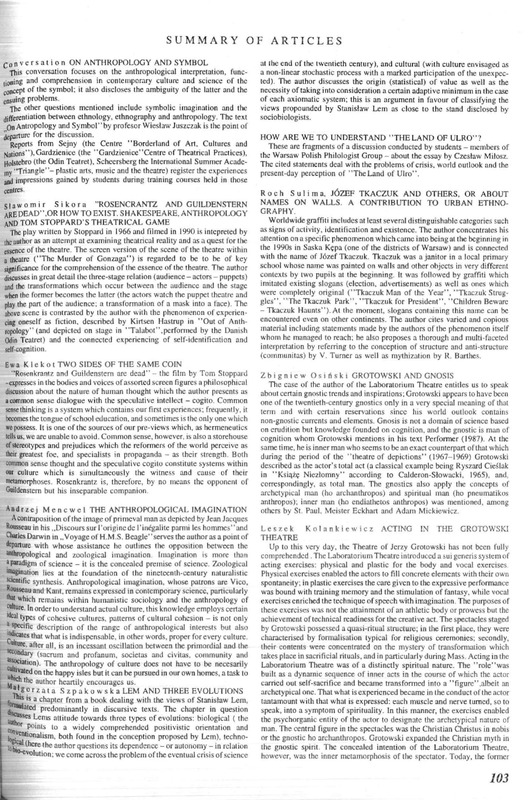
SUMMARY
OF
g v e r s a t i o n ON ANTHROPOLOGY AND S Y M B O L
•This conversation focuses on the anthropological interpretation, fune[joning and comprehension in contemporary culture and science of the
concept of the symbol; it also discloses the ambiguity of the latter and the
ensuing problems.
The other questions mentioned include symbolic imagination and the
differentiation between ethnology, ethnography and anthropology. The text
On Antropology and Symbol"by profesor Wiestaw Juszczak is the point of
departure for the discussion.
Reports from Sejny (the Centre "Borderland of Art, Cultures and
Nations" ), Gardzienice (the "Gardzientce"Centrc of Theatrical Practices).
Holslebro (the Odin Teatret), Scheersberg the International Summer Acade
my •'Triangle"- plastic arts, music and the theatre) register the experiences
and impressions gained by students during training courses held in those
centres
C
o
Slawomir S i k o r a
"ROSENCRANTZ AND GUILDENSTERN
AREDEAD'.OR HOW TO EXIST. S H A K E S P E A R E . ANTHROPOLOGY
AND TOM S T O P P A R D S T H E A T R I C A L G A M E
The play written by Stoppard in 1966 and filmed in 1990 is intepreted by
the author as an attempt at examining theatrical reality and as a quest for the
essence of the theatre. The screen version of the scene of the theatre within
o theatre ("The Murder of Gonzaga") is regarded to be to be of key
significance for the comprehension of the essence of the theatre. The author
discusses m great detail Ihe three-stage relation (audience-actors - puppets)
and the transformations which occur between Ihe audience and the stage
when the former becomes (he latter (the actors watch the puppet theatre and
play Ihe pan of the audience; a transformation of a mask into a face). The
above scene is contrasted by the author with the phenomenon of experien
cing oneself as fiction, described by Kirtsen Hastrup in "Out of Anth
ropology" (and depicted on stage in "Talabot".performed by the Danish
Odin Teatret) and the connected experiencing of self-identification and
self-cognition.
Ewa K l e k o t TWO SIDES O F T H E SAME COIN
"Rosenkrantz and Guildenstern are dead" - the film by Tom Stoppard
-expresses in the bodies and voices of assorted screen figures a philosophical
discussion about the nature of human thought which the author presents as
a common sense dialogue with the speculative intellect - cogito. Common
sense thinking is a system which contains our first experiences, frequently, it
becomes the tongue of school education, and sometimes is the only one which
we possess. It is one of the sources of our pre-views which, as hermcneutics
tells us. wc are unable to avoid. Common sense, however, is also a storehouse
of stereotypes and prejudices which the reformers of Ihe world perceive as
their greatest foe, and specialists in propaganda - as their strength. Both
common sense thought and the speculative cogito constitute systems within
our culture which is simultaneously the witness and cause of their
metamorphoses. Rosenkrantz is, therefore, by no means the opponent of
Guildenstern but his inseparable companion
A n d r z e j M e n c w e l T H E ANTHROPOLOGICAL IMAGINATION
A contraposition of the image of primeval man as depicted by Jean Jacques
Rousseau in his ..Discours sur l'origine de l'inégalité parmi les hommes"and
Charles Darwin in ..Voyage ol H. M. S. Beagle" serves the author as a point of
«panure with whose assistance he outlines the opposition between the
anthropological and zoological imagination Imagination is more than
paradigm of science - it is the concealed premise of science. Zoological
imagination lies at the loundation of the nineteenth-century naturalistic
scientific synthesis. Anthropological imagination, whose patrons arc Vico,
Rousseau and Kant, remains expressed in contemporary science, particularly
mat which remains within humanistic sociology and the anthropology of
allure. In order to understand actual culture, this knowledge employs certain
*' l types of cohesive cultures, patterns of cultural cohesion - is not only
* 'Pecific description of the range of anthropological interests but also
^cates 'hat what is indispensable, in other words, proper for every culture.
"Iture. after all. is an incessant oscillation between the primordial and the
*condary (sacrum and profanum. societas and civitas, community and
' gallon). The anthropology of culture does not have to be ncccsarily
^ iivated on the happy isles but it can be pursued in our own homes, a task to
•eh the author heartily encourages us.
a
ej
S o r z a t a S z p a k o w s k a L E M AND T H R E E EVOLUTIONS
Ills is a chapter from a book dealing with the views of Stamslaw Lem,
ulated predominantly in discursive texts. The chapter in question
"Cusses Lems attitude towards three types of evolutions: biological ( the
° points to a widely comprehended positivistic orientation and
, eilionalism, both found in the conception proposed by Lem), technolohi
h o r questions its dependence - or autonomy - in relation
""solution: we come across the problem of the eventual crisis of science
r
r e l t l c
au,
ARTICLES
al ihe end of the iwentieth century), and cultural (with culture envisaged as
a non-linear stochastic process with a marked participation of the unexpec
ted). The author discusses Ihe origin (statistical) of value as well as the
necessity of taking into consideration a certain adaptive minimum in Ihe case
of each axiomatic system; this is an argument in favour of classifying the
views propounded by Stanisław Lem as close to the stand disclosed by
sociobiologists.
HOW A R E W E TO UNDERSTAND " T H E L A N D OF U L R O " ?
These are fragments of a discussion conducted by students - members of
the Warsaw Polish Philologist Group - about the essay by Czesław Miłosz.
The cited statements deal with the problems of crisis, world outlook and the
present-day perception of "The Land of Ulro".
R o c h S u l i m a , JÓZEF T K A C Z U K AND OTHERS, OR ABOUT
NAMES ON W A L L S . A CONTRIBUTION T O URBAN ETHNO
GRAPHY.
Worldwide graffiti includes at least several distinguishable categories such
as signs of activity, identification and existence. The author concentrates his
attention on a specific phenomenon which came into being at the beginning in
the 1990s in Saska Kepa (one of Ihe districts of Warsaw) and is connected
with ihe name of Józef Tkaczuk. Tkaczuk was a janitor in a local primary
school whose name was painted on walls and other objects in very different
contexts by two pupils at the beginning. It was followed by graffiti which
imitated existing slogans (election, advertisements) as well as ones which
were completely original ("Tkaczuk Man of the Year". "Tkaczuk Strug
gles". "The Tkaczuk Park". "Tkaczuk for President". "Children Beware
- Tkaczuk Haunts"). At ihe moment, slogans containing this name can be
encountered even on other continents. The author cites varied and copious
material including statements made by ihe authors of the phenomenon itself
whom he managed to reach; he also proposes a thorough and multi-faceted
interpretation by referring to the conception of structure and anti-structure
(communitas) by V. Turner as well as mythization by R. Barthes.
Z b i g n i e w O s i ń s k i GROTOWSKI AND GNOSIS
The case of Ihe author of the Laboratorium Theatre entitles us to speak
about certain gnostic trends and inspirations; Grotowski appears to have been
one of ihe twentieth-century gnostics only in a very special meaning of that
term and with certain reservations since his world outlook contains
non-gnostic currents and elements. Gnosis is not a domain of science based
on erudition but knowledge founded on cognition, and the gnostic is man of
cognition whom Grotowski mentions in his text Performer (1987). At the
same time, he is inner man who seems to be an exact counterpart of that which
during the period of the "theatre of depictions" (1967-1969) Grotowski
described as ihe actor's total act (a classical example being Ryszard Cieślak
in "Książę Niezłomny" according to Calderon-Slowacki. 1965), and.
correspondingly, as total man. The gnostics also apply the concepts of
archetypical man (ho archanthropos) and spiritual man (ho pneumatikos
anthropos); inner man (ho cndialhctos anlhropos) was mentioned, among
others by St. Paul. Meister Eckhart and Adam Mickiewicz.
Leszek
K o l a n k i e w i c z A C T I N G IN T H E GROTOWSKI
THEATRE
Up lo this very day, the Theatre of Jerzy Grotowski has not been fully
comprehended . The Laboratorium Theatre introduced a sui generis system of
acting exercises: physical and plastic for Ihe body and vocal exercises.
Physical exercises enabled the actors to fill concrete elements with their own
spontaneity; in plastic exercises the care given to the expressive performance
was bound with training memory and Ihe stimulation of fantasy, while vocal
exercises enriched the technique of speech with imagination The purposes of
ihese exercises was not the attainment of an athletic body or prowess but the
achievement of technical readiness for the creative act. The spectacles staged
by Grotowski possessed a quasi-ritual structure; in the first place, they were
characterised by formalisalion typical for religious ceremonies; secondly,
their contents were concentrated on the mystery of transformation which
takes place in sacrificial rituals, and in particularly during Mass. Acting in the
Laboratorium Theatre was of a distinctly spiritual nature. The "role"was
built as a dynamic sequence of inner acts in ihe course of which the actor
carried out self-sacrifice and became transformed into a "figure".albeit an
archetypical one. That what is experienced became in the conduct of the actor
tantamount with lhat what is expressed: each muscle and nerve turned, so to
speak, into a symptom of spirituality. In this manner, the exercises enabled
the psychorganic entity of the actor to designate the archetypical nature of
man. The central figure in the spectacles was Ihe Christian Chrisms in nobis
or the gnostic ho archanthropos. Grotowski expanded the Christian myth in
ihe gnostic spirit. The concealed intention of the Laboratorium Theatre,
however, was the inner metamorphosis of the spectator. Today, ihe former
103
�habitué ol i he Wroclaw Laboratorium Theatre feels quite al home in the Odin
Teatrel in Holstehro or ihe " G a r d / i e n i c c ' C e n l r c ol Theatrical Practices
W o j c i e c h D u d z i k UN T H E ALTERNATIVE THEATRE
The phenomenon ol the allernulive theatre in Poland is about 4() years old
lis sources are comprised of the need far self-realization, a desire for cantad
with an and other people as well as a feeling of rebellion or a mission to b e
fulfilled The creation of such theatre is usually inaugurated by a leader with
a Wrong personalny, while the ensemble itsef is united by joint ihoughi The
a l t e r n a t e theatre is ideological The actor frequently plays himself, and h i s
Ilicalre is one o f self-expression It lacks a slur and everyone is engaged in
work l o i t h e group as a whole The inanial law period initialed the
disintegration of alternative theatres in Poland
Jadwiga
B o c h e ń s k a
Its origin has exened a marked impact on ihe image of the world ottered bv
the clips
In Ihe dominating model of Ihe video clip, connected wilh i h e J i v .
semination of M T V . the fundamental constructive operation is rapid m o n i a g g
which has led 10 i h e launching of music which creates a prevailing v i s i o n of
a conflict less and symbolic world
The anti-video clip, which often resigns from swifi cuts, has conic inin
being as a form of an opposition against its commercial counierpan ] \ .
presented world discloses that what is concealed in ihe dominating i \ | v o f
video clip sexual obsessions and deviations, social and political radicalise
and frequent ironic references In commercial video clips and other products
ol mass culture The anti-video clip turns ihe apparently carnival world ofij^j
clip inlo a true carnival
"ENGAGED AKT"AND THE ENGAGED
VIEWER
The author discusses the conception proposed by Siergiey Eisensiein
concerning relations between cinematic expression and Ihe primeval ac
tivities of man ( such as hunting or wcav ing) 1 he filmmaker tries to "hum
d o w n " Ihe desired shois and to "weave i h e i n " together in such a way
i uioniagci as to obtain an intended and precisely defined impact upon the
viewer A synthesis of emotional, aesthetic and intellectual values also leads
towards i l i , . goal (Ihe conception of intelleclual montagel A n unporlani
clement i n ihts process was I he application of codes, suitable for various
I v p c s ol culture and historical periods T h e purpose formulated hy Eisensiein
is distinctly pragmatic - in his system art i s subjected to ideology, while
references t o c u l t u r a l experience are to serve Ihe intensification of its
influence
M a n n s / C / u h a j T H E W O R L D A S S E E N IN T H E V I D E O C L I P
The v i d e o clip - o n e o f the inosi expansive audio-visual genres - e m e r g e d
I r o n i a mixture o f television commercials and presentations o l pup conceits
Noty o
M a g d a Ie n a J a w o r s k a "POLESIE"
This is a report trom the most recent Expedition conducted b\ n^r
" G a r d / i e n i c e " Theatre which look place in Sepleinher and October I'WJ
and whose range included three different regions ol the Ukraine B .
sarabia. Polesie and the Hucul Highlands Such expeditions to the rural'
"enclaves of traditional culture" play an enoiinous role in ihe a L t i v M
pursued by " G a r d / i e n i c e " Organized since ihe very beginning ol ih9
theatre l i e Tor Ihe past IX years) lives consiiiuie nol only a s e a r c h fflrj
anisiic inspiration or an allenipt al finding a new audience I'mii.irilv. ihejji
are a way of life which obliterates Ihe division heiween an and .uiivinef
eonneded u i t h daily functioning F i n a l l y , ihe expeditions are a ihcalriS
eal phenomenon which enables people w ho are nol professionally connedi
led with Ihe theatre In en|oy full participation in n This lex! is a reennl
of Ihe personal experiences id Ihe auhor. n Ihus deals with events whicH
made Ihe greaiesi impression upon her during the I'olesie siage of the
t >
Expedition
autorach
M a ł g o r z a t a B a r a n o w s k a - poetka, krytyk i historyk literatury. Autorka
k s i ą ż e k , Pamiętnik mistyczny. Surrealna wyobraźnia i poezja. To jest
wasze
życie. Autorka wielu artykułów o w y o b r a ź n i symbolicznej i kulturze masowej
m.in. Pocztówka
jako wyraz wyobraźni
masowej
w: Problemy
wiedzy
E w a K l e k o t absolwentka antropologu i etnologu UW. asystentka w Katedv
rze Etnologii i Antropologu Kulturowej U W Za|mu|e s i ę s z t u k ą \
i uwarunkowaniami kulturowymi przekazu wizualnego.
0 kulturze.
(Ossolineum 1986). autorka dwu t o m ó w poetyckich
Zamek w Pirenejach.
O g ł a s z a w „ T w ó r c z o ś c i " Prywatną historię
L e s z e k K o l a n k i e w i c z - adiunkt w Katedrze Kultury Polskiej UW,
Iropolog teatru S t a ł y w s p ó ł p r a c o w n i k ..Dialogu". Autor m.in. Ś«
Anauda
(1980)
Miasto.
poezji
Z b i g n i e w B e n e d y k t o w i e ! - antropolog kultury, redaktor ..Kontekstów",
kierownik Pracowni Antropologii Kultury, Filmu i Sztuki Audiowizualnej
w Instytucie Sztuki P A N . Autor prac o w y o b r a ź n i symbolicznej i antropo
logii w s p ó ł c z e s n e j m.in. książki (z D. Benedyktowicz) Dom
w
tradycji
ludowej.
J a d w i g a B o c h e ń s k a - pracownik naukowo-dydaktyczny Katedry Kultury
Polskiej. Autorka książki Polska myśl filmowa do roku 1939. antologii t e k s t ó w
źródłowych tego okresu oraz wielu artykułów d o t y c z ą c y c h p o c z ą t k ó w historii
kina polskiego. Specjalizuje s i ę w problematyce z w i ą z a n e j z rolą audiowizual
nych ś r o d k ó w przekazu w kulturze.
D a r i u s z C z a j a - etnolog (studia U J ) , pracuje w Katedrze Etnologii U J ;
n a p i s a ł r o z p r a w ę d o k t o r s k ą n a temet symbolu w filmie.
Mariusz
Czubaj
-
doktorant
w Katedrze Kultury Polskiei U W ; iegc
W o j c i e c h M i c h e r a - archeolog, etnolog (studia UW): prowadzi zi
w Studium K s z t a ł c e n i a Otwartego (UW), w P a ń s t w o w e j W y ż s z e j Szl
AntyDàniken.
Teatralnej. Aulor książki
Z b i g n i e w O s i ń s k i teatrolog, profesor U W . Katedry Kultury Po)skiei
dyrektor artystyczny i programowy O ś r o d k a B a d a n i a T w ó r c z o ś c i Jerżegł]
Grotowskiego i P o s z u k i w a ń Teatralno-Kulturowych we Wrocławiu Aulor
wielu k s i ą ż e k i artykułów z z a k r e s u historii teatru polskiego, edytor tekstów'
M i e c z y s ł a w a Limanowskiego i Juliusza Osterwy. Z k s i ą ż e k na|waznie|SZCj
Teatr Dionizosa.
Romantyzm
w polskim teatrze współczesnym.
WydawrwS
two Literackie. Kraków 1972; Grotowski
i jego Laboratorium
PIW. tflfcR
s z a w a 1980; Grotowski
wytycza trasy. Pusty Obłok. W a r s z a w a 1 9 9 3 . 3
T e r e s a R u t k o w s k a - pracuje w Instytucie Sztuki P A N . sekretarz r
..Kwartalnika Filmowego". Zajmuie s i ę teorią filmu i kultury wsp-
zainteresowania k o n c e n t r u j s i ę g ł ó w n i e w o k ó ł p r o b l e m ó w antropologicz
S ł a w o m i r S i k o r a - etnolog (studia U W ) , sekretarz redakcji ..Konie'
Za|muje s i ę a n t r o p o l o g i ą filmu i fotografii.
nych i historii idei
W o j c i e c h Dudzik - adiunktw Katedrze Kultury Polskiej U W , historyk teatru.
Autor m.in. książki Wiliama Horzycy
dramat
niespełnienia
(1948-1959)
A l e k s a n d e r J a c k o w s k i - Antropolog kultury, krytyk sztuki, autor prac
z zakres sztuki ludowei i naiwnej. Autor m.in. Sztuka
zwana
naiwną
ludu polskiego
i
Sztuka
L u d w i k S t o m m a - profesor, etnolog, w y k ł a d o w c a w Ecole Pratique d*»
Hautes E t u d e s (Sorbona),
R o c h S u l i m a - profesor U W . pracownik Katedry Kultury Polskiej UW gcM'
kieruie z e s p o ł e m do B a d a n Kultur Ś r o d o w i s k o w y c h i Z r ó ż n i c o w a ń KulluBJr
(1995)
nych. Autor wielu k s i ą ż e k m i n . Folklor
M a g d a l e n a J a w o r s k a . Absolwentka W y d z i a ł u Polonistyki U W . specjalizacia w Katedrze Kultury Polskiej animacja kultury.
W i e s ł a w J u s z c z a k — profesor w Instytucie Sztuki P A N . historyk sztuki,
łiiozoł. autor wielu k s i ą ż e k i artykułów.
Literatura
a dialog
Małgorzata Szpakowska
profesor
U W . kierownik Katedry Kultury Polskiej
i
i literatura.
Dokument
i l>H
Etos.
adiunkt w Katedrze Kultury Polskiei UTM
wieloletni redaktor w m i e s i ę c z n i k u ..Dialog ' krytyk literacki autorka
ż e k : Światopogląd
Andrzej Mencwel.
kultur. Słowo
O kulturze
Stanisława
i znachorach
Ignacego
Witkiewicza
1976). i tomu e s e | * J
( 19B3).
Historyk literatury i kultury polskiej, z w ł a s z c z a X X w. Autor licznych
artykułów; ż k s i ą ż e k n a j w a ż n i e j s z e : Stanisław
myśli krytycznej.
nach
kulturalizmu
1 04
Brzozowski.
Czytelnik W a r s z a w a 1976: Etos
polskiego.
lewicy.
P I W . W a r s z a w a 1990
Kształtowanie
Esej
o
narodzi
Joanna Tokarska-Bakir
1
etnolog, adiunkt w Katedrze Etnolog" *•"{
Iropologii Kulturowej UW. I n t e r e s u j s i ę h e r m e n e u t y k ą .
p o n o w o c z e s n o s c i ą T ł u m a c z y z francuskiego i angielskiego
tybetan(St>W
J
�