-
Title
-
On memory and Its Threats/ Polska Sztuka Ludowa - Konteksty 2014 Special Issue
-
Description
-
Polska Sztuka Ludowa - Konteksty 2014 Special Issue s.21-33
-
Creator
-
Kapuściński, Ryszard
-
Date
-
2014
-
Format
-
application/pdf
-
Identifier
-
oai:cyfrowaetnografia.pl:6074
-
Language
-
ang
-
Publisher
-
Instytut Sztuki PAN
-
Relation
-
oai:cyfrowaetnografia.pl:publication:6502
-
Rights
-
Licencja PIA
-
Subject
-
Kapuściński, Ryszard (1932-207)
-
Type
-
czas.
-
Text
-
Polesia Czar and a childhood
RYSZARD K A P U Ś C I Ń S K I
landscape
Zbigniew Benedyktowicz: W e are to talk about
memory and its significance in contemporaneity as well
as its assorted forms and manners of appearance. Let
us, however, start with your private and most intimate
“memory place”, the very onset of your biography. You
must have been asked often about the Polesie region
and the town of Pińsk - your birthplace and the land
of your childhood...
Ryszard Kapuściński: I am constantly requested to
comment about all sorts of things and endlessly about
Polesie. This is also a moral problem, because I am the
only living writer born in Pińsk. A t the moment, I thus
live as if under social pressure and feel some sort of a
moral obligation. We know very well that everyone is
writing about W ilno and Lwów, and that Polesie and
Pińsk are situated exactly halfway between those two.
Polesie is a somewhat poor and abandoned land and
little has been written about it.
Z. Benedyktowicz: D o you frequently compare
that, which you remember as a child and that, which
you encounter now? Do such confrontations reveal
something permanent?
R. Kapuściński: I often travel there whenever I
am capable of doing so and have the time. Here stands
the house in which I was born and here lies the cem e
tery with the graves of those closest to me, members of
my family. My grandmother and cousins were buried
On Memory and Its
Threats - Ryszard
Kapuscinski
Talks with Zbigniew
Benedyktowicz and Dariusz
Czaja
here. My parents were elementary school teachers in
Pińsk and up to this day some of the locals remember
them. I am even an honorary member of the Polish
Circle in Belarus. Finally, some of the old streets have
survived.
Z. Benedyktowicz: W hat about the landscape and
Nature?
R. Kapuściński: Polesie was an extrem ely exo t
ic part of Europe, a land of sprawling m arshes with
only a single road from Brześć (Brest) to Pińsk built
o f paving stones; the rest was com posed of bogs or
dunes. It was simply im possible to reach certain viL
lages, accessible only by boat or, in the winter, by
sleigh. C om m unication was m aintained with boats.
T h at world no longer exists. D uring the Soviet era
the m arshes were drained and turned into deserts.
Paradoxically, part of Polesie survived thanks to the
R ed Army, which set up training areas; consequently,
it was forbidden to do or change anything. This part
o f Polesie preserved its original form. O n the other
hand, people o f the past are no longer, or only a very
small num ber has survived. T he policy pursued dur
ing the Soviet period consisted of a “R ussification ”
o f the area close to the border. R ussians arrived from
further inland aand, consequently, the character of
the whole region underwent great transform ations.
T he Borderlands still feature m uch of their allure.
This is a m agnificent them e, since the Borderlands
ch aracter rem ains, predom inantly within the in h ab
itants. People of the Borderlands stick together and
Polesie circles are active in G dań sk and W roclaw .
In the various parts o f the world that I visited I al
ways m et Poleszczuki - former residents o f Polesie,
who came to see me and w anted to talk about the
past and show photographs. In N ew York or London
som eone w ould appear and pointing to a photo say:
’’Look. H ere’s your M um ” . Som etim es, they brought
photographs taken in their schooldays ...
Z. Benedyktowicz: This is interesting in view of
the fact that sociological studies or publicistics stress
predominantly the threat of globalisation. Your exam-
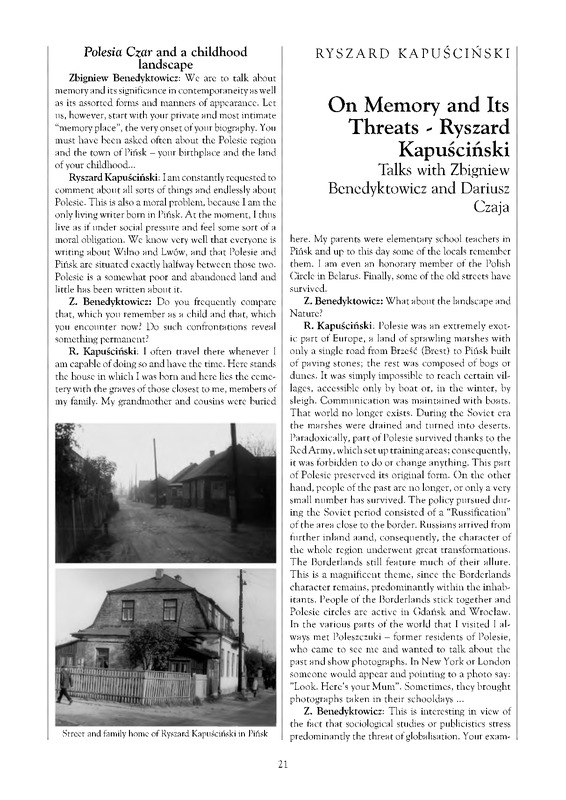
Street and family home of Ryszard Kapuściński in Pińsk
21
�Ryszard Kapuściński • ON MEMORY AND ITS THREATS - RYSZARD KAPUŚCIŃSKI
shall be leaving soon?” A n d that person sits down and
describes everything. The recollections are at times
extraordinary, as in the case of a 90 years-old lady who
now lives near W roclaw. I also possess an enormous
collection of photographs. It was even suggested to
organise a large-scale exhibition of my photographs
of Pińsk. This memory about a world of the past is
really very much alive. Travelling across the world I
appreciate the power of the feeling of identity and at
tachm ent to one’s birthplace, that small homeland.
Despite enormous and growing emigration people
leaving their native land take those feelings with them
and thus cherish the strongest possible connection
with the “small hom eland” . This awareness of identity
linked with a concrete place is m an’s great need. It is
the reason why A frica is so fascinating as a continent
that has preserved tribal awareness in a most visible,
palpable, and experienced form. This is not the con
sciousness of a “generalised” person, but regional, lo
cal awareness. Apparently, there is no such thing as an
awareness of the hom eland - the homeland is a fluid
concept in the history of societies, a rather artificial
product of our mentality; it is tribal awareness that is
the strongest in man.
Z. Benedyktowicz: W hat if we were to try to es
tablish at this exact moment that what has been pre
served in your memory first and foremost?
R. Kapuściński: W hat do I remember? It seems to
me that we are dealing here with a much wider prob
lem. My thesis about memory is as follows - ask: when
does man come into being? N ot biologically, but when
does he start existing as a human being? In my opinion,
he emerges with the very first reminiscence that can
be reached. W e thus search while saying: “I remember
this, and this, and one more thing”, and in this way we
arrive at the very first recollection when we no longer
remember anything that occurred earlier. It is exactly
at that point that m an begins and ”1” emerges, that my
identity and my extremely individual, private life story
start. I am in the habit of asking people: “W hat is the
first recollection of your life?” Two things arise upon
this occasion.
T he first is the discovery that so few people actu
ally think about this, and that they begin to labo
riously recollect. Generally speaking, people do not
ponder this theme and are forced to dig deep in order
to reach their first memory. The second issue con
cerns the character of those reminiscences. I have
asked hundreds of people about this, and it is inter
esting to discover that each has different recollec
tions. Som e are linked with a cat, another - with a
fire, and yet others with a boiled sweet purchased
by grandm other. These rem iniscences vary greatly,
and are one of the proofs of m an’s differentiation.
A lready the very first recollections distinguish us to
such a great extent.
In Polesie...
In New York... New York 1984- Photo: Andrzej Strumiłło
ple shows how assorted local peripheral cultures suc
cessfully function alongside this p ro c e ss...
R. Kapuściński: Yes, this is an extremely strong phe
nomenon. I believe that it is the reverse of globalisation.
It is the latter menace that sets free a feeling of distinct
ness, a certain need for identity and belonging to some
sort of a local community. Those bonds are extremely
powerful. It is because I come from Pińsk that people
bring to those meetings assorted photographs and items
that they took from there. These durable relations con
tain a certain emotional load. The people in question
are extremely proud of the fact that they are the carriers
of memory and willingly gather to reminisce.
By way of example, I say: “Alright, would you like
to write all this down and then mail it to me, because I
22
�Ryszard Kapuściński • ON MEMORY AND ITS THREATS - RYSZARD KAPUŚCIŃSKI
Dariusz Czaja: What do you consider to be the
point of departure for memory? W hat is it? Is it a
word? Colour ...?
R. Kapuściński: An image!
Z. Benedyktowicz: An image? And not sound?
R. Kapuściński: It will always be an image. After
all, we know that earliest reminiscences concern the
period when we were three or four years old, more or
less the age when a child thinks in images. As a rule,
this is a case of visual recollections. Even if there did
take place some sort of a loud noise, such as thunder,
it too must have been associated with an image, either
of a storm or the place where it took place. I always
found this phenomenon extremely interesting and
noteworthy. I would like to write about my childhood
in Pińsk.
the operation of introducing order and hierarchy, the
arrangement of memory, becomes extremely relevant.
I think in a certain way because I am writing an auto
biographical reportage and constantly encounter this
problem. I recall an episode from an African country
but cannot remember when it took place. What oc
curred “before” and “after”? Did I stay there in 1967 or
perhaps in 1968? Was it Ghana or rather the Republic
of South Africa? Here problems start and demand se
rious effort.
Z. Benedyktowicz: Do you keep such a diary?
R. Kapuściński: No, I am incapable of doing this
simply because my journeys are extremely exhausting
physically. A s a rule, they take place in the tropics,
there is a lot of work in progress and texts that have
to be immediately handed over; later, I am so tired
that I do not have the strength for anything else. Years
later, I am compelled to reconstruct the past out of
elements: airplane tickets, passport visas, various o
ther things. Furthermore, there is yet another
problem, the reason why I am not a great enthusiast of
diaries. A person who keeps a diary writes down every
day that, which he regards as important. Reading it
years later it turns out that usually such records make
but a slight contribution. This fact is associated with
the selective role of memory.
Take the highly instructive reminiscence about
Gorky, who upon a certain occasion was introduced
to a young writer named Paustovsky who brought one
of his stories. Gorky read it and they made an arrange
ment to meet again. Gorky said: "Young man, this text
shows talent, but I would like to give you a piece of ad
vice: spend the next ten years travelling across Russia,
working and earning a living. Write nothing. Do not
keep any notes. Once you return, make a record of all
that you saw. Why then? Because you shall remember
that, which was truly significant, while that, which you
do not recall was simply not worth remembering”.
A t this moment I am writing Podróże z Herodotem,
i.e. about experiences that took place in the 1950s. I
still recall them. By way of example, in 1956, upon the
wave of the October thaw, my editorial board sent me
for the first time to India. I flew via Rome, in an old
wartime DC-3. The airplane landed in Rome in the
evening. For the first time in my life I saw a town all
lit up. This came as such a shock that although fifty
years have passed I still remember precisely the view
of the illuminated city at night.... This is why I firmly
believe in the selective role played by memory. There
is no need to member everything because such a proc
ess serves no purpose.
D. Czaja: But this would produce an interesting
conclusion. Apparently, it is not we who consciously
and intentionally put those data into order or con
struct an image of the past pertaining to us; this proc
ess takes place somewhere “in the back of the head”,
The chaos of memory and the order
introduced into it
Z. Benedyktowicz: You have just mentioned that,
as a rule, people are forced to delve deep into their
memory in order to reach their first reminiscence. Did
you encounter such a phenomenon also in your life,
when earliest recollections find themselves beneath
those that are “worked over”, and about which we
know that they are the property of others and had
been already heard somewhere?
R. Kapuściński: Yes, this has to be cleared up.
This is the Husserlian idea of purification. Arrival at
these primary things is extremely difficult, especially
in the case of those about which we had been already
told. This is connected with two overlapping problems
with memory and reminiscences. The first is the in
troduction of order. It turns out that we find it very
difficult to put all those recalled images into order
and thus encounter certain chaos. In other words, the
process of introducing order must be purposeful, con
scious, and intended - I must arrange everything in or
der and determine what was “before” or “after”. It be
comes necessary to establish the sequences of certain
events. This is extremely important for memory. Sec
ondly, that, which is essentially linked with memory
or perhaps with its absence is the fact that memory is
fragmentary and without a continuum. We remember
only certain episodes from the past but do not have
access to their complete sequence.
D. Czaja: Additionally, it is interesting to note
that we immediately arrange them into some sort of a
plot, construe narration, and gather those details into
a linear sequence.
R. Kapuściński: We have to do this, otherwise
we shall get lost and everything will simply scatter. In
other words, in order for memory to function usefully
it requires certain operations and effort. This is not
automatic since that, which autonomously imposes
itself is chaotic, fragmentary, and non-cohesive. Only
23
�Ryszard Kapuściński • ON MEMORY AND ITS THREATS - RYSZARD KAPUŚCIŃSKI
without our will. In other words, we contain some sort
of a selection mechanism that is nothing else but a
resultant of all the significant events in our heretofore
life.
R. Kapuściński: Yes. It is not that, which I daily
decide that I shall remember or forget that is impor
tant. It suddenly turns out that I recall a certain thing,
which, actually, I should not remember but by some
miracle it exists in my memory. Then I start wonder
ing why this is taking place and why I recollect pre
cisely that thing and not another.
D. Czaja: A t this stage there comes into being a
certain subtlety, not to say: difficulty, probably not the
last that we shall discuss today while drifting between
memory and oblivion. I have in mind selection associ
ated with memory. You mentioned the “introduction
of order” into memory data. If we, however, perform
a slight semantic retouching then we shall immedi
ately arrive at the “construction” of memory. Another
slight shift and we are dealing with a “mythicisation”
of memory. How can those subtleties be separated? Is
it at all possible to introduce some sort of an acute
distinction? When do we once again deal with such
remembrance of the past about which we may say:
"This truly took place”, and when with something that
I described as the mythologisation of memory or, if we
speak about the collective dimension, with the ideologisation of memory? After all, each of those operations
performs some sort of a selection, right?
R. Kapuściński: In my opinion there is no unam
biguous response to this question. All depends on the
given person, the situation in which he finds himself,
and many different factors. As a reporter I might say
that in this case the foundation is some sort of an ethi
cal attitude, an elementary compulsion that says: “I
remember that”. This means that I am responsible for
what I wrote. In other words, I guarantee that I had
really experienced something, that the book contains
my experience. This was my argument while writing at
the time of prevailing censorship. If the censors com
plained I answered: ”I was there, and if you want to,
then come with me”. It seems to me that personal expe
rience constituted the foundation of what I wrote. A t
the same time, it provided me with a feeling of power.
I do not know how to write, nor am I a typical author.
My problem consists of the fact that I am deprived of
that sort of imagination, and thus I have to actually be
everywhere in order to write something, I have to per
sonally remember things. Everything must leave a di
rect imprint on my memory. Then, when I come back,
I do not deliberate about the form in which I am going
to write - a poem, a drama or a philosophical treatise;
I simply try to write a text. The point is for this text
to be the most faithful recreation of the memory of my
experiences, of what I saw and thought. Naturally, I
am fully aware that this is all very subjective, i.e. that
everyone sees reality differently. I often encountered
this phenomenon during assorted meetings with my
readers. Someone stands up and says: "Mister, I saw
what you described but it was quite different...”. And
I absolutely believe him because the number of as
sorted versions of the same events corresponds to the
number of its witnesses. Consequently, there is no such
thing as objective memory. Nothing of the sort exists.
Memory is the most subjectivised element of culture.
We really remember extremely different things. I have
a sister who is a year younger and lives in Canada. I
did not see her for years and once we met I, thinking
about Pińsk, reached for a tape recorder, saying: "Ba
sia, what do you recollect from our years in Pińsk?”.
Let me add that we are very close and when we were
little we always walked holding hands. One could thus
say that we saw exactly the same thing. When she be
gan to extract reflections from her memory it turned
out that they were totally different from mine. In other
words: she remembered things that I did not recollect
at all. And vice versa. You can see just how strong is
the individualisation of memory. As a result, I always
use the formula: “according to me, this is what hap
pened”. I could never say that my perception is the
only true one.
Z. Benedyktowicz: Despite this radical subjectivisation of memory there also exists something like
the memory of a generation, perhaps not as objective
but one in which people can at least recognise them
selves...
R. Kapuściński: Naturally. The memory of a gen
eration or of a nation - they both exist. Just like col
lective memory I too possess deep archetypical strata,
that whole Jungian phenomenon. But in my personal
experience as a reporter, a person travelling around
the world, collecting observations and stories, and
writing about them I am most fascinated by the fact
that memory is individualised...
D. Czaja: ... that the past is perceived differently in
each personal experience ...
R. Kapuściński: ... extremely so. This is what I
find so fascinating in Herodotus, because it turns out
that he already tackled these difficulties. The reason
lay in the fact that his writing was connected directly
with the problem of memory. Recall the opening invo
cation of his book: These are the researches of Herodotus
of Halicarnassus, which he publishes in the hope of there
by preserving from decay the remembrance of what men
have done. Herodotus struggled with the obliteration
of memory, encountered already at the time. By way
of example, upon his arrival in Thebes he discovered
that everyone said something different about a certain
past event. To this he responded that he was obliged
to describe assorted versions. His task consisted of a
faithful presentation. He felt compelled to propose
an objective account. It was Herodotus who was the
24
�Ryszard Kapuściński • ON MEMORY AND ITS THREATS - RYSZARD KAPUŚCIŃSKI
first in world literature to announce this differentia
tion of memory and the image of the past. We know,
however, that past reality resembles quicksand. We all
make our way along this sandy terrain, of which no
one is certain.
D. Czaja: There undoubtedly exists some sort of
tension between subjectivity and the objective image
of a thing. You mentioned that Herodotus attempted
to coordinate various versions of the past. He too,
however, was probably not free from subjectivity.
Within the context of your recollections of the past
you mention the individualisation of memory and the
subjectivity of the image of the past. There arises the
following problem: what is the situation of an historian
who tries to trust memory (witnesses or documents)
but, at the same time, tries to solve the question re
peated after Ranke: “What actually happened” (wie es
eigentlich gewesen)? To put it directly: he attempts to
be objective. Do you, in the wake of numerous texts
demythologising our naive faith in “genuine reality”
recreated by the historian, still believe in the objectiv
ism of historical studies, the scientific, to coin a term,
image of the past?
R. Kapuściński: My approach is as follows: I re
gard the key to such situations and problems to be
the French term: approximation. In other words, such
objectivism is possible only in an approximated form.
Approximation means that we harbour certain ideals,
which we accept and in some way assume. I would like
to write an ideal book. But all that I am capable of do
ing is, at best, to come close to the theoretical ideal,
which I have adopted. The same situation occurs in
science and the humanities. Everything is approximation. Importance is attached to the degree in which we
manage to approximate this devised collective ideal.
Some succeed in approaching it extremely close whilst
others will never attain it. An historian who assumes
that he will write an objective book about the battle
of Grunwald also presupposes some sort of cognitive
ideal. The degree to which he will attain it will be
come the yardstick of his work. We cannot achieve
an absolute because this is simply impossible, and the
yardstick of assessing our effort is the degree of ap
proximation to this absolute.
D. Czaja: Fine, but how do we know that we are
coming close to the epistemological absolute?
R. Kapuściński: Social awareness contains a func
tioning concept of the ideal. We feel that a certain
novel, for example, In Search of Lost Time by Proust,
comes close to it, or that Joyce succeeded, but some
inferior author did not. This is a collective comprehen
sion of the ideal, just as Znaniecki wrote in Społeczne
role uczonych that someone is eminent in a given do
main of science. How is one to define who is brilliant
in a certain field? The solution proposed by znaniecki
claims that a group of specialists regards someone as
outstanding. This is the criterion, and there is no oth
er. In my opinion, the same holds true for every ideal.
D. Czaja: In other words, this would take place
according to the principle of some sort of consensus, a
collective contract, right?
R. Kapuściński: Yes, this is the case. Joint reflec
tion, joint evaluation, joint comprehension. This is
how I envisage it. I am incapable of discovering a dif
ferent criterion defining why a particular reportage is
considered better than another. People, members of a
group, simply think that someone is better, another is
worse, and yet another is superior.
D. Czaja: Or could it be that what we describe
as “the truth of the past” is simply a function of the
time, in which it had been formulated? Let us take a
closer look at mediaevalist research in the past several
decades. After all, this is not the case of an avalanche
discovery of some new, previously unknown docu
ments. The image of the Middle Ages, nonetheless,
changed from the infamous “Dark Ages” to excellent
multi-strata studies, such as those by Gurievich or re
cent publications by Le Roy Ladurie. What will hap
pen to those visions of the Middle Ages in another
several decades?
R. Kapuściński: The humanities as a whole are
deeply immersed in living and endlessly active matter.
In Brzozowski’s brilliant definition of memory the lat
ter is always working and transposing, and there is no
such thing about which we could find out something
once and for all. He was of the opinion that it is matter
that succumbs to constant transformation.
D. Czaja: If this is so, then perhaps it is the ideal as
such that is fiction?
R. Kapuściński: Yes, because this ideal too chang
es. I maintain that the greatness of the humanities
consists of the fact that we permanently work with
matter subjected to limitless transformation. It is fasci
nating to follow its trends and assorted varieties. This
is what I find so unusual and interesting. Furthermore,
it testifies to the quality of the human intellect.
B ad memory, repressed memory
D. Czaja: We are speaking the whole time about
the positive function of memory, memory that sal
vages, creative memory, and, finally, memory build
ing our identity thanks to which we know who we are
and where we come from. I would like us - and by no
means due to contrariness - to speak for a while about
the sort of memory that can produce resistance and
about unwanted, negative memory.
Our discussion thus cannot lack Nietzsche and his
celebrated and highly controversial text : On the Use
and Abuse of History for Life. What does Nietzsche tell
us? He declared more or less: why do you want to re
member? This is the hump that you carry at all times.
The excess of history has seized the plastic force of life. It
25
�Ryszard Kapuściński • ON MEMORY AND ITS THREATS - RYSZARD KAPUŚCIŃSKI
no longer understands how to make use of the past as a
powerful nourishment. A whole diatribe against histo
rians and the historical sense. Nietzsche criticised a
stand that perceives the world through the prism of
sight always focused on the past. He was irritated by
the fact that in this manner we build a society that
erects shrines to the past and the old.
My question too embarks upon this Nietzschean
motif of memory that could become a burden and an
obstacle, and which does not create but hampers, es
pecially if it pertains to a cohesive tribal group. Take
the example of the war in the Balkans. It is said at
times, while observing the frenzied Balkan melting
pot, that, paradoxically, if local population groups re
membered less and did not accuse each other of the
suffering endured in the past, during the lifetime of
their fathers or grandparents, and if they were capable
of forgetting, then the bloody massacres of the 1990s
would have never taken place. What is your opinion
about such a portrayal of this issue?
R. Kapuściński: I do not share this opinion. I
disagree with Nietzsche, especially considering that
today we endure assorted problems involving memory
and there exist a number of serious threats entailing
memory loss.
On the other hand, here are several remarks about
tribalism. Unfortunately, this particular word is en
dowed with a negative meaning and Africans find
its use offensive and prefer “nationality” or “people”.
They consider tribe or tribalism to be anathema.
In order to understand what actually took place in
the Balkans it is necessary to introduce a certain dif
ferentiation, to distinguish between tribal awareness
and its use for political purposes and strife. This some
what resembles the use of a knife to cut bread and ...
throats. The same holds true for tribalism, which in
itself is an enormous value to be applied either for the
sake of a political game or one conducted for winning
power and certain political profits. From this point of
view, tribalism is a powerful feeling of local commu
nity, neither better nor worse than any other emotion.
In political games it is possible to make use of every
sort of feeling with a tangible outcome. In the Balkans
such emotions were applied for destructive and out
right murderous purposes. After all, scores of genera
tions led normal lives in harmony. Mixed marriages
abounded. Pińsk, where I was born, was an interna
tional small town, where 72% of the population was
composed of Jews, Ukrainians, Byelorussians, Latvians
and Lithuanians. There was no feeling of radical ani
mosity. Leaving Pińsk I was bereft of all ethnic aware
ness and was even unconscious of its existence. We all
lived together. As long as a burning fuse is not inserted
into such diverse matter - and this can be done only
from the outside - there is no threat. It is not part of
man’s nature, and without that external factor he will
not become ablaze with hatred. This is simply some
thing that man lacks.
D. Czaja: I seriously doubt it. After all, we all be
long to “the tribe of Cain”, right? I recently watched a
shocking British documentary about Srebrenica. N at
urally, we know that men have been killing as long
as the world exists, but the scale and type of those
murders, totally impartial, exceeds all boundaries of
our imagination...
R. Kapuściński: True, this is already bestiality.
Once the wheel of hatred is set into motion it be
comes difficult to stop it. I constantly repeat that I am
concerned with one thing: that people will never start
anything of this sort by themselves! Take the example
of a multi-tribal African town in which every inhab
itant has his street and house. Nothing special takes
place. Suddenly, one day, agitators arrive and declare:
“Listen, you’re poor while that man on the next street
is a member of the ruling elite; wouldn’t you like to
be one, too? If you continue to remain passive you’ll
die of hunger and achieve nothing...”. This is the way
things start. People go into the streets brandishing
machetes and start fighting “for their cause”, killing
and assaulting. This is the type of mechanism I am
concerned with. More exactly, I am anxious about the
fact that such a feeling of tribal affiliation may be eas
ily used for political purposes.
D. Czaja: I agree, but it must fall on susceptible
ground. Inciting one against the other only awakens
dormant demons. And they do really exist!
R. Kapuściński: True, very often they only have
to be awakened. I do not maintain that man is an ideal
creature, but I do claim that every person contains all
sorts of features. It all depends on the sort of traits to
which we refer and which we stir. I affirm that man
as such does not act in this manner as if “from the in
side” and that only certain circumstances will awaken
the negative, dark side. This is what I have in mind.
True, such darkness exists as an imminent component
in a dormant state that could be described as passive.
In order to achieve it, it is necessary to create suit
able conditions. This is the case with tribalism. On the
other hand, I repeat obstinately that clan, family or
tribal bonds are an extremely positive emotion since
it enables us to function in the world. An individual
simply cannot exist outside a clan. This is the essence
of the philosophy of African societies and, generally
speaking, the philosophy of clan societies as such.
Here lies also one of the differences between the
East and the West. In Western civilisation it is the in
dividual who is the most prominent, and we deal with
the liberty of the individual, his rights, and so on. In
non-Western societies the situation is the reverse supreme value is attached to the collective, a fact that
simply follows from different historical experience, i.e.
the individual could not survive in conditions created
26
�Ryszard Kapuściński • ON MEMORY AND ITS THREATS - RYSZARD KAPUŚCIŃSKI
by local poverty and is forced to seek the support of
the community. Only the latter is capable of facing
Nature. The individual is incapable of doing this and
of taming Nature. In a word, subjugation to the col
lective is a condition for endurance in contrast to
developed Western civilisation where the individual
can easily survive and relish assorted rights. This is a
certain luxury, i.e. the enjoyment of civic rights and
similar privileges that the highly technological society
can well afford. Poor society, dependent on Nature,
cannot afford this.
Back to the Balkans. The whole story, as we know,
started at the time of the Turkish invasion. Previously,
this was a normal and peaceful community. A t a cer
tain moment, tribal animosities were stimulated and
kept alive. A t this stage, the basic issue comes to the
fore. My theory about the origin of tribal and national
conflicts claims that war did not start on 1 Septem
ber 1939, nor did it break out on the day when the
first shots were fired. In the contemporary world, war
begins with changes in the language of propaganda.
Whenever we observe language and the way in which
it transforms itself and certain words start to appear
then it becomes obvious that suddenly there come
into being such terms as: enemy, foe, to destroy, to
kill ... i.e. there emerges a language of aggression and
hatred or, to put it differently, so-called hate speech.
There is still no sign of war and nothing is said about
it, but the language of communication begins to alter.
A t that very moment, in the wake of those vagaries of
the language and their intensification, we notice the
looming menace of war. This process could be classi
cally observed in the Balkans. I claim that each war,
be it in Iraq, the Balkans or any other country, starts
in this manner.
D. Czaja: Let us, therefore, make matters clear.
Our issue presents an extremely interesting fragment
of the most recent book by Paul Ricoeur on history,
memory, and oblivion. We include a chapter on how
to successfully tackle the difficult problem of bad
memory. This is a thoroughly practical question and
I am even inclined to agree with you that tribalism as
such is not a threat. The war in the Balkans has come
to an end, and now what? What about memory that
does not wish to forget? What should be done about
it? It is easy to say: testify, educate, and teach. All this
is fine, but we do not really believe in the effective
ness of such activity. After all, we had our Sqsiedzi.
We also recently held a difficult and painful discus
sion about Jedwabne. Now what? Should the whole
problem be simply described, explained, recalled, and
taught at school? Certainly. But something else must
also be done. I agree with Ricoeur who wrote about
the need for the Freudian term: “the work of mourn
ing” , some sort of grief tackling the past. Powerful suf
fering, a process of filtering the facts. Otherwise, when
traumatic experiences of the past become relegated to
textbooks or even, as in the case of Jedwabne, state
ceremonies are held, without private mourning we
shall as a community enjoy the comfort of feeling that
everything has been already done and now we can en
joy peace and quiet. It has all become part of the past.
What is your opinion?
R. Kapuściński: Naturally, this is an extensive
theme, dramatic and, for all practical purposes, one
that does not offer any solutions. I have in mind the
fact that the moment when such development has
been revealed, the dynamic of destructive processes
is appalling. Once this Pandora’s box has been opened
it becomes extremely difficult to close it again. It will
probably be never possible to shut it tightly, a feat that
will remain unaccomplished for the next few genera
tions. It is here that time starts to exert an impact.
The once incited bloody conflict and the instigation of
hatred possess terrible results and cannot be set right
in a brief space of time. This is an exceedingly pain
ful circumstance. Man’s great frailty consists of the
fact that he is unable to abandon it either ultimately
or satisfactorily for many generations. Up to this very
day, despite the passage of decades, certain societies
are completely unable to confront reality. By way of
example, Japanese society still refuses to settle ac
counts with the memory of its past crimes. This great
nation is incapable of even approaching the problem.
I believe that the task in question is too demanding
and horrible ...
D. Czaja: But something must be done and things
cannot be left unchanged.
R. Kapuściński: Theoretically, you are right.
Naturally, I have in mind good will and intentions. In
such cases it is necessary to return to those problems,
face them, and mull them over. Once again, this has
to be attained with a conviction that in this case too
there functions an approximation mechanism, i.e. that
we may only draw closer to the solution of such ques
tions. This is a case of human weakness, and matters
of this sort cannot be ultimately resolved.
D. Czaja: Perhaps this could become the moment
when it becomes possible to embark upon the work of,
so to speak, wise forgetting. The latter would involve
grief or at the very least be preceded by some sort of
reflection, if not atonement.
R. Kapuściński: Yes, this is certainly right. None
theless, the process in question could be accomplished
in relation to only a certain part of society or individu
als, but it is difficult to imagine that it could refer to
entire societies and communities.
D. Czaja: I insist that something should be done
because scores of examples testify that a simple ejec
tion of traumatic past events from memory actually
does not yield anything.
27
�Ryszard Kapuściński • ON MEMORY AND ITS THREATS - RYSZARD KAPUŚCIŃSKI
R. Kapuściński: It generates nothing because real
an avalanche, a burden that makes life impossible and
produces permanent exhaustion. Existing information
exceeds many times the capacity of the average hu
man intellect.
Finally, the third threat involves the enormous
acceleration of historical processes. This means that
history used to follow a slow course. Three hundred
years ago nothing took place, two hundred years ago
- the same, and the human mind was adapted to that
tempo. Man could absorb historical moments and
those of his life. History exerted a stabilising effect.
Man lived in a constant environment, which he was
capable of encompassing within his memory and mas
tering. Now, due to terrible acceleration, on the one
hand, temporal and, on the other hand, spatial, with
space and time acting as our two fundamental orien
tation points in the world we have lost the feeling of
stabilisation and enrootment in the world.
D. Czaja: How would you, in connection with this
multi-trend loss of memory by contemporary society,
define our epoch, the time in which we live? By way
of example, Pierre Nora, author of the already classi
cal Les Lieux de mémoire, seems to be saying something
quite different: we live at a time of commemoration, a
time of gathering memories. Take a look at numerous
memory “sites”: museums, archives, compendia, dia
ries, monuments - assorted “appliances” for remem
bering. What is actually taking place: are we living at
a time of memory or a time of forgetting?
R. Kapuściński: Naturally, museums and archives
do exist. I, however, am concerned with something
quite different, namely, that more and more of our
interior is being extracted and delegated to assorted
institutions. I have in mind the entire institutionalisa
tion and bureaucratisation of memory. Various insti
tutions are being established - in Poland, for example,
the Institute of National Remembrance - to organise
our memory. We are becoming increasingly convinced
that “they” will deal with the issue at stake. “They”
have their archives and the individual, as I have men
tioned, is getting rid of his memory and dispatching it
to an anonymous institution. I am concerned with dis
tinctive memory, the sort that differentiates us. This
is the memory that we develop in time and via which
we create ourselves, our identity, and personality. We
differ, i.a. due to the fact that we have diverse memo
ries, that each one of us remembers different things
and values, and becomes attached to certain stages or
types of memory.
Furthermore, I am concerned with the fact that
the statement that we live at a time of remembrance
can be at most a symbol of the fact that we live at a
time of increasingly institutionalised memory and less
so at a time of memory as a personal, private value.
D. Czaja: Perhaps it would be possible to com
bine those two things. It could be deduced already
ity stays on.
D. Czaja: Sometimes, it returns with even greater
force.
R. Kapuściński: Yes. I think that this is one of
those weaknesses of human nature, the nature of
societies with which we simply do not know how to
deal. There are multiple things about which we do not
know what should be done. They entail great themes
and equally great weaknesses, such as human cruel
ty. For centuries, people have been embarking upon
similar questions and we are still incapable of tackling
them successfully. Dostoevsky was always fascinated
by the mystery of unnecessary, disinterested cruelty. A
person has killed? Yes. But why does he quarter, slice,
boil, why does he additionally... why, why...?
We are incapable of resolving such questions. The
essence and greatness of the humanities probably lie in
the fact that they recognize the existence of a range of
queries to which we shall never find solutions.
Threats to memory and time of
commemoration
Z. Benedyktowicz: Let us now discuss the threats
to memory looming in contemporary culture, which
you mentioned on the margin. In what domains of life
would you situate them? O f what are they supposed
to consist?
R. Kapuściński: In my opinion, there are three
such threats. The first entails the enormous develop
ment of mechanical memory carriers, which means
that man is slowly unlearning the art of remembrance.
The art of memory is something that has to be mas
tered; one has to learn how to remember. Today,
everything is transposed into a computer, a book, a
record, an encyclopaedia. We no longer- as has been
the case until recently - have to learn everything by
heart nor do we have to train our memory since eve
rything is recorded on assorted carriers. Memory is as
if relegated from our heads and transferred into me
chanical memory carriers although it is an absolutely
essential part of human awareness, which Plato de
scribed as the soul. The process of getting rid of the art
of remembrance poses a very grave menace for human
personality. This is by no means a purely mechanical
problem. It is something more: it pertains to man’s
skills and ability to think, to his and our identity. This
peril is growing. In the course of the development of
the “net” and the computerisation and electronisation
of life we shall steadily become invalids as far as our
memory is concerned.
The second threat facing memory is, in my opin
ion, an excess of data. As the British say: abundance
of riches. Human awareness is simply flooded with
such an amount of information that it is no longer ca
pable of mastering it. This excess acts in the manner of
28
�Ryszard Kapuściński • ON MEMORY AND ITS THREATS - RYSZARD KAPUŚCIŃSKI
Africa. Photo: Ryszard Kapuściński
29
�Ryszard Kapuściński • ON MEMORY AND ITS THREATS - RYSZARD KAPUŚCIŃSKI
from what you have said that the search conducted in
one’s past, described by scholars, the quest for family
genealogies, literary or cinematic returns to the time
of childhood, museum tours, the universal predilec
tion among readers for diaries, and various types of
nostalgia, in a word, the whole movement “towards
memory” is some sort of a counter-reaction to the
earlier mentioned civilisation acceleration. Could this
be an instinctive defence against Milosz’s accélération
d’histoire, that powerful and still encroaching variabil
ity of daily life?
R. Kapuściński: I do not claim that these phenom
ena exclude each other. I do maintain, however, that
the situation in which the art of remembering is hand
ed over to institutions is a dangerous tendency. Nor
do I insist that this is a case of either one or the other.
We know that by the very nature of things man is a
lazy creature and prefers to seek diverse facilitations
in life; hence I discern in this process a trend towards
rendering life easier. This is not a charge addressed
against technology. Imagine, however, a situation in
which everything has been already computerised and
suddenly a virus attacks this digitally recorded mem
ory. It could then turn out that we shall remain to
tally deprived of all memory. Naturally, I am speaking
about certain hazards, those bad paths of civilizational
progress. I do not maintain that all is a catastrophe nor
do I prophecy the end of the world.
Z. Benedyktowicz: Earlier, you mentioned threats
facing memory in the contemporary world in connec
tion with the development of new technologies. To
what extent, in your opinion, could conventional di
visions into societies “with history” and “without his
tory”, once existing in anthropology, be referred to
the contemporary world? Is it possible to speak today
about “societies with memory” and “without memo
ry”? Characteristically, American culture used to be
described as culture without memory not because it
has a relatively brief history but also owing to a dis
tinct appreciation of the present, for living for the mo
ment, for life without that constant gazing into the
past, so typical for Europe. Quite possibly, the absence
of significant traumatic experiences is the reason why
in that model of culture people are so insensitive to
the past and do not experience so strongly the pres
sure of the duty to remember and to conserve memo
ry. Is American culture really like that? How does this
appear from the perspective of your American experi
ences?
R. Kapuściński: We live in a world in which mul
ticultural qualities are a norm. We are enclosed within
a world of assorted cultures and traditions offering us
totally dissimilar commodities. On the one hand, we
are dealing with societies dominated by oral cultures:
i.e. the societies of America, Latin America or Asia,
where this symptom of values really prevails. There
exists yet another type of society, bearing the heavy
burden of historical thought. It includes our society
and European societies in general. History constitutes
a large part of our culture: historical thought, the sym
bolic of historical memory, the feeling of a continuum
in time. Then there is a third group of new societies,
whose roots stem from emigration and whose history is
relatively brief: the USA, Canada, Australia, and oth
er, smaller ones. They are no more than 200 years old
and are not burdened with history; thus their world
faces the future. One could say that the future is their
past.
But this too is changing. Take a look at all that,
which transpired in the US in the wake of 11 Septem
ber. This was a classical example of building own tradi
tion, a nobilitation of patriotism, and the construction
of identity around such symbolic signs as the flag and
the anthem. These new societies clearly experience
the need to create national identity, which they can
not derive from the past since they simply do not have
it. They lack some sort of a “battle of Grunwald” or an
event with a similar rank. Hence, they are compelled
to erect this “past” ad hoc. I would not be inclined to
say that this is a bad thing. Generally speaking, they
find the idea of hierarchising culture strange. Such a
society is what it is because it has a certain history and
simply has to be accepted as such.
D. Czaja: Nonetheless, it is possible to observe in
American culture also other types of a return to the past,
this time in a rather more grotesque version. Take the
example of the rather comical snobbery for “the old”,
naturally in its European version. “American” books
by Eco or Baudrillard mention all those churches or
castles transferred to distant Idaho and there recreated
anew brick by brick, as well as other artificial practices
of prolonging one’s lineage. Naturally, this is not only
an American speciality. What are we to think, for in
stance, about the contemporary phenomenon - actu
ally, a fashion - for an artificial resurrection of the past,
a costume-like enlivening of memory? You mentioned
a moment ago the battle of Grunwald, which reminds
me of a certain amusing newspaper article about the
annual recreation of the “battle of Grunwald” on the
historical site, involving teams of knights, “our” men
and the enemy, using swords and lances and engaged
in armed skirmishes. Interestingly, the outcome is not
historically predetermined. I even recently heard that
the Teutonic Knights won [laughter]. How would you
assess those returns to the past, the whole process of
putting on - literally and metaphorically - someone
else’s costume? Just how sensible is this theatralisation
of memory, which some might find funny and others
- grotesque? Do such journeys into the past actually
assist in regaining memory?
R. Kapuściński: I would say that as long as people
are not killing or setting fire to each other...
30
�Ryszard Kapuściński • ON MEMORY AND ITS THREATS - RYSZARD KAPUŚCIŃSKI
Africa. Photo: Ryszard Kapuściński
31
�Ryszard Kapuściński • ON MEMORY AND ITS THREATS - RYSZARD KAPUŚCIŃSKI
D. Czaja: ... then let them play...
R. Kapuściński: Yes, let them play. I, theretofore,
hanged...” sort. Everything is forgotten. Something quite
different is at stake, and this is a model of culture totally
different from its European counterpart. Start with the
fact that the dead must be immediately buried. The first
reaction is to instantly inter the person who died or had
been killed. There is no funeral ceremony or prepara
tions of the sort known to us...
This fact is also connected with a totally different
attitude to time, its treatment and experiencing. If an
ancestor is recalled then not as a martyr but because
he is still alive, participates in the life of the community
by giving advice, metes punishment or reprimands; in a
word, he remains next to, and together with us. Signifi
cantly, such ancestors are buried in the direct proximity
of the homestead. Numerous graves are located next to
homes and often the living walk over them. The ances
tor seems to have departed but he remains an extremely
ambivalent figure. It is impossible to totally forget him
because he continues to function. Illness among the liv
ing could be a sign that we have neglected some of our
duties vis a vis the ancestor, who in this way reminds us
that he still exists.
Z. Benedyktowicz: Perhaps this awareness that
ancestors continue to accompany us does not generate
martyrological remembrance and cultural martyrdom?
R. Kapuściński: Yes, because belief in the presence
of the deceased is extremely strong. This holds true not
only for African religions. Such a conviction about the
return of the dead is a constant component of numerous
religions in which the boundary between life and death
is never final or total. Such an approach remains so abso
lutely at odds with our culture in which death is a terrible
caesura. There it is fluent reality. Consequently, despair
is also dissimilar and extremely theatrical, since basically
death is something quite natural. I always experienced
this as a problem on assorted African frontlines. Some
times, accompanying these men I realised that they were
facing certain death. They, on the other hand, treated
it as something normal; quite simply: someone dies. The
relation between the living and the dead differs. This is a
positive philosophy inasmuch as death does not produce
such a terrible gap in the world around us. It is not hor
rendous tragedy or insufferable pain.
Remember that the average African woman used to
give birth to twenty children and that throughout the
whole childbearing stage in her life she produced a child
year after year. Out of this total some five children sur
vived, quite a large number. If, therefore, a woman bur
ies her children each year her attitude towards death is
totally dissimilar to ours. She lives and simply gives birth
to successive offspring. The relation towards death and
life is totally different. In certain Latin American coun
tries I often accompanied groups of Indians. In Bolivia
or Peru, I would suddenly see a father carrying a small
coffin made of plain boards to be buried in a cemetery
high in the mountains. A thing quite inconceivable in
would not perceive anything blameworthy in those phe
nomena. Naturally, this is connected with the fact that
we are living in a world of intensively functioning mass
culture and, as result, a world of enormous deposits of
kitsch, which has already become a permanent element
of culture. Some might find this to their liking, while
others might not; these mass culture phenomena can
be ignored or criticized but they shall objectively exist.
Willingly or not, we are compelled to participate in this
process.
Z. Benedyktowicz: My question about American
culture has also a second hidden agenda. Naturally, we
know enough about American pop culture and numer
ous phenomena, including embarrassing ones, from this
particular domain. On the other hand, if we inquire
about the best chairs of classical philology in the world
then it turns out that, as Zygmunt Kubiak said during
a discussion held by our editorial board, ancient Greek
studies flourish best at Harvard...
R. Kapuściński: It must be kept in mind that Amer
ican society is highly diversified. The campus phenom
enon takes place also in this world. But this is a closed
enclave, almost totally isolated from society. It is, and is
not, America. True, in each academic domain you en
counter all: means, ambition and talent. These people
are intentionally drawn there and enjoy excellently or
ganized work. Such campuses represent the highest pos
sible level. The whole problem consists of the fact that
they exert but a slight impact on the rest of the country.
This is also the reason why I find it difficult to say that all
those phenomena are actually “America”, just as those
who are familiar with Africa find it difficult to use the
name: "Africa”. “America” and "Africa” are comprised
of so many realities simultaneously, so many different
worlds, at time highly contradictory, that the applica
tion of a single name in order to encompass everything
is simply misleading.
z . Benedyktowicz: I would like to ask about yet an
other detail, closely connected with historical trauma
and ways of overcoming this sort of memory. In his re
view of Rondo de Gaulle’a, a book by Olga Stanisławska,
Jacek Olędzki wrote about an issue strange for the Euro
pean: African museums, even those focused on coloni
alism, lack martyrological memory. In other words, the
strong presence of the cult of ancestors seems to have
replaced remembrance, that specific process of concen
trating on the painful past so familiar to us from personal
experience. Is this really the case?
R. Kapuściński: Let us start from the fact that there
are no European-style museums in Africa. They are mu
seums only because that is their name and they do not
display anything of special importance. No such institu
tions exist. Local culture and tradition lack a remem
brance site of the “here men were shot, there they were
32
�Ryszard Kapuściński • ON MEMORY AND ITS THREATS - RYSZARD KAPUŚCIŃSKI
Poland, but understandable within the rules of local cub
ture.
why he travelled across the world, attempting to render
the Greeks aware of the nature of their culture when
facing other cultures.
Z. Benedyktowicz: Thanking you for accepting the
invitation of our editorial board and for the stimulating
conversation I ask once again: when can we expect your
book to be published?
R. Kapuściński: Without disclosing too much I
would like to add that this book has produced grave
problems. I chiefly have in mind the way in which I
should control the entire classical material. After all,
there recently took place a significant breakthrough in
historical research, and in the past years we have all wit
nessed a great revolution in this domain. Consequently,
unruffled traditional science about antiquity is starting
to become somewhat part of the past. There exists a
vast new literature on the topic, with which I am mak
ing my very first acquaintance. Since the whole time I
have maintained contacts with my friends, experts on
antiquity, they assist me by proposing various interesting
titles and urge: “Look, this could be useful, and you must
read this or that”, to which I respond: ”1 shall never fin
ish writing this book!”. Naturally, the proposed studies
are extremely interesting and I eagerly study them since
they recommend is an entirely new approach to history,
extremely vital and in accord with novel tendencies de
scribed as postmodern. Consequently, there is no way
out: this Herodotus is still growing.
Arrangement of discussion
Dariusz Czaja
The editors would like to thank
the author and Ms. Iza Wojciechowska
for the photographs and cooperation.
“I shall never finish this book!”
Z. Benedyktowicz: I have the impression that so far
we have said too little about the book you are now writ
ing: Podróże z Herodotem. Here are a few details. I know
that the book, albeit with a famous ancient historian
in the background, originates from individual, private
memory...
R. Kapuściński: ... both mine and his. To a certain
extent this is a highly autobiographical book based on
authentic experiences. Everything started when in 1956
I was presented with the idea - an exercise of sorts - of a
voyage to India, Pakistan, and Afghanistan. Naturally, it
accompanied me all over the world although not always.
Now, years later, I read Herodotus anew. But this is ex
actly what happens with a book - obviously, if it is good
and outstanding. It turns out that each time we read
it as if it was new. The extraordinary feature of a great
book is the fact that it contains many books, or rather
their endless number. One could describe it as multi
text. The extraction of those assorted texts depends on
when we read the book, in what sort of circumstances,
mood, and situation, and what we seek in it at the given
moment.
Summing up: I regard Herodotus to be a teacher of
sorts, who taught me perception of the world as well as
an attitude towards others and different cultures. After
all, he was the first globalist, the first to understand that
in order to comprehend one’s culture it is necessary to
become acquainted with others, since the essence of our
culture is reflected only in the latter. This is the reason
33
�