-
Title
-
The Study of Polish Folklore on the Centennial Aniversary of "Lud" / LUD 1995 t.79
-
Description
-
LUD 1995 t.79, s.43-54
-
Creator
-
Krawczyk-Wasilewska, Violetta
-
Date
-
1995
-
Format
-
application/pdf
-
Identifier
-
oai:cyfrowaetnografia.pl:1979
-
Language
-
ang
-
Publisher
-
Polskie Towarzystwo Ludoznawcze
-
Relation
-
oai:cyfrowaetnografia.pl:publication:2131
-
Subject
-
folklorystyka
-
Text
-
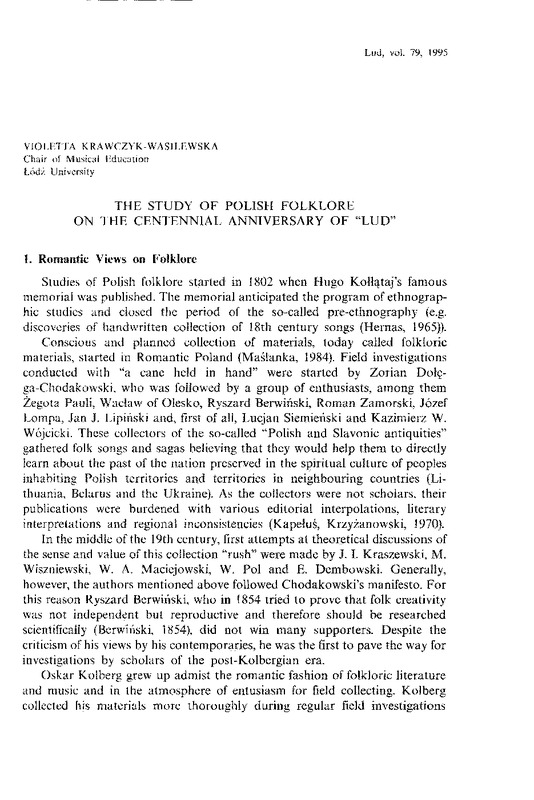
Lud,
VIOLETTA
vol. 79, 1995
KRAWCZYK-WASILEWSKA
Chair
of M lIsical
Łódź
Univcrsity
ON
Education
THE STUDY OF
THE CENTENNIAL
POLISH
FOLKLORE
ANNIVERSARY
OF
"LUD"
I. Romantic Views on Folklore
Studies of Polish folklore started in 1802 when Hugo Kołłątaj's
famous
memorial was published. The memorial anticipated
the program of ethnographic studies and closed the period of the so-called
pre-ethnography
(e.g.
discoveries of handwritten
collection of 18th century songs (Hernas, 1965».
Conscious
and planned
collection
of materials,
today called folkloric
materials, started in Romantic
Poland (Maślanka,
1984). Field investigations
conducted
with "a cane held in hand"
were started
by Zorian
Dołęga-Chodakowski,
who was followed by a group of enthusiasts,
among them
Żegota Pauli, Wacław of Olesko, Ryszard Berwiński, Roman Zamorski, Józef
Lampa, Jan J. Lipiński and, first of all, Lucjan Siemieński and Kazimierz W.
W ójcicki. These collectors of the so-called "Polish and Slavonic antiquities"
gathered folk songs and sagas believing that they would help them to directly
learn about the past of the nation preserved in the spiritual culture of peoples
inhabiting
Polish territories
and territories
in neighbouring
countries
(Lithuania, Belarus and the Ukraine). As the collectors were not scholars, their
publications
were burdened
with various
editorial
interpolations,
literary
interpretations
and regional inconsistencies
(Kapełuś,
Krzyżanowski,
1970).
In the middle of the 19th century, first attempts at theoretical discussions of
the sense and value of this collection "rush" were made by J. I. Kraszewski, M.
Wiszniewski,
W. A. Maciejowski,
W. Pol and E. Dembowski.
Generally,
however, the authors mentioned above followed Chodakowski's
manifesto. For
this reason Ryszard Berwiński, who in 1854 tried to prove that folk creativity
was not independent
but reproductive
and therefore should be researched
scientifically
(Berwillski,
1854), did not win many supporters.
Despite the
criticism of his views by his contemporaries,
he was the first to pave the way for
investigations
by scholars of the post-Kolbergian
era.
Oskar Kolberg grew up admist the romantic fashion of folkloric literature
and music and in the atmosphere
of entusiasm
for field collecting. Kolberg
collected his materials
more thoroughly
during regular field investigations
�44
(from 1839 for fifty years) on almost all Polish lands. Although an amateur, he
had an enormous methodological talent, seen in the evolution of his research
programme. Initially, he wanted to popularize folk songs in salons. Therefore,
he recorded both the text and music, at the same time ordering the genres and
giving the location of each song. As he was gaining experience and as his
collections were growing, he planned to systematize the songs and started to
record their melodic variants in different areas. Soon, however, he changed his
research assumptions. He noticed a relation between songs and other elements
of folk culture, which he also started to collect and describe, although he was
not always able to properly explain and understand individual phenomena.
Such a wide spectrum helped him to abstract the notion of region (most often
referred to by him as "the country"), for which he created a model of
folkloric-ethnographic monograph. Thirty three volumes arranged in a "series"
(i.e. regional encyclopedic monographs) were published during Kolberg's life
under one common title Lud, jego zwyczaje, sposób życia. mowa. podania.
przysłowia,
obrzędy, gusła, zabawy. pie.Ś'ni, muzyka i tańce [The people, its
customs, way of life, speech, sagas, proverbs, rituals, superstitions, games,
songs, music and dances] 1. The title itself is the first definition and classification of folklore. The extent of Kolberg's work has won him the first place
among other European collectors of folklore. In history of Polish studies of
folklore he was a link between Romantic collecting of "antiquities" and the
scholarly study of the folklore of the positivist era.
2. Beginnings of Scholarly Studies of Folklore
In the last quarter of the 19th century a tendency grew up to studyfolklore
in accordance with the requirements of modern European science. Likewise, in
Poland it was thought necessary to respond to an urgent need to expand
knowledge about one's own country and nation, at the time annexed by foreign
powers.
That period witnessed the development of archaeology, anthropology,
linguistics, ethnography and ethnology. These sciences gave a new meaning to
such terms as "culture" and "civilization". This was also a time when a new
term, namely "folklore", discovered by William Thoms in 1846 and brought to
Poland by Jan Karłowicz in 1888, was popularized 2.
When the Anthropological Commission at the Academy of Sciences in
Cracow and its Ethnological Section were established in 1874, the research
1 A new edition of Kolberg's
works, with the inedita, comprises 68 volumes published as
Dzieła wszystkie Oskara Kolherga [Oskar Kolberg's Complete Works], Wrocław - Poznań.
1961 -1995.
2 1. Karlowiez, Folklore, "Wisła" vol. 2, 1888, p. 84. Cr. also W. Thoms, Folklor [Folklore],
"Literatura Ludowa" 1975, No 6, pp. 37 - 39 (translated by V. Krawczyk).
�45
programme of ethnographic work was agreed upon. It was later modified by
various resolutions (Jaworska, 1982). Much space in the programme was
devoted to the principles of collecting ethnographic materials in the field,
fidelity of recordings, methods of text verification (it was proposed to omit
obscene elements), problem of phonetic transcription of dialectal expressions 3
and other editorial problems. Another postulate was to restrict collection as
such and focus on interpretation.
Consequently, towards the end of the 19th century studies of folklore were
inspired by positivist scholars, who interpreted folk literature and culture from
ethnological, historical, linguistic and literary points of view. They conducted
their own research and headed teams of amateurs who furnished field
materials. They also organized institutional scientific activities in aU three
annexed territories. Their views were published in scholarly journals edited by
anthropologists and philologists.
One of such journals was "Zbiór Wiadomości do Antropologii Krajowej"
(an organ of the Anthropological Commission, Polish Academy of Sciences in
Cracow), edited by Izydor Kopernicki between 1877 and 18954. Articles on
folklore were also published in this periodical by Kolberg's foUowers: Władysław Siarkowski, Władysław Kosiński, Karał Matyas, Józef Rostafiński and
Seweryn Udziela.
"Wisła", a monthly issued in Warsaw between 1887 and 1916, published
articles written by amateurs (usuaUy more progressive inhabitants of the
country), who submitted them foUowing precise instructions given by the
editorial board. Up till 1903 "Wisła" was edited by Jan Karłowicz, an eminent
linguist and father of the Polish comparative school in folkloric studies. In his
works on sagas, fairy tales and songs (Kapełuś, 1982a), he advocated studies
based on extensive comparative Polish and foreign materials. This approach
rejected the old views advocated by Max oMLiller (the solar theory of myths)
and the romantic concept of the national character of plots of fairy tales and
lyrics of songs. Noticing the polygenesis of folkloric phenomena, he came close
to the English anthropological school of Tylor and Lang. Karłowicz also took
account of the historical aspect of sagas. The research method to study folk
prose, which he advocated, was very similar to the Finnish method (also called
comparative-geographic
method), although Karłowicz was not familiar with
3 After the discovery of the phonetic alphabet by Lucjan Malinowski, the discussion related to
the use of the phonetic transcription continued in the Commission from 1888 to 1890. Eventually,
it was decided not to publish texts in their phonetic transcription, whieh was unintelligible to many
readers, and let dialectologists study them phonetically.
4 After
1895 anthropological and philological articles were published in "Materiały Antropologiczno-Archeologiczne
i Etnograficzne" (1896-1919); the ethnographic section was edited
by Seweryn Udziela, the author of many works on the folklore of Galicia, organizer and first
director of the Ethnographic Museum in Cracow.
�46
the latter (Krawczyk-Wasilewska,
1986, pp. 123 - 125). In this way, Karlowicz
laid foundations for modern folkloric comparative studies which were followed
by the next generation.
3. "Lud" (1895-1918) -
a Folkloric Periodical
Apart from "Wisła" an important contribution to the development of the
Polish folkloric thought at the beginning of the 20th century, was made by
"Lud", published in Lvov as a journal of the Ethnological Society.
In the first volume the editorial board (headed by Antoni Kalina, a Slavist)
published an extensive methodological article entitled Najnowsze prądy w ludoznawstwie [The latest trends in ethnography] by Iwan Franko, an Ukrainian
writer and scholar (Franko, 1895). It is significant that in the article, which was
an expanded version of a paper read at the first meeting of the Ethnological
Society, the wordfolklore
was used as an English equivalent of the Polish word
ludoznawstwo
[ethnography] and German Volkskunde. The concept was used
in a very broad meaning, althoug.h it pertained to the study of a people,
generally understood as "the lower strata which underwent the smallest
civilizational changes". Speaking in favour of modern research in the spirit of
the migratory-historical and comparative-literary and anthropological schools,
Franko often made references to examples from traditional oral literature:
myths, fairy tales and songs.
Folkloric phenomena understood as above were extensively represented in
successive volumes of "Lud", edited by Kalina's followers (after 1904), i.e. Karol
Potkań ski (historian), Seweryn Udziela (ethnographer) and historians of
literature - Wilhelm Bruchnalski and Józef Kallenbach.
In the twenty volumes of "Lud", which appeared till 1918, various valuable
ethnographic materials were published, mainlyon
the folklore of Galicia
(written by B. Gustawicz, J. Świętek, H. Dobrowolski,
L. Młynek, H.
Windakiewiczowa, W. Brzega, S. Udziela and others). Materials on the folklore
of other areas were published sporadically, for example on the Sieradz folklore
(I. Piątkowska), Poznań folklore (W. Łabiński) or Silesian folklore (W.
Madłówna). It must be mentioned that towards the end of the 19th century
research work was not comparable with the great collection effort. The
situation did not change much after 1905 when Seweryn Udziela published an
appeal to the collectors (in "Lud") to put more emphasis on descriptions and
comments (Udziela, 1905).
Apart from documentation on fairy tales and songs, editors of "Lud" were
also interested in folk theatre. They published many articles on satirical
performances and Christmas nativity plays (S. Gonet, W. Semkowicz,
F. Gawełek, J. Cieplik and others) and a historical synthetic study entitled
�47
Polskie
widowiska
ludowe
[Polish
folk performances]
prepared
by Adam
Fischer in 19I3.
In the first decade of the 20th century "Lud" published articles on current
folkloric phenomena. There were articles on written documents of Galician
peasants, such as literary pieces or folk epistolographic forms. Collection of
children's and Jewish folklore was promoted. Notice was made of the dialect
and folklore of Polish and Ukrainian recruits, the folklore and language of
rafters and the Lvovian suburban folklore and thieves' jargon (Kapełuś, 1982b,
pp. 355 - 358).
The editorial board of "Lud" also encouraged contributors to collect and
write about proverbs. This appeal was responded to by Franciszek Krcek who
wrote a critical supplement to Samuel Adalberg's Księga przysłów i wyrażeń
przysłowiowych
[A book of proverbs and proverbial expressions] (Adalberg,
1880 - 1894). It must be said at this point that Krcek wrote many short articles
and rewiews and made a considerable contribution to the modern approach to
problems of folklore.
Very few articles were written about the folklore of Slavs inhabiting
territories bordering Poland. Most of them were on Ukrainian and East
Carpathian folklore. There were also some reviews, among them one of
the collection of fairy tales made by J. Polivka, a Bohemian comparative
scholar.
Comparative studies on oral literature dominated in volumes published
between 1909 and 1912. Mention should be made of interesting articles by
Stanisław Ciszewski and Adam Fischer, as well as an extensive essay by Witold
Klinger, a classical philologist, entitled Do wpływów starożytności
na folklor
[The influences of ancient times on folklore] (Klinger, 1909). "Lud" must be
also credited for publication of articles bordering on literature and folklore.
These articles, belonging rather to literary comparative studies, were published
by W. Bruchnalski, S. Oobrzycki, W. Jankowski, H. Łopaciński, S. Maykowski,
W. Nartowski, S. Wasylewski, H. Windakiewiczowa,
S. Windakiewicz,
W. Szyszkiewicz and S. Zdziarski (Karpińska, Niewiadomska, 1988).
In 1907 editors of "Lud" published a pioneer study entitled O metodach
zbierania i porządkowania
melodii ludowych [On methods of collecting and
ordering folk melodies] by Adolf Chybiński, the father of modern musical
ethnography in Poland (Chybiński, 1907; 1910).
In sum, between 1895 and 1918 "Lud" played an important role in the
promotion of folkloric studies which, at the time, were part of ethnography.
The studies were pursued by skilled amateurs and scholars representing
different humanistic, social, artistic and natural disciplines. This was the reason
for the variety of methods used and problems researched. All the activities were
subordinated to one supreme goal - to deepen knowledge about the nation at
the time annexed by foreign powers.
�48
4. Folklore in the Interwar Period
When Poland regained her independence, new social, cultural and scientific
reality appeared. The attitude to folklore and peasant culture changed under
the influence of regionalistic ideology (also promoted outside the boundaries of
Poland) and the agrarian orientation. Agrarianism as a doctrine of folk
movement ennobled peasant culture, seeing in it a valuable part of the national
culture, worthy of development.
Agrarian ideas became apparent, inter alia, in the discovery of folkloric and
literary achievements of peasant diarists, such as J. Kupiec, H. Oerdowski,
Jantek of Bugaj, S. Nędza-Kubiniec or F. Kuraś. The ideas of regionalism, on
the other hand, shaped the national ideals, opposing the culture of Polish
villages to urban cosmopolitical culture. Regionalists noticed creative powers
in folklore and folk tradition, capable of providing incentives for national art
and culture.
Due to this type of thinking, folk features were often included in literature,
music, art and theatrical plays. The ideas of an amateur folk theatre were also
born then. Jędrzej Cierniak, the author of these ideas, wanted to create
a peasant theatre that would stage dramatized rituals and customs, traditional
and modern ones, with genuine props, costumes, music and folk songs (Olcha,
1963).
In the interwar period field collecting was continued and amateur movement pursued. A network of regional circles of the Tourist Society and regional
museums was established. First issues of such magazines as "Ziemia" and "Orli
Lot" were published.
The scientific approach to folklore lost its former, one-sided character. In
ethnographic, sociological and cultural studies conducted by Adam Fischer,
Aleksander Bruckner, Stefan Czarnowski or Kazimierz Moszyński one could
easily detect new theoretical and methodological assumptions. Folklore was
investigated from the genetic and typological, interethnic and historical-sociological positions, as a living category, constituting an integral element
of the national culture. The view advocated in 1929 by Stefan Czarnowski,
a sociologist, that folklore was a relic of primary times and that the folklore of
different social and occupational groups should be studied (Czarnowski, 1956),
was very significant for the history of Polish studies of folklore at the time.
At this point special mention must be made of a publication entitled
Przysłowia polskie [Polish proverbs] by Jan S. Bystroń (1933), the first Polish
synthetic paremiological monograph. Bystroń, like Karłowicz who analysed
fairy tales and sagas, followed the trends at that time dominant all over the
world (Krawczyk-Wasilewska,
1986, p. 127).
Assumptions of comparative literature and linguistics could be detected in
the works written by philologists Witold Klinger, Jan Janów, Stefan
�49
Vrtel- Wierczyński and Ryszard Gansiniec. One could find ancient elements in
Polish folklore, Slav elements in fairy tales, legends and romances. The
comparative school was created by Julian Krzyżanowski, the author of many
studies on the relations between literature (mainly old Polish literature) and
folk and popular literature (Krzyżanowski, 1935) and works on ancient
Russian epic folk songs and fairy tales.
Mention should also be made of the presence of folklore in "Lud". The
periodical, edited by Adam Fischer (from 1914 to 1939), changed its character
and became more a scholarly and anthropological
journal. Fischer had
excellent collaborators in the persons of Jan Czekanowski and Bronisław
Malinowski. Soon, many reviews of and articles about works of foreign
folklorists were published in "Lud". Much attention was given to Slavonic
folkloric studies (in Bohemia, Slovakia, Slovenia, and Lusatia). Works by
English, French, German, Italian and Hungarian authors were discussed (e.g.
reviews by Karol Korany). Readers could also find information about Greek,
Lithuanian and Panamanian folklore. "Lud" also carried articles describing
investigations of folklore connected with customs and rituals (satirical performances and nativity plays), methodological, regional and historical descriptions of musical and choreographic folklore (Karpińska, Niewiadomska, 1988).
5. Studies of Folklore Versus Philology and Anthropology
In post-war history of the Polish folkloric thought a separate chapter was
written by Julian Krzyżanowski (1882-1976), an eminent historian of Polish
literature, editor and theoretician of folklore and organizer of the ethnographic
scholarly community.
Krzyżanowski's studies of fairy tales begun before the First World War
resulted in a pioneer catalogue entitled Polska bajka ludowa w układzie
systematycznym
[Polish folk fairy tales], arranged in accordance with the
international system developed by Aarne-Thompson (Krzyżanowski, 1947). In
addition to many studies of fairy tales, Krzyżanowski also entered the domain
of paremiology - he dealt with the genesis and systematic description of
Polish proverbs. Results of his studies were published in Mądrej głowie dość
dwie słowie [A wise head will do with two words] and in a critical and enlarged
version of Adalberg's books (Krzyżanowski, 1958 - 1960; 1969 - 1978). Krzyżanowski was in favour of the isolation of folkloric studies from ethnography. In
his studies of the theory of oral and written literature he proved the integrity of
the two. This won him the support of a group of young philologically-oriented
scholars (Helena Kapełuś, Ryszard Górski, Ryszard Wojciechowski and
others). Krzyżanowski helped establish the Research Department of Folk
Literature affiliated with the Institute of Literary Studies of the Polish
Academy of Sciences in Warsaw. In 1957 he founded the first folkloric
4 -
Lud
t.
LXXIX
�50
magazine, "Literatura
Ludowa", which he edited till 1972. Of his many
publications,
mention should be made of Słownik folkloru
polskiego
[A dictionary of Polish folklore] (1965) and Dzieje folklorystyki
polskiej [The
history of Polish studies of folklore] (Kapełuś, Krzyżanowski, 1970; 1982).
Julian Krzyżanowski's work continued and developed the long tradition of
comparative, genetic and historical investigations. This direction was also
dominant in the works of Polish folklorists of the past fifty years.
In the middle of 1960s Polish investigations of folklore were very
diversified. The topics addressed were very varied and methodologies used very
different. Increased interest in the folklore of different occupational communities and a new approach to children's folklore (Jerzy Cieślikowski, Dorota
Simonides) were noticed. More monographs on single types of folklore were
published (for example, there were monographs ofthe ballad (Jadwiga Jagiełło),
riddles (Mirosław Kasjan). Discovery of such phenomena as folklorism
(Burszta, 1974, pp. 309 - 311) or a new approach to the folk character of
literature (Sulima, 1976) and the language of folklore (Bartmiłlski, 1973; 1990)
indicated an interdisciplinary approach to the study of folklore.
The profile of "Literatura Lu~owa" was changed in 1972 when Czesław
Hernas became editor-in-chief. The editorial board abandoned regional descriptions of verbal folklore and opened themselves to the modern folkloric
thought. The magazine published translations and reviews of foreign works
written in the spirit of structuralism, semiotics, contextualism and ethnolinguistics. The magazine also sponsored contemporary Polish investigations and
was a discussion forum about the specific character of folklore and its
functioning, particularly in modern times.
Scholars more frequently adopted the anthropological-cultural
approach in
which folklore was treated as a living element of social communication.
Because of this, investigations had to account for the cultural and situational
context.
At the end of 1970s problems related to the new definition of folklore as
part of symbolic culture (expressed not only by words) were strenghtened. This
was connected with the need to use new methods to investigate the phenomenon within the framework of folkloric studies. Mention should be made here of
manual-like works (Waliński, 1978; Krawczyk-Wasilewska, 1979; 1986; Czekanowska, 1988; Kowalski, 1990). Such terms as "folklore", "folkloric studies",
"folklorism" were redifined in Słownik etnologiczny
[An ethnological dictionary] (Staszczak, 1987) and an anthropological approach could be detected
in articles on folklore published in "Polska Sztuka Ludowa", particularly when
the name of the periodical was changed to "Polska Sztuka Ludowa. Konteksty" (in 1990).
One must not forget about the development of ethnolinguistic investigations, particularly in the last decade, which focused on means of expression
�51
in folklore, main linguistic stereotypes, themes and formulae. The most notable
achievements in this respect must be attributed to the Lublin centre, where
"Etnolingwistyka" was published since 1988 (editor-in-chief: Jerzy Bartmiński).
In recent years the Łódź centre initiated investigations of modern folklore
from the ecological point of view. Experience in human and deep ecology
inspired the need to look at folklore as an expression of ecological awareness,
in which the latter is a relation between the condition and quality of life in face
of civilizational, cultural, political and moral hazards.
In the past fifty years a considerable progress was made in the investigations of Polish musical folklore owing to the development of ethnomusicology, particularly at the Institute of Art, Polish Academy of Sciences, but also
at the academic centres in Poznań and Katowice. Mention must be made of
interesting achievements by Jadwiga Sobieska, Jan Sadownik, Ludwik Bielawski, Anna Czekanowska, Jan Stęszewski, Piotr Dahlig, Bogusław Linette and
Zbigniew Przerembski. All these authors also used the experience of "philological" and "anthropological"
folkloric studies.
Let us also remember that Slavonic philologists, active in many scientific
centres, were also interested in problems of folklore. These problems were also
followed by the Polish Ethnological Society, the sponsor of many publications.
In 1961, the Polish Ethnological Society appointed the editorial board of
Oskar Kolberg's Dzieła wszystkie [Oskar Kolberg's Complete Works], headed
till 1987 by Józef Burszta and after J. Burszta's death by Bogusław Linette.
Sixty eight volumes have been published to date.
In the foregoing only the most characteristic directions of modern folkloric
studies were discussed. It is clear that they are mutually supportive and
complementary although often their basic assumptions are different. Folkloric
studies have not developed a uniform research base; they are rather a system of
interpretative views on a specific fragment of culture in change. As there are
possibilities of new interpretations, the number of folklorists grows as sciences
on culture develop.
In conclusion it must be stressed that folklore and folkloric studies are still
present in "Lud", in studies and articles, reviews and reports on conferences
and events significant to modern studies of folklore.
BIBLIOGRAPHY
Adalberg Samuel
1889 - 1894 Księga przysłów i wyrażeń przysłowiowyclt polskich [A book of Polish proverbs and
proverbial expressions], Warszawa.
Bartmiński Jerzy
1973
O jrzyku folkloru [About the language of folklore], Ossolineum, Wrocław.
1990
Folklor. kzyk, poetyka [Folklore, language, poetics], Ossolineum, Wrocław.
�52
Berwiński Ryszard
1854
Studia
o literaturze
ludowej
1970
Rytmika
polskich
pieśni
historycznej
i naukowej krytyki [Studies of
of historical and scientific criticism]. vol. I - 2.
ze stanowiska
folk literature from the standpoint
Poznań.
Bielawski Ludwik
ludowych
[Rhythmicity
of Polish
folk songs].
PWM.
Kraków.
1976
1986
Strefowa teoria czasu i jej znaczenia dla antropologii
muzycznej
[Zonal time theory
and its significance to musical anthropology],
PWM, Kraków.
Drogi i bezdroża
muzykologii
polskiej [About Polish musicology]. Ossolineum,
Wrocław.
Burszta Józef
ludowa - kultura narodowa
[Folk culture - national culture], LSW.
Warszawa.
Bystroń Jan Stanisław
Przysłowia
polskie [Polish provcrbs], PAU. Kraków.
1933
Chybiński Adolf
O metodach zbierania i porządkowania
melodii IUl/owych [On methods of collecting
1907
and ordering of folk melodies], "Lud" vol. 13, pp. 171 - 201.
1910
Etnografia
muzyczna
na l II międzynarodowym
kongresie
muzycznym
w Wiedniu
(25 - 29 maja 1909) [Musical ethnography at the 3rd Intcrnational Musical Congress
in Vienna (25-29 May 1909)], "Lud" vol. 16, pp. 160-178.
Cieślikowski Jerzy
1967
Wielka zabawa [Great play]. Ossolineum. Wrocław.
Literatura i podkultura dziecięca [Children's literature and subculture]. Ossolineum.
1975
Wrocław.
Czarnowski Stefan
Kształtowanie
się Iolkloru polskiego [The formation of Polish folklore], in: Dzieła
1956
[Collected works]. vol. 5, PWN, Warszawa.
Czekanowska Anna
1988
Etnografia muzyczna,. Metodologia
i metodyka [Musical ethnography. Methodology
and methods], "Pomorze". Bydgoszcz.
Polish Folk Music:
Slavonic
Heritage,
Polish Tradition,
Contemporary
Trends,
1990
Cambridge University Press. Cambridge.
Dahlig Piotr
1987
Muzyka
ludowa we współczesnym
społeczeństwie
[Folk musIc in modern society].
WSiP. Warszawa.
Fischer Adam
1913
Polskie widowiska
ludowe [Polish folk theatrical plays], "Lud" vol. 19.
Franko Iwan
1895
Najnowsze prądy w ludoznawstwie
[The lastest trends in ethnography], "Lud" vol. I.
Hernas Czesław
1965
W kalinowym lesie. U źróde/.folklorystyki
polskiej [In the cranberry forest. Sources of
Polish studies of folklore]. vol. 1- 2, PIW. Warszawa.
Jagiełło Jadwiga
1975
Polska bal/ada ludowa [Polish folk ballad], Ossolineum, Wrocław.
Jaworska Elżbieta
1974
1982
Kultura
DziałalnoŚl'
Iolklorystyczna
Komisji
Antropologicznej
Akademii
Umiejęlllości
\II
Kra-
[Folkloristic activities of the Anthropological
Commission. Academy of
Sciences in Cracow], in: Dzieje Iolklorystyki
polskiej 1864 - 1918 [History of Polish
studies of folklore 1864-1918]. cd. H. Kapeluś, J. Krzyżanowski, PWN, Warszawa.
kowie
�53
Kapełuś Helena
1982a
Jan K arlowicz ( 1836 - 19(3), in: Dziejefolklorystyki
polskiej 1864 - 1918 [History of
Polish studies of folklore 1864-1918], ed. H. Kapełuś, J. Krzyżanowski, PWN,
Warszawa.
1982b
"Lud". Organ Towarzystwa
Ludoznawczego
we Lwowie ["Lud". A journal of the
Ethnological Society in Lvov], in: Dziejefolklorystyki
polskiej 1864 -1918 [History of
Polish studies of folklore 1864 - 1918], cd. H. Kapełuś, J. Krzyżanowski, PWN
Warszawa.
Kapełuś Helena, Krzyżanowski Julian (eds)
1970
Dziejefolklorystyki
polskiej 1800-1863.
Epoka przedkolbergowska
[History of Polish
studies of folklore 1800 - 1863. The pre-Kolbergian era], Ossolineum, Wrocław.
1982
Dzieje jólkloryslyki
polskiej
1864 -1918 [History of Polish studies of folklore
1864-1918], PWN, Warszawa.
Karłowicz Jan
1888
Folklore, "Wisła" vol. 2.
Karpińska Grażyna Ewa, Niewiadomska Maria
1988
Bihliografia
zawarto.~ci "Ludu" za lata 1895 -1985 ["Lud" from 1895 to 1985.
A bibliography], PTL, Wrocław.
Kasjan Jan Mirosław
1983
Polska zagadka ludowa [Polish folk riddle], Ossolineum, Wrocław.
Klinger Witold
1909
Do wplyw(hv starożytno.ki
na folklor [The influences of ancient times on folklore],
"Lud" vol. 15.
Kowalski Piotr
1990
W~pólczesny folklor ifolklorystyka
[Modern folklore and studies of folklore], PTL,
Wrocław.
Krawczyk-Wasilewska Violetta
1979
Wprowadzenie
do folklorystyki
[Introduction
to studies of folklore], Uniwersytet
Łódzki, Łódź.
I986
W~pólczeslla wiedza o folklorze
[Contemporary
knowledge about folklore], LSW,
Warszawa.
Krawczyk- Wasilewska Violetta (ed.)
1992
Ecology and Folklore, Łódź.
1994
Ecology and Folklore II, Łódź.
Krzyżanowski Julian
1935
Paralele [Parallels], Warszawa.
1947
Poi.~ka hajka ludowa w układzie systematycznym
[Polish folk fairy tales], vol. 1- 2,
Warszawa.
1958 - 1960 Mqdrej glowie do.v£'dwie słowie [A wise head will do with two words], vol. 1- 2, PIW,
Warszawa.
Krzyżanowski Julian (ed.)
1965
Slownik folkloru polskiego [A dictionary of Polish folklore], Wiedza Powszechna,
Warszawa.
1969-1978
Nowa ksirga przysłów
i wyrażeń przysłowiowych
polskich.
W oparciu o dzielo S.
Adalhaga
[A new book of Polish proverbs and proverbial expressions. Based on S.
Adalberg's book], vol. 1-4, PIW, Warszawa.
Linette Bogusław
1981
Ohrzędowe
pieJni weselne
kryteriów
wyznaczających
w Rzeszowskiem.
Typologia
wqtków
muzycznych
jako
regiony etnograficzne
[Wedding songs in the Rzeszów
province. Typology of musical
regions], KAW, Rzeszów.
elements
as criteria
determining
ethnographic
�54
Maślanka Julian
1984
Polska folklorystyka romantyczna [Polish romantic studies of folklore], Ossolineum,
Wrocław.
Olcha Antoni
1963
Jędrzej Cierniak i jego dzie/o. W~tęp do źróde/ i nurtów polskiego teatru ludowego
[Jędrzej Cierniak and his work. An introduction to the sources and trends of Polish
folk theatre], Warszawa.
Przerembski Zbigniew
1994
Style iformy melodyczne polskiej pieśni ludowej [Styles and melodic forms of Polish
folk songs], IS PAN, Warszawa.
Sadownik Jan (ed.)
Pieśni ludowe Podhala [Folk songs in Podhale], PWM, Kraków.
1971
Simonides Dorota
Wspó/czesna śląska proza ludowa [Modern Silesian folk prose], WSP, Opole.
1969
Wspó/czesny folklor s/owny dzieci i m/odzieży [Contemporary
verbal folklore of
1976
children and teenagers], PWN, Wrocław.
Sobieska Jadwiga
1972
Ze studiów nad folklorem muzycznym Wielkopolski [From studies of the musical
folklore of Wielkopolska], PWM, Kraków.
Staszczak Zofia (ed.)
1987
S/ownik etnologiczny. Terminy ogólne [An ethnological dictionary. General terms],
PWN, Warszawa.
Stęszewski Jan
1966
Prolegomena do klasyfikacji etnomuzykologicznych [An introduction to ethnomusical
classifications], "Muzyka" No 3-4.
Rzeczy, świadomość i nazwy w badaniach etnomuzykologicznych [Things, awareness
1974
and names in ethnomusieologieal investigations], "Rocznik Historii Sztuki" No 10.
Sulima Roch
1976
Folklor i literatura [Folklore and literature], LSW, Warszawa.
1982
Literatura a dialog kultur [Literature and dialogue of cultures], LSW, Warszawa.
1990
S/owo i etas: szkice a kulturze [Word and ethos: essays about culture], "Galicja",
Kraków.
Thoms William
1975
Folklor [Folklore], "Literatura Ludowa" No 6.
Udziela Seweryn
1905
O potrzebie zestawienia i uporządkowania opowiadań ludowych [About the need to
classify and order folk tales], "Lud" vol. II.
Waliński Michał (ed.)
1978
Teoria kultury. Folklor a kultura [Theory of culture. Folklore versus culture],
Uniwersytet Śląski, Katowice.
Translated by Zbigniew Nadstoga
�