http://zbiory.cyfrowaetnografia.pl/public/2160.pdf
Media
Part of Summary of articles / Polska Sztuka Ludowa - Konteksty 1991 t.45 z.2
- extracted text
-
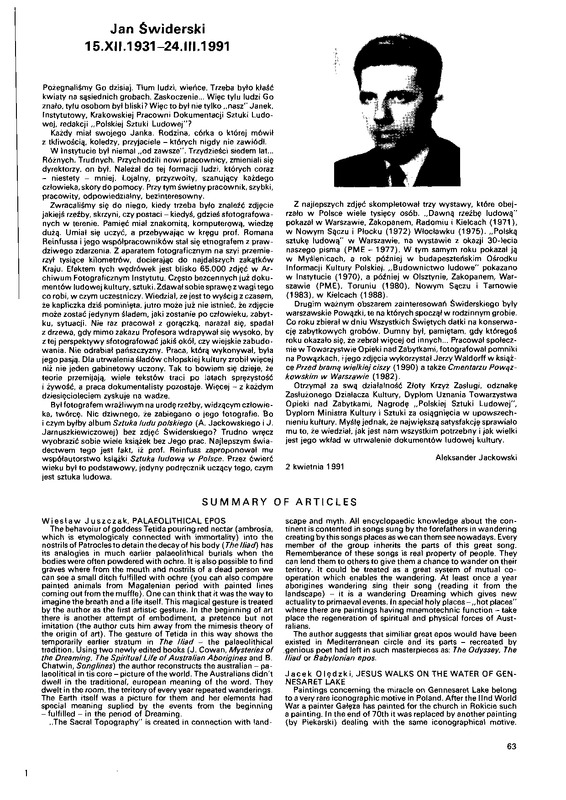
Jan Świderski
15.XII.1931-24.III.1991
Pożegnaliśmy Go dzisiaj. Tłum ludzi, wieńce. Trzeba było kłaść
kwiaty na sąsiednich grobach. Zaskoczenie... Więc tylu ludzi Go
znało, tylu osobom był bliski ? Więc to był nie tylko „nasz" Janek,
Instytutowy, Krakowskiej Pracowni Dokumentacji Sztuki Ludo
wej, redakcji „Polskiej Sztuki Ludowej"?
Każdy miał swojego Janka. Rodzina, córka o której mówił
z tkliwością, koledzy, przyjaciele - których nigdy nie zawiódł.
W Instytucie był niemal „od zawsze". Trzydzieści siedem lat...
Różnych. Trudnych. Przychodzili nowi pracownicy, zmieniali się
dyrektorzy, on był. Należał do tej formacji ludzi, których coraz
- niestety - mniej. Lojalny, przyzwoity, szanujący każdego
człowieka, skory do pomocy. Przy tym świetny pracownik, szybki,
pracowity, odpowiedzialny, bezinteresowny.
Zwracaliśmy się do niego, kiedy trzeba było znaleźć zdjęcie
jakiejś rzeźby, skrzyni, czy postaci - kiedyś, gdzieś sfotografowa
nych w terenie. Pamięć miał znakomitą, komputerową, wiedzę
dużą. Umiał się uczyć, a przebywając w kręgu prof. Romana
Reinfussa i jego współpracowników stał się etnografem z praw
dziwego zdarzenia. Z aparatem fotograficznym na szyi przemie
rzył tysiące kilometrów, docierając do najdalszych zakątków
Kraju. Efektem tych wędrówek jest blisko 65.000 zdjęć w Ar
chiwum Fotograficznym Instytutu. Często bezcennych już doku
mentów ludowej kultury, sztuki. Zdawał sobie sprawę z wagi tego
co robi, w czym uczestniczy. Wiedział, że jest to wyścig z czasem,
że kapliczka dziś pominięta, jutro może już nie istnieć, że zdjęcie
może zostać jedynym śladem, jaki zostanie po człowieku, zabyt
ku, sytuacji. Nie raz pracował z gorączką, narażał się, spadał
z drzewa, gdy mimo zakazu Profesora wdrapywał się wysoko, by
z tej perspektywy sfotografować jakiś okół, czy wiejskie zabudo
wania. Nie odrabiał pańszczyzny. Praca, którą wykonywał, była
jego pasją. Dla utrwalenia śladów chłopskiej kultury zrobił więcej
niż nie jeden gabinetowy uczony. Tak to bowiem się dzieje, że
teorie przemijają, wiele tekstów traci po latach sprężystość
i żywość, a praca dokumentalisty pozostaje. Więcej - z każdym
dziesięcioleciem zyskuje na wadze.
Był fotografem wrażliwym na urodę rzeźby, widzącym człowie
ka, twórcę. Nic dziwnego, że zabiegano o jego fotografie. Bo
i czym byłby album Sztuka ludu polskiego (A. Jackowskiego i J .
Jarnuszkiewiczowej) bez zdjęć Świderskiego? Trudno wręcz
wyobrazić sobie wiele książek bez Jego prac. Najlepszym świa
dectwem tego jest fakt, iż prof. Reinfuss zaproponował mu
współautorstwo książki Sztuka ludowa w Polsce. Przez ćwierć
wieku był to podstawowy, jedyny podręcznik uczący tego, czym
jest sztuka ludowa.
SUMMARY
W i e s ł a w J u s z c z a k , PALAEOLITHICAL EPOS
The behavoiur of goddess Tetida pouring red nectar (ambrosia,
which is etymologicaly connected with immortality) into the
nostrils of Patroclesto detain the decay of his body (The Iliad) has
its analogies in much earlier palaeolithical burials when the
bodies were often powdered with ochre. It is also possible to find
graves where from the mouth and nostrils of a dead person we
can see a small ditch fulfilled with ochre (you can also compare
painted animals from Magalenian period with painted lines
coming out from the muffle). One can think that it was the way to
imagine the breath and a life itself. This magical gesture is treated
by the author as the first artistic gesture. In the beginning of art
there is another attempt of embodiment, a pretence but not
imitation (the author cuts him away from the mimesis theory of
the origin of art). The gesture of Tetida in this way shows the
temporarily earlier stratum in The Iliad - the palaeolithical
tradition. Using two newly edited books ( J . Cowan, Mysteries of
the Dreaming. The Spiritual Life of Australian Aborigines and B.
Chatwin, Songlines) the author reconstructs the australian - palaeolitical in tis core - picture of the world. The Australians didn't
dwell in the traditional, european meaning of the word. They
dwelt in the room, the teritory of every year repeated wanderings.
The Earth itself was a picture for them and her elements had
special meaning suplied by the events from the beginning
-fulfilled - in the period of Dreaming.
„The Sacral Topography" is created in connection with land
Z najlepszych zdjęć skompletował trzy wystawy, które obej
rzało w Polsce wiele tysięcy osób. „Dawną rzeźbę ludową"
pokazał w Warszawie, Zakopanem, Radomiu i Kielcach (1971),
w Nowym Sączu i Płocku (1972) Włocławku (1975). „Polską
sztukę ludową" w Warszawie, na wystawie z okazji 30-lecia
naszego pisma (PME - 1977). W tym samym roku pokazał ją
w Myślenicach, a rok później w budapeszteńskim Ośrodku
Informacji Kultury Polskiej. „Budownictwo ludowe" pokazano
w Instytucie (1970), a później w Olsztynie, Zakopanem, War
szawie (PME), Toruniu (1980), Nowym Sączu i Tarnowie
(1983), w Kielcach (1988).
Drugim ważnym obszarem zainteresowań Świderskiego były
warszawskie Powązki, te na których spoczął w rodzinnym grobie.
Co roku zbierał w dniu Wszystkich Świętych datki na konserwa
cję zabytkowych grobów. Dumny był, pamiętam, gdy któregoś
roku okazało się, że zebrał więcej od innych... Pracował społecz
nie w Towarzystwie Opieki nad Zabytkami, fotografował pomniki
na Powązkach, i jego zdjęcia wykorzystał Jerzy Waldorff w książ
ce Przed bramą wielkiej ciszy (1990) a także Cmentarzu Powąz
kowskim w Warszawie (1982).
Otrzymał za swą działalność Złoty Krzyż Zasługi, odznakę
Zasłużonego Działacza Kultury, Dyplom Uznania Towarzystwa
Opieki nad Zabytkami, Nagrodę „Polskiej Sztuki Ludowej",
Dyplom Ministra Kultury i Sztuki za osiągnięcia w upowszech
nieniu kultury. Myślę jednak, że największą satysfakcję sprawiało
mu to, że wiedział, jak jest nam wszystkim potrzebny i jak wielki
jest jego wkład w utrwalenie dokumentów ludowej kultury.
Aleksander Jackowski
2 kwietnia 1991
OF
ARTICLES
scape and myth. All encyclopaedic knowledge about the con
tinent is contented in songs sung by the forefathers in wandering
creating by this songs places as we can them see nowadays. Every
member of the group inherits the parts of this great song.
Rememberance of these songs is real property of people. They
can lend them to others to give them a chance to wander on their
teritory. It could be treated as a great system of mutual co
operation which enables the wandering. At least once a year
aborigines wandering sing their song (reading it from the
landscape) - it is a wandering Dreaming which gives new
actuality to primaeval events. In special holy places-„hot places"
where there are paintings having mnemotechnic function - take
place the regeneration of spiritual and physical forces of Aust
ralians.
The author suggests that similiar great epos would have been
existed in Mediterranean circle and its parts - recreated by
.genious poet had left in such masterpieces as: The Odyssey, The
Iliad or Babylonian epos.
J a c e k O l ę d z k i , J E S U S WALKS ON THE WATER OF GENNESARET LAKE
Paintings concerning the miracle on Gennesaret Lake belong
to a very rare iconographic motive in Poland. After the llnd World
War a painter Gałęza has painted for the church in Rokicie such
a painting. In the end of 70th it was replaced by another painting
(by Piekarski) dealing with the same iconographical motive.
63
1
These painting were also shown during the Corpus Christi mass
on the improvised altar on the boats (on the water). The author's
conversations with the inhabitants of Murzynów, traditional,
situated over the Vistula river village wchich belongs to the parish
of Rokicie have pointed out that almost anyone was not able to
describe over mentioned scene. He has been told very often that
Saint Peter with Jesus are standing (sitting) in the boat and
fishing. There were also some opinions that presented scene
shows fishermen topic not religious. They also forgot about the
replacing of the paintings in the end of 70th. Despite the same
motive the way of showing of two picture was a little bit different.
The opinions of people show clearly that their perception is
limited very much. The author showing the transientness of
historical memory of these people suggests that it is possible that
the earlier, prewar paintings presented the same iconographical
motive.
This article is crowned with the part of the Gospel according to
Matthew describing the miracle on the Gennesaret Lake in the
first polish translation of Stanisław Murzynowski from 1553
(who also lived in Murzynów).
Zdzisław Skrok, SYMBOLIC PADLOCKS. NOTES ON THE
FUNERAL CUSTOMS OF POLISH JEWS
Scientific research of Jewish burial-grounds in Poland were
made on a small scale. It is the result of many factors e.g. Middle
Ages and the next centuries were for a long time outside the
interest of polish archeology. Political reasons were also impor
tant and strict injunctions in Jewish culture not to infringe graves.
Therefore the archeological material is so rare and so accidental.
Padlocks were found or in the grave, near the face, or they were
used to lock the coffin (e.g. Cedynia). It is rather obvious that
putting of the padlocks in the graves was connected with
symbolic of locking but particular motivations are still not clear.
The new light for this custom is concerned with the information
(Wyszogród) that Jews were carrying padlocks near the visors of
the skull-caps during the prayers (it was a symbol of cutting the
thoughts off the outer world). The article is concerned with the
attempt of interpretation of the genesis of that custom.
Beata Szydło
YOU HAVE GOT THIS POWER FROM MY
SON AND FROM M E " - A B O U T THE MIRACULOUS EVENT IN
OŁAWA
In the beginning of 80th in Oława there existed a social event
very controversive. One of the inhabitants of this town had
revelation of Holy Virgin-Mary. A lot of pilgrims from all over the
country were gathering in Oława waiting for a miracle. This
occurrence has lasted three years about and erupted a very many
social emotions. Informations about it were presented in the
newspapers and TV. There were a lot of tales about healing and
signs which were seen all over the local fields. After some years
the occurrence seemed to be over so it was a chance to make an
analysis without hard emotions. The hero of this event Kazimierz
Domański has written his experience and called it revelations. The
structur of these writtings is very typical for that kind of relations.
There were used very characteristic motives for folklore. Similar
texts appear in definite social conditions and they are created for
social order. They also show some peculiar ways of people
reactions - immutable despite all changing in traditional folk
culture.
M a r i a G i e d z , G R A B A R K A - T H E HOLY MOUNTAIN
Grabarka (a village near Siemiatycze) is the most popular
Orthodox place of worship in Poland. The day of Saint Spas (the
Transfiguration) is an occasion for gathering the pilgrims from all
over Poland (often come catholics from vicinity). An Orthodox
Church is situated on the hill, at the foot of it there are: a well and
a holy water of a stream. Coming pilgrims perform their ritual
ablutions and then go to the "holy side". An architectural
complex consisted of: Orthodox Church (curb-plate construc
tion, triple with gable roof (in 1990 church went up in flames -the
new one refers to Byzantine architecture), monastery buildings
(nunnery) and winter Orthodox Church. In the past Grabarka was
connected with Greek Catholic persuasion. In XlXth century
during the partition of Poland Russian authorities led Orthodox
Church as obligatory.
There is a lot of legends connected with the beginning of
Grabarka - place of worship. Some of them - orthodox - tie
establishing of the Church with catching from the river the icon of
Spas (the Transfiguration) in XI Nth century-this version came to
life in XlXth century during the partitions; second version joins
above mentioned establishing with the pest in 1710 - one of the
inhabitants of Siematycze had a vision: rescue from the pest could
be obtained by common pilgrimage and setting a great wooden
cross on the Grabarka hill.
Till today a lot of pilgrims bring on their shoulders crosses of
diferent dimensions which are dug around the orthodox church
building. The wood of the crosses surrounded the building.
64
J e r z y C h u m i ń s k i , CATASTROPHE: BEHAVIOURS AND
THE MEMORY OF THE EVENT
In August 1944 in the vicinity of the village Wojnicz the british
aircraft taking part in aid action for rising up in Warsaw was
smashed. After years the inhabitants decided to build a monu
ment dedicated to killed airmen.
The author - wittness of the catastrophe - deals with relations
and behaviours of people concerning the catastrophe and
waches later very much mythologized reports left in human
beings memory.
A l e k s a n d e r J a c k o w s k i , CREATIVITY OF THE ADVAN
CED OLD AGE
The phenomenon of old people who begin to create is specific.
Their creativity born usually at the mature level. It is difficult to
find out the phase of creative research. There are different motives
of the beginning this new activity. The most often it is linked with
the change of life style, leisure when they become retire people
but also the willing to leave the mark, return to the youth land,
earning, ambitions. The most often (but not always) boldness
and originality of the creativity we write about grow from
ignorance of artistic trends, conventions, patterns. This creativity
seeks patterns in another non-profesional creativity. Sometime
one can watches the connection between artistic activity and the
profession led before.
The author presents four artists at old age having different
curriculum vitae and creations. K o n s t a n t y N o w e k - the
carpenter, he begun to sculpture at the age of 74 having no
strengh for his work. Hel E n r i (Helena Enri) - the idea of
painting was born at the age of 79 spontaneously, one evening
she was waiting for her son (a painter too). Her painting goes out
of the limits of amateurism, shows instinct in choosing colors,
using paintbrush (the part of her late, beloved son's diary and her
cv. are added to the text).
A l f r e d D ł u g o s z - university educated, he had led many
jobs. Early he had troubles with his eyes. After an operation he
had a keener perception of colors. He begun to paint at the age of
81 trying to recreate his visual method of free associations
proposed by Strindberg for painting. An anex consists of the parts
of letters to the author of the text. H e l e n a W a l i c k a - when she
was 65 she became retire and her daughter induced her to paint
oto fulfill the emptiness. As in her job (a nurse) her painting are
dominated by good and beauty.
O l g a D a n g l o v s , CREATIVITY AND FOLK PAINTING
The author deals with the phenomenon of painting in Zahoria
(Czechoslovakia) in 60th and 70th. Glass.paintings were taken
up over the gates in front of the houses and wall paintings on the
attics and on the walls of the porches. Landscapes were leading
subject of these paintings. In traditional folk art that subject
practically was not present. One can think that its appearance was
the result of widespreading of smugness tastes: for non-profesio
nal artists patterns for their paintings were often postcards,
pictures from illustrated magazines etc. The event of existing such
paintings is linked with the tradition of this part of the country,
namely ornamental wall paintings inside and outside the buil
dings as well. The author renders a presumable set of adoptions
linked with the entrance of smugness tastes: paintings from
zahoria, tapestries, views, XlXth and XXth century paintings. It is
easy to notice the folklorization of subjects and style of painting
(for example strong contour line). The author recognizes the
phenomenon as interesting from psychological and sociological
point of view despite tentorial and temporal limitation but she
treats it as not so interesting from artistic point (less creative).
C z e s ł a w R o b o t y c k i, "VENUS" FROM BIELSKO. AN ANA
LYSIS EXAMPLE OF THE VISUAL ENVIRONMENT
Our everyday visual environment is still not properly described
and interpreted. This article is an attempt of analysis of some
chosen examples from that environment. Such as: an advertising
of sleeping-bag, a poster encouraging reservists to work, A New
Year Calendar and a sculpture from the garden attached to
a homestead. The author proposes different ways of interp
retation: up to the common sense, iconological and anthropolo
gical. The first two he treats as insufficient. The last one using the
knowledge of the anthropologist (the rules of mythical thinking)
enriched by the knowledge of historian of art (watching the
borrowings: a woman advertising the sleeping-bag - the different
performing of Venus (in painting), garden sculpture -for example
Ganimedes by Thordwaldsen etc.) and social psychologist (the
categories of cognitive schemes) let for full interpretation of the
event. The author underlines that for the contemporary condition
of the visual environment the great influence have such new
media as: TV, albums etc. and that the popular reception of art still
connected with the combine of aesthetic standarts with moral
and custom ones.