http://zbiory.cyfrowaetnografia.pl/public/5927.pdf
Media
Part of Noty o autorach , summary, contens / Polska Sztuka Ludowa - Konteksty 2007 t.61 z.1
- extracted text
-
noty o autorach.ps - 4/25/2007 2:17 PM
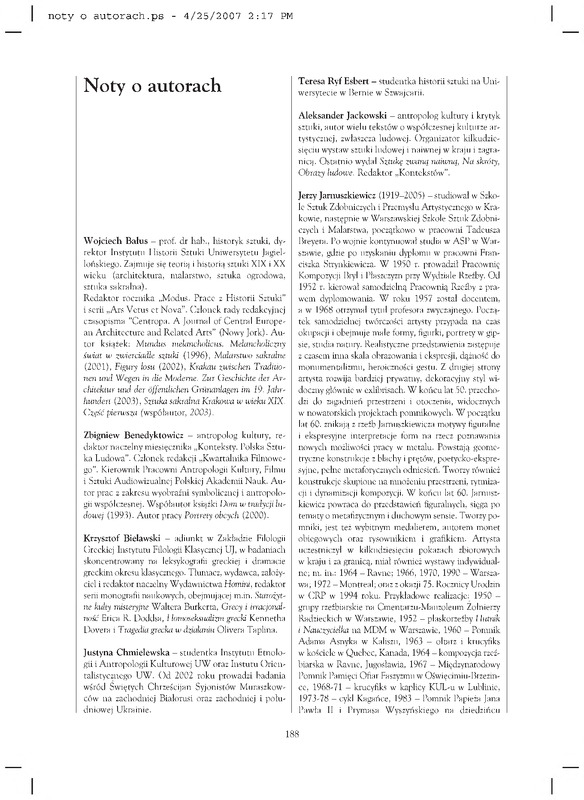
Noty o autorach
Teresa Ryf Esbert - studentka historii sztuki na Uni
wersytecie w Bernie w Szwajcarii.
Aleksander Jackowski - antropolog kultury i krytyk
sztuki, autor wielu tekstów o współczesnej kulturze ar
tystycznej, zwłaszcza ludowej. Organizator kilkudzie
sięciu wystaw sztuki ludowej i naiwnej w kraju i zagra
nicą. Ostatnio wydał Sztukę zwaną naiwną, N a skróty,
Obrazy ludowe. Redaktor „Kontekstów”.
Jerzy Jarnuszkiewicz (1919-2005) - studiował w Szko
Wojciech Bałus - prof. dr hab., historyk sztuki, dy
rektor Instytutu Historii Sztuki Uniwersytetu Jagiel
lońskiego. Zajmuje się teorią i historią sztuki XIX i XX
wieku (architektura, malarstwo, sztuka ogrodowa,
sztuka sakralna).
Redaktor rocznika „Modus. Prace z Historii Sztuki”
i serii „Ars Vetus et Nova”. Członek rady redakcyjnej
czasopisma ”Centropa. A Journal of Central Europe
an Architecture and Related Arts” (Nowy Jork). A u
tor książek: Mundus melancholicus. Melancholiczny
świat w zwierciadle sztuki (1996), Malarstwo sakralne
(2001), Figury losu (2002), Krakau zwischen Traditio
nen und Wegen in die Moderne. Zur Geschichte der A r
chitektur und der öffentlichen Grünanlagen im 19. Jahr
hundert (2003), Sztuka sakralna Krakowa w wieku XIX.
Część pierwsza (współautor, 2003).
Zbigniew Benedyktowicz - antropolog kultury, re
daktor naczelny miesięcznika „Konteksty. Polska Sztu
ka Ludowa”. Członek redakcji „Kwartalnika Filmowe
go”. Kierownik Pracowni Antropologii Kultury, Filmu
i Sztuki Audiowizualnej Polskiej Akademii Nauk. A u
tor prac z zakresu wyobraźni symbolicznej i antropolo
gii współczesnej. Współautor książki Dom w tradycji lu
dowej (1993). Autor pracy Portrety obcych (2000).
Krzysztof Bielawski - adiunkt w Zakładzie Filologii
Greckiej Instytutu Filologii Klasycznej UJ, w badaniach
skoncentrowany na leksykografii greckiej i dramacie
greckim okresu klasycznego. Tłumacz, wydawca, założy
ciel i redaktor naczelny Wydawnictwa Homini, redaktor
serii monografii naukowych, obejmującej m.in. Starożyt
ne kulty misteryjne Waltera Burkerta, Grecy i irracjonalność Erica R. Doddsa, Homoseksualizm grecki Kennetha
Dovera i Tragedia grecka w działaniu Olivera Taplina.
Justyna Chmielewska - studentka Instytutu Etnolo
gii i Antropologii Kulturowej UW oraz Instutu Orientalistycznego UW. Od 2002 roku prowadzi badania
wśród Świętych Chrześcijan Syjonistów Muraszkowców na zachodniej Białorusi oraz zachodniej i połu
dniowej Ukrainie.
le Sztuk Zdobniczych i Przemysłu Artystycznego w Kra
kowie, następnie w Warszawskiej Szkole Sztuk Zdobni
czych i Malarstwa, początkowo w pracowni Tadeusza
Breyera. Po wojnie kontynuował studia w ASP w War
szawie, gdzie po uzyskaniu dyplomu w pracowni Fran
ciszka Strynkiewicza. W 1950 r. prowadził Pracownię
Kompozycji Brył i Płaszczyzn przy Wydziale Rzeźby. Od
1952 r. kierował samodzielną Pracownią Rzeźby z pra
wem dyplomowania. W roku 1957 został docentem,
a w 1968 otrzymał tytuł profesora zwyczajnego. Począ
tek samodzielnej twórczości artysty przypada na czas
okupacji i obejmuje małe formy, figurki, portrety w gip
sie, studia natury. Realistyczne przedstawienia zastępuje
z czasem inna skala obrazowania i ekspresji, dążność do
monumentalizmu, heroiczności gestu. Z drugiej strony
artysta rozwija bardziej prywatny, dekoracyjny styl wi
doczny głównie w exlibrisach. W końcu lat 50. przecho
dzi do zagadnień przestrzeni i otoczenia, widocznych
w nowatorskich projektach pomnikowych. W początku
lat 60. znikają z rzeźb Jarnuszkiewicza motywy figuralne
i ekspresyjne interpretacje form na rzecz poznawania
nowych możliwości pracy w metalu. Powstają geome
tryczne konstrukcje z blachy i prętów, poetycko-ekspresyjne, pełne metaforycznych odniesień. Tworzy również
konstrukcje skupione na mnożeniu przestrzeni, rytmizacji i dynamizacji kompozycji. W końcu lat 60. Jarnusz
kiewicz powraca do przedstawień figuralnych, sięga po
tematy o metafizycznym i duchowym sensie. Tworzy po
mniki, jest też wybitnym medalierem, autorem monet
obiegowych oraz rysownikiem i grafikiem. Artysta
uczestniczył w kilkudziesięciu pokazach zbiorowych
w kraju i za granicą, miał również wystawy indywidual
ne; m. in.: 1964 - Ravne; 1966, 1970, 1990 - Warsza
wa; 1972 - Montreal; oraz z okazji 75. Rocznicy Urodzin
w CRP w 1994 roku. Przykładowe realizacje: 1950 grupy rzeźbiarskie na Cmentarzu-Mauzoleum Żołnierzy
Radzieckich w Warszawie, 1952 - płaskorzeźby Hutnik
i Nauczycielka na MDM w Warszawie, 1960 - Pomnik
Adama Asnyka w Kaliszu, 1963 - ołtarz i krucyfiks
w kościele w Quebec, Kanada, 1964 - kompozycja rzeź
biarska w Ravne, Jugosławia, 1967 - Międzynarodowy
Pomnik Pamięci Ofiar Faszyzmu w Oświęcimiu-Brzezince, 1968-71 - krucyfiks w kaplicy KUL-u w Lublinie,
1973-78 - cykl Kagańce, 1983 - Pomnik Papieża Jana
Pawła II i Prymasa Wyszyńskiego na dziedzińcu
188
noty o autorach.ps - 4/25/2007 2:17 PM
NOTY O AUTORACH
KUL-u w Lublinie, 1983 - Pomnik Małego Powstańca
w Warszawie, 1983 - cykl Stacje Męki Pańskiej.
Tadeusz Kantor (1915-90) - reżyser, twórca happenin
gów, malarz, scenograf, pisarz, teoretyk sztuki, aktor we
własnych przedstawieniach, wykładowca krakowskiej
ASP. Czerpał inspiracje z konstruktywizmu i dadaizmu,
malarstwa informel i surrealizmu. Kształcił się w Akade
mii Sztuk Pięknych w Krakowie pod okiem wybitnego
scenografa międzywojnia Karola Frycza. W roku 1955
grupa plastyków, krytyków i teoretyków sztuki pod jego
kierownictwem założyła teatr CRICOT 2. Pierwszą pre
mierą CRICOT 2 była Mątwa wg Witkiewicza (1956),
W drugim przedstawieniu Cyrk, odnaleźć można było
kolejny rozpoznawalny element ówczesnych widowisk
Kantora - ambalaż. Ambalaż miał pozbawiać aktorów
i przedmioty właściwego im kształtu, czynić z nich niezróżnicowaną materię. Kolejnym krokiem od ambalażu
było przejście do „teatru informel” (1960-62) - teatru au
tomatycznego, poddającego się przypadkowi, ruchowi
materii. Aktorzy w przedstawieniu „teatru informel” W małym Dworku wg Witkiewicza (1961) - byli trakto
wani na równi z przedmiotami, zostali całkowicie pozba
wieni indywidualności. Ideę „teatru informel” zastąpiła
koncepcja „teatru zerowego” (1962-64), pozbawionego
akcji dziania się. Jej najpełniejszym wyrazem był spektakl
Wariat i Zakonnica także wg Witkiewicza, wystawiony
przez Kantora w 1963 roku. Następnie ewolucja prakty
ki i estetyki akcji scenicznych doprowadziła Kantora do
granicy teatru pojmowanego tradycyjnie. W roku 1965
powstają pierwsze polskie happeningi - Cricotage i Linia
Podziału. Dwa lata później słynne: List oraz Panoramiczny
Happening Morski. Rozczarowanie happeningiem przy
wiodło Kantora na powrót do teatru. W 1972 roku po
wstają Nadobnisie i Koczkodany wg Witkiewicza, w któ
rych elementy happeningu zostały wchłonięte przez
widowisko. Trzy lata później spektaklem Umarła Klasa
rozwinął Kantor kolejny nurt w swym teatrze opatrzony
przez autora mianem „teatru śmierci”. Właśnie do tego
nurtu przypisywane są najwybitniejsze i najbardziej znane
spektakle artysty: Wielopole, Wielopole (1980), Niech sczezną artyści (1985), Nigdy już tu nie powrócę (1988) oraz
wystawione pośmiertnie Dziś są moje urodziny (1991),
których motywem głównym jest śmierć, przemijanie i pa
mięć oraz utrwalona w niej historia. W widowiskach „te
atru śmierci” uwypukla się obecna w całej twórczości
Kantora koncepcja „Realności Najniższej Rangi”.
Agnieszka Karpowicz - asystentka w Instytucie Kul
tury Polskiej na Wydziale Polonistyki Uniwersytetu
Warszawskiego. Zajmuje się awangardową i neoawangardową kulturą artystyczną XX wieku oraz antropo
logią słowa. Prezentowany tekst jest fragmentem roz
prawy doktorskiej Kolaż. Awangardowy gest kreacji.
Themerson. Buczkowski. Białoszewski. Książka ukaże
się w 2007 roku.
Ważniejsze publikacje: Słowo kolażu („Przegląd Huma
nistyczny” 2005, nr 1), Ready-made. Przedmiot w pro
zach Mirona Białoszewskiego, („Pamiętnik Literacki”
2006, z. 1).
Jacek Leociak - adiunkt w Instytucie Badań Literac
kich PAN, kierownik Zakładu Badań Nad Literaturą
Holocaustu IBL PAN. Opublikował: Tekst wobec Za
głady. O relacjach z getta warszawskiego (1997, przekład
angielski 2004) oraz (wspólnie z Barbarą Engelking)
Getto warszawskie, Przewodnik po nieistniejącym mieście
(2001, przekład angielski ukaże się w 2006 w Yale
University Press). Artykuły, szkice, recenzje publiko
wał w „Pamiętniku Literackim”, „Tekstach Drugich”,
„Tygodniku Powszechnym”, „Nowych Książkach”,
„Res Publice” i „Res Publice Nowej”, „Midraszu”,
„Gazecie Wyborczej” , „Rzeczpospolitej” oraz w książ
kach zbiorowych. Zajmuje się literaturą dokumentu
osobistego i formami zapisu doświadczeń granicznych
(w tym doświadczenia Zagłady).
Aleksandra Melbechowska-Luty - historyk sztuki,
studia na UW, doktorat z nauk humanistycznych (UW
1966). Specjalizacja: historyk sztuki polskiej XIX/XX w.
Adiunkt w Instytucie Sztuki PAN (gdzie pracowała
w latach 1955-85), Pracownia Słownika Artystów Pol
skich. Autorka 8 książek, m.in. Teofil Kwiatkowski (mo
nografia), Ossolineum, Wrocław 1966; Widmo. Zycie
i twórczość Ludwika De Laveaux, Wrocław 1988; Posągi
i ludzie. Antologia tekstów o rzeźbie polskiej XIX w., IS
PAN, Warszawa 1993 (wspólnie z Piotrem Szubertem);
Mali mistrzowie polskiego pejzażu XIX w., Neriton, War
szawa 1997; Nokturny. Widoki nocy w malarstwie pol
skim, Arkady, Warszawa 1999 Sztukmistrz. Twórczość
artystyczna i myśli o sztuce Cypriana Norwida, 2001;
Posągi i ludzie. Rzeźba polska dwudziestolecia między
wojennego 1918-1939, 2005.
Marek Nowakowski - pisarz, debiutował w 1957 r. opo
wiadaniem Kwadratowy na łamach „Nowej Kultury”,
które opisywało świat marginesu społecznego. W kolej
nych tomach (powieść Trampolina, 1964; zbiory opowia
dań Silna Gorączka, 1963; Zapis, 1965; Gonitwa, 1967;
Mizerykordia, 1971; Układ Zamknięty, 1972; Śmierć żół
wia, 1973) pisarz poszerzał krąg peryferyjności. Następnie
wydał Wesele raz jeszcze (1974), Robaki (1968); Książę no
cy (1972); Chłopiec z gołębiem na głowie (1979), Raport
o stanie wojennym (1982-1984), Notatki z codzienności
(1983), Dwa dni z aniołem (1984), Wilki podchodzą ze
wszystkich stron (1985), Grisz, Ja tiebia skażu (1986). Ra
port o stanie wojennym zapewnił mu europejski rozgłos.
Rozważania autotematyczne pojawiły się w tomach Por
tret artysty z czasów dojrzałości, (1987), Karnawał i post
(1989) oraz w opowiadaniu Bożydar z tomu Grecki bożek
(1993). Po 1989 roku wydał m.in. Homo Polonicus
(1992), Grecki bożek (1993 Strzały w motelu George
189
noty o autorach.ps - 4/25/2007 2:17 PM
SUMMARIES
(1997), a także zbiory opowiadań, będących rodzajem
nostalgicznego powrotu do Warszawy tuż-powojennej
i jej barwnego półświatka (Powidoki, 1995, 1997).
Dorota Piekarczyk - językoznawca, adiunkt w Zakła
dzie Językoznawstwa Ogólnego UM CS w Lublinie.
Autorka prac z zakresu językowego obrazu świata,
m.in. książki Kwiaty we współczesnym językowym obra
zie świata (Lublin 2006).
Joanna Pietruszka - absolwentka Instytutu Etnologii
i Antropologii Kulturowej Uniwersytetu Warszaw
skiego. Interesuje się życiem codziennym w krajach
postsocjalistycznych.
Czesław Robotycki - etnograf, antropolog kultury,
prof. dr hab., dyrektor Instytutu Etnologii i Antropolo
gii Kulturowej UJ. Autor książek: Tradycja i obyczaj
w środowisku wiejskim, Environment and Pollution (ra
zem z M. Ekstromer), Etnografia wobec kultury współ
czesnej, Nie wszystko jest oczywiste oraz 140 artykułów.
Redaktor wydawnictw UJ: „Prace Etnograficzne”, serii
„Anthropos”, Przewodniczący Rady programowej serii
„Cultura”. Zajmuje się analizą różnych form polskiej
kultury współczesnej i Europy środkowej (świadomość
narodowa i etniczna, twórczość amatorska i inne formy
ekspresji kulturowej, etos, obyczajowość itp.).
(1930—39), Polacy na Biennale Sztuki w Wenecji 1895—99
oraz Poza kanonem. Sztuka polskich artystek 1880—39. Pu
blikowała m.in. w „Biuletynie Historii Sztuki”, „Twór
czości”, „Kresach”, „Znaku”, „Architekturze”.
Paweł Stangret - absolwent filologii polskiej Uniwer
sytetu Kardynała Stefana Wyszyńskiego w Warszawie.
Doktorant Instytutu Badań Literackich PAN. Publi
kował m.in. w „Didaskaliach”, „Tekstach Drugich”,
„Teatrze”, „Dialogu”. Zajmuje się twórczością literac
ką Tadeusza Kantora, interesuje go także pogranicze
sztuk plastycznych i literatury. W IBL PAN przygoto
wuje rozprawę doktorską na temat Lekcji mediolańskich
Tadeusza Kantora pod kierunkiem prof. Marii Prussak. Obecnie na UKSW prowadzi konwersatorium Co
to jest teatr? Jest stypendystą Polskiej Akademii Nauk.
Bernd Stieghorst - kolekcjoner, pracował jako kura
tor w muzeum rzeźby w Zurichu. Żyje i pracuje w Zurichu i Monachium.
Joanna Szadura - językoznawca, adiunkt w Zakładzie
Tekstologii i Gramatyki WspółczesnegoJęzyka Polskie
go IFP UM CS w Lublinie. Swoje zainteresowania do
tyczące problemów językowego obrazu świata i stereo
typów językowych rozwija, uczestnicząc w pracach nad
wydawanym w Lublinie Słownikiem stereotypów i symbo
li ludowych. Członek Komisji Etnolingwistycznej Komi
tetu Językoznawstwa Polskiej Akademii Nauk.
Artur Rumpel - absolwent Śląskiej Akademii Me
dycznej (farmacja) i Uniwersytetu Śląskiego (etnolo
gia). Bada religijność ludową i symboliczne aspekty
folkloru. Publikował w „Gadkach z Chatki”, „Panacei”
i „Uniwersytecie Kulturalnym”. Mieszka w Rybniku.
Wiesław Szpilka - etnolog (studia UJ), studia dokto
Joanna Sosnowska - dr hab. historyk sztuki, docent
Bartłomiej Walczak - socjolog, antropolog kultury
w Instytucie Sztuki PAN w Warszawie. Ukończyła stu
dia na Uniwersytecie Warszawskim, doktoryzowała się
w Instytucie Sztuki PAN, tam też uzyskała habilitację
w 2004 roku. Wykłada na Akademii Sztuk Pięknych
w Warszawie. Zajmuje się polską sztuką XIX i XX wieku.
Wydała Materiały do dziejów Instytutu Propagandy Sztuki
w Wyższej Szkole Pedagogiki Resocjalizacyjnej Peda
gogium w Warszawie. Zainteresowania badawcze: epi
stemologia i metodologia nauk społecznych, metodo
logia badań on-line, teoria i historia antropologii
amerykańskiej, analiza i filozofia tekstu, narratologia
i teorie dyskursu, yanomamologia.
Summaries
eidetic (phenomenological) ethnography, outlined in
his previous texts. The experiences registered by Stoller are analysed with the assistance of the conception
of triple mimesis (Paul Ricoeur) and instruments ap
plied for text analysis. Regardless of the dramaturgy of
the experience itself, the case of Paul Stoller is an
excellent contribution to reflections on the boundary
of cognition in anthropology, and the translatability of
perspectives between distinct varieties of Lebenswalt.
The dramatic history of the author of Money Has No
Smell demonstrates that an attempt at a total opening
up towards local cognitive categories, the detextualisation of culture, and the assumption of ”the skin” of the
Bartłomiej Walczak Paul Stollers Project of Eidetic
Ethnography
A presentation of the controversial In Sorcery’s Shadow
by Paul Stoller and Cheryl Olkes - a record of Stoller’s experiences with the Songhay in Niger. The au
thor of this review formulated the thesis that Stoller’s mimetic involvement in sorcery and the resultant
strong emotive (and psychosomatic) reaction are the
consequence of an attempt at realising a programme of
ranckie Instytut Sztuki PAN, pisze pracę doktorską
poświęconą etnologicznej interpretacji kultury maso
wej. Mieszka w Kościelisku.
190
noty o autorach.ps - 4/25/2007 2:17 PM
SUMMARIES
Other may end in a significant deprecation of research
objectives and a mimetic merge of two identities.
The text is partly based on chapter V of the Ph. D.
dissertation Podmiot a przedmiot poznania nauk społecz
nych na przykładzie antropologii kulturowej. Analiza wy
branych struktur narracyjnych w pisarstwie antropolo
gicznym (The Subject and the Object of Cognition in
the Social Sciences upon the Example of Cultural
Anthropology. An Analysis of Selected Narration
Structures in Anthropological Writings), presented in
2006 in the Institute of Applied Social Sciences at
Warsaw University.
Agnieszka Karpowicz The Collage Experiment. The
Leopold Buczkowski Archive
The "ephemera of memory” comprise a category con
stitutive for the works of Leopold Buczkowski. Punctualistic, aleatoric non-fiction constructions create
museum space in which the author tries to revive
"Rusin words-sounds”, i. e. the living, dialogical and
multicultural vernacular of pre-war Podolia. His sto
ries, however, progress more in time than in space by
creating simultaneously overlapping strata of myriad
versions of events, myths, and imagery, enrooted in
collective imagination. The homophonic quality of
the ephemera corresponds to the fleeting nature of
human memory.
With attempts at capturing living speech and music
as his point of departure, Buczkowski arrived at decontextualised records or even written down conver
sation when, for instance, he creates narration com
posed of quotations from Polish-French phrase-books.
Only decontextualisation, characteristic for the writ
ten word, is regarded by the author as a tool suitable
for building a memory museum; he thus endeavours
to create an archive of forms no longer existent after
the Second World War, in this way salvaging a dying
world and chronotypes doomed to oblivion.
By setting up an archive of past forms of culture and
art Buczkowski also conducts an in-depth analysis of
modern culture based on the bourgeois ethos and wri
tings which he holds responsible for the catastrophe
of the Second World War.
In the ”museum of memory” writing has assumed the
shape of archaeology, i. e. the extraction of the relics
and forms of a vanishing world from oblivion. This is the
reason why narration brings to mind a collection. It re
mains specific because its medium is the printed word.
Just as in collections of objects, it constitutes an attempt
at reaching, via material (here: the letter, the visible sign
of writing), that which is invisible and impalpable forms of a world which perished in World War II.
The instruments applied by the author are close to the
techniques of twentieth-century art which also frequ
ently turns into archaeology by gathering actual objects
and the debris of contemporary civilisation. Prose by
Buczkowski resembles a visual art collage, an assembla
ge executed with the help of the recycling technique.
Jacek Leociak Contemporary Antigone
One the determinant of humanity mentioned by
Giambatisto Vico is burial of the dead. The author of
this study does not deliberate on burial conceived as
attempts at taming dread of the deceased or an act
stemming from fear of the impurity of the corpse. He
is interested in testimonies describing situations in
which the human corpse is defiled and the burial ritu
al - violated, as well as in attempts at restoring the
thus undermined order of things. Subsequently, he
ponders on the nature of interment in extreme situ
ations (such as the world wars or the Holocaust) and
the cultural meanings borne by the act of defiling the
corpse and desacralising the burial ground. The artic
le starts with recalling classical tradition (Homer, So
phocles, Virgil, and the Bible) and goes on to study re
cords from the Warsaw ghetto (primarily those by
Rachela Auerbach). In doing so the author focuses on
burial comprehended as the obligation of the living
towards those who were not allowed to survive. In
this context, efforts to fulfil the burial ritual should be
understood as a final protection of the foundations of
humanity at the time of Shoah.
Paweł Stangret A Concise History of the Avantgarde in
Tadeusz Kantor’s Lekcje mediolańskie
The article considers the presence of the avantgarde
in the oeuvre of Tadeusz Kantor, and tries to capture
the artist’s conceptions relating to contemporary art.
The helpfulness of Lekcje mediolańskie (The Milan
Lessons) lies in the fact that this publication is situ
ated on a margin of Kantor’s theoretical reflections
and artistic undertakings. The text shows how abs
traction, Constructivism and Surrealism affected the
work of the author of Umarła klasa (Dead Class).
Lekcje mediolańskie also indicates the reasons why
Kantor referred to precisely those three trends, sum
ming up their role and significance in twentieth-cen
tury art. Kantor returned to the bases of modern art
in order to define his whole oeuvre and contempora
neity as such vis a vis the listed currents.
Aleksandra Melbechowska-Luty, Elegy and Drama.
191
The Niches, Passages and Thresholds of Jacek Sempoliński.
In March 2006 the Studio Gallery in Warsaw held an
exhibition of paintings and drawings by Jack Sempo
liński, testifying to the considerable extent in which
his oeuvre is connected with the ingenium of Kazi
mierz on the Vistula, an exceptionally picturesque
noty o autorach.ps - 4/25/2007 2:17 PM
SUMMARIES
small town whose symbolic, myth and legend have
successively grown in the course of past centuries.
Sempoliński used to come here already as a child, and
from 1979 he spends his summer vacations in an old
thatched-roof cottage in nearby Męćmierz. The show
featured numerous "Kazimierz” works (executed in
mixed techniques) in which objects and motifs chan
ge into sui generis phenomena of spiritual art, functio
ning on a lower level and living a life of their own.
The works in question include a Baroque statue of St.
John from the parish church, transposed by the artist,
The Crucified from the church of St. Anne, dramatic
Heads of the dying Christ, simple crosses without the
figure of Jesus, executed in pencil, water paint or pa
stel, the local quarry with outlines of blocks of stone,
the shadow of a cross or a skull, as well as views of the
castle in Janowiec, a metaphor of the author’s recol
lections and youthful experiences.
Aleksander Jackowski Jerzy Jarnuszkiewicz
In this fragment of a book currently in print, Aleksan
der Jackowski reminisces about the outstanding sculp
tor Jerzy Jarnuszkiewicz, recalling the post-war years,
the 1950s and the 1960s in the artist’s oeuvre. This pe
riod certainly differed from the contemporary condi
tions of Polish art ”His era required memory and forced
the artist to tackle the setting of lies and the gag of cen
sorship. Today, young artists are free of such determi
nants and feel no need to commemorate anything. The
world of their imagination is open. They astonish and
even shock, without having to paying any price for do
ing so (...) Could a portrait of an artist, even such an
acclaimed one, be of any interest at a time when all the
components of art are changing, and when it has beco
me outright embarrassing to speak about the categories
of beauty and consider what which is ethical (...)?”
The proposed text is also an attempt at personal me
ditation on memory: ”We live in such rapid times that
unrecorded memory vanishes instantly. Art? Everyday
there appear more painters and sculptors than in the
whole history of mankind. The rushing tide of facts is
simply enormous. Which young intelligent person to
day knows anything about Tadeusz Sieklucki, Tade
usz Brzozowski, Józef Gielniak or Jerzy Panek? About
the great artists?
What are you working on at the moment? - I was
asked by a female journalist from an important daily.
- I’m writing about Jarnuszkiewicz... - And who’s he?
Well, I am writing so that she would know”.
Aleksandra Melbechowska-Luty Tribal Rhapsody.
Private Notes on the Art of Magdalena Abakanowicz
The numerous sculptures by Magdalena Abakanowicz
(and her examples of related arts) include unusual vi
sual concepts, meanings and contents relating to
man’s individual and group experiences. Abakano
wicz is interested in all that is alive: man, animal and
plant, their diverse” bodies”, which she shapes or
commemorates in anthropomorphic or biomorphic
forms by using natural material, e. g. wool, canvas, ju
te, hide, horsehair, and wood but also stone and me
tal. The characteristic features of her works include
monumentalism and a masterly treatment of ”mobile”
textures which link the structures of the surface with
the very core of a given composition. Abakanowicz is
the author of highly unconventional fabrics known as
Abakany; these by no means decorative or utilitarian
objects comprise large-scale soft sculptures organising
space. She finds the thread which ties together the
structure of living organisms to be fascinating mate
rial. The human figures which are, as a rule, incom
plete, maimed, naked, headless, armless, and sexually
undefined (derived from the myth of Androgyne), are
accompanied by Sitting Figures, Backs, Heads, Faces,
Self-portraits and the figures and heads of animals.
Hundreds of figures - swathed in sacking or cast in
bronze - are arranged in rows and crowds against the
backdrop of a panorama of large towns, in parks and
gardens or on the banks of rivers and lakes. These
“collective” compositions carry universal symbolic
messages and speak about ”primary things” extracted
from the depths of time; simultaneously, they are
transposed into contemporary life and evoke a meta
phorical image of the endless ”migration of the pe
oples”. Abakanowicz constantly resorts to the oldest
motifs, such as the form of the circle. She executes ro
und spoke constructions and rolled bearings, and in
Israel arranges large circles composed of limestone in
the Negev Desert. She also embarks upon the cathar
sis motif and depicts perennial War Games involving
wounded human bodies and war machinery - guns
and missiles, resembling toppled trees. Her Sarcophagi
bring to mind coffins and the covers of nuclear reac
tors. Untamed imagination directs her towards archi
tectural-town planning sculpture designed on an im
mense scale. Abakanowicz is the author of visions of
plant-entwined houses-gardens intended for Paris and
the 640-metres high Hand Monument, probably the
loftiest statue in the world, stretched towards the sky
and commemorating the victims of Hiroshima. Her
entire oeuvre refers to the existential and spiritual
condition of homo universalis and all cultures, at the
same time becoming part of the ”correspondence of
the arts” since the compositions resound with the
echoes of musical rhythm or correspond to the visions
of poets (T. S. Eliot) and architects (Hand Monument
evokes the conception launched by Le Corbusier who
half a century earlier executed a sculpture of The
Open Hand raised towards the heavens in the Indian
town of Chandigarh).
192
noty o autorach.ps - 4/25/2007 2:17 PM
SUMMARIES
Joanna Sosnowska An Old Female Artist Paints
Wojciech Bałus Dan Brown, his Macho and the Qu
estion of Truth
Only recently has old age become the object of reflec
tions pursued in assorted domains of science. Indubita
bly, the reason for this phenomenon lies in constantly
expanding longevity. We still do not have at our dispo
sal criteria for determining the precise onset of old age,
and prevailing opinions remain at odds. As a rule, it is
accepted that old age is tantamount to maturity when
spiritual issues predominate over material ones, parti
cularly corporeal. Marcel Proust was an exponent of
a contrary view claiming that the commencement of
old age is marked by a changed attitude towards the
surrounding world, when bodily relations, to use the
expression coined by the writer, become more impor
tant than spiritual ones. This is the moment when con
tact with the object, the landscape and another person
assumes a new significance, and becomes a nourish
ment of sorts, indispensable for life and creativity.
Późna twórczość wielkich artystów (The Late Works of
Great Artists), a book by Mieczysław Wallis published
more than thirty years ago and devoted predominan
tly to aged artists - albeit not exclusively, since the
very term ’’late works” does not have to denote creati
vity dating from an artist’s old age, makes no mention
of female artists as if the very problem did not pertain
to them. From a statistical viewpoint, for centuries
women tended to die earlier than men, but this was
not the essential reason for the omission. The expla
nation should be sought in the category of womanho
od obligatory in our culture. Only a woman capable of
fulfilling maternal functions was regarded as notewor
thy. An old woman who had already completed all
her duties towards the family and society, became
a matron and was accepted only in this guise. Appa
rently, the combined status of a matron and an artist
was excluded. Those two social constructions could
not be mixed, and female artists were refused the ri
ght to have a family; for all practical purposes old fe
male artists did not exist. Nevertheless, there always
remained the sort of a woman who violated the impo
sed rules of conduct, and frequently she was an artist.
Already in her youth Olga Boznańska rejected the de
mands of the patriarchal world and did not accept the
functions deemed fitting for a woman by totally devo
ting herself to art. By refuting all subjugation to co
nventions, in time she drew attention to something
which usually remains invisible, i. e. otherness atta
ined by age itself. As an older woman she fascinated
the visitors who appeared in her rather unkempt stu
dio. Physical relations, understood as contact with ob
jects and people, remained extremely important due
to the very fact that she was a painter, and with age
they grew even more intense. She needed them in the
same manner as the one described by Proust, succum
bing to the tide of life delineated by old age.
In his critical comments about Dan Brown’s bestsel
lers, W. Bałus, an historian of art, omits their widely
commented factographic preposterousness and focu
ses on the measures applied by the novelist in order to
construct the leading protagonist as well as the lat
ter’s conceptions about culture. Robert Langdon, the
hero of Brown’s books, appears to be a scientific ma
cho and an advocate of scientism, whose knowledge
possesses all the traits of total unambiguity akin to ni
neteenth-century visions of culture. Brown is descri
bed as yet another "master of suspicions”, and his bo
ok is regarded as a successive example of postmodern
para-religious nonsense.
Artur Rumpel Pious Inscriptions in the Tworki Deanery
Folk songs are suffused with symbolic, in the past uni
versally understood and today largely forgotten. A l
most every song had not a single meaning but at least
two or even more. A t present it has become impossi
ble to discover all of them although in certain cases
such an objective may be attained. The presented
song Miała Kasia Jasia (Kate and her Johnny) descri
bes the tragic death of a young man on the battlefield
and the complicated love for a poor boy, disclosed by
a sequence of legible symbols which create a logical
whole.
Czesław Robotycki Against Kopaliński and towards
Bartmiński. On a Polish Dictionary of Folk Stereotypes
and Symbols
The title of the article suggests a cautious use of dic
tionaries of catalogue-arranged symbols in all inter
pretations of culture (in Poland the author of the
most popular dictionary of this sort is W. Kopaliński).
C. Robotycki claims that the anthropologist will find
ethno-linguistic dictionaries of greater use. Dictiona
ries of symbols list meanings without indicating their
pragmatic context, while the latter variety locates
symbolic meanings within the context of the vocabu
lary, grammar and pragmatic rules. Such a dictionary
has been written by Jerzy Bartmiński (together with
a team of collaborators). The range of this publication
encompasses folk symbols and linguistic stereotypes,
making it possible to reconstruct the linguistic image
of the world of culture. The author discusses the pre
mises of the presented dictionary and the manner of
their realisation; he also emphasises the importance of
links between ethno-linguistic and anthropological
reflections, indicating the long tradition of ethno-linguistics derived from the philosophy of the language,
anthropology and linguistic studies.
193
noty o autorach.ps - 4/25/2007 2:17 PM
SUMMARIES
Aleksander Jackowski “N a Skróty”. Postscript
towards the maintenance of a continuum and resistan
ce against the gradual loss of impact on one’s fate.
A postscript to the autobiographical N a Skróty
(Shortcuts) by the long-term editor-in-chief of ’’Pol
ska Sztuka Ludowa” and a steady collaborator of the
quarterly ’ Konteksty” ; the book was published seve
ral years ago.
Joanna Pietruszka On Those who Stayed Behind. A Stu
dy on Old Age and the Looming Extinction of the Ukrainian
Countryside
A presentation of old age along the borderline betwe
en contemporary society and a Ukrainian traditional
rural community facing extinction. The portrayed gro
up of people share their place of residence, age, and
experiences of historical events as well as the progres
sing disappearance of village life. Upon the basis of
a local comprehension of the conception of age - wi
thin the context of performed social roles and health,
the author interprets the organisation of life and the
changes transpiring within the community. Observa
tions of daily life, communication and memory of the
deceased serve as a foundation for describing strivings
Justyna Chmielewska An Old Story of New Jerusalem
An attempted reconstruction of the history of the Murashkovtsy Christian Holy Zionists - a religious communi
ty established in the 1930s in present-day Western Bela
rus and Ukraine. The chief protagonists are the prophets
Ivan Murashko and Olga Kirylchuk-Korneychuk who,
according to the Zionists, embodied the Second Coming
of Christ. By basing herself on on-the-spot interviews the
author tried to bring the reader closer to hagiographic
narrations about the miracles and sanctity of the Father
and Mother of Zion, as the founders of the movement
were known, and the history of New Jerusalem - a holy
city built in 1936-39 in Volhynia as a realisation of the
idea of the Kingdom of God on Earth.
We learn about prophets, apostles, holy blood and New
Zion as well as about rejection and strong social stigma
tisation. The post-war history of the group is branded
with persecution, arrests and imposed wanderings from
Volhynia across the Caucasus to Central Asia and fi
nally to the environs of Odessa where more than 350
members of the congregation continue to reside.
From the very onset the Zionists, engaged in imple
menting their utopia, remained on the margin of so
cial and religious life. Ridiculed by some and openly
branded by others, they sought refuge in isolation, fled
the outside world, and closed themselves in enclaves
governed by rules formulated by the prophets. The
presented text is an attempt at bringing the reader
close to the alternative created by the Murashko ad
herents in their New Jerusalem.
Wiesław Szpilka No So Long Ago
In 1981 ”Polska Sztuka Ludowa” published a survey on
Ethnography - ethnology - anthropology of culture. What
are they? What is their objective? The survey was a sui generis generation manifesto issued by researchers connec
ted with the editorial board of ”Polska Sztuka Ludowa”
(today: ’’Konteksty”), who at the time perceived ethno
graphy as a ’ science without boundaries” and one which
”opts for freedom”. This methodological breakthrough
(which coincided with the proclamation of martial law)
became the reason why, according to the author of the
article, Polish ethnography lost its innocence.
The presented text, written in the form of a recollec
tion, challenges oblivion. Józef Czapski wrote that
”personal reminiscences rebel against the reduction of
our past, which has been already pigeonholed by hi
storians and devoured by statistics and figures in the
order of millions to become abstract and almost me
aningless for the next generation”.
Fot. Marta Leśniakowska
194
noty o autorach.ps - 4/25/2007 2:17 PM
Polska Sztuka Ludowa
KONTEKSTY
f CULTURAL ANTHROPOLOGY f ETHNOGRAPHY f ART
2007 rok LXI nr 1 (276). Indeks 369403. ISSN 1230-6142. Cena 15 zł
INSTITUTE OF ART POLISH ACADEMY OF SCIENCES, SOCIETY LIBER PRO ARTE
Contents 1 2007
B artłomiej W alczak Paul Stoller’s Project of Eidetic Ethnography
A gnieszka K arpowicz The Collage Experiment. The Leopold Buczkowski
Archive
J acek L eociak Contemporary Antigone
Paweł S tangret A Concise History of the Avantgarde in Tadeusz
Kantor’s “Lekcje mediolańskie”
A leksandra M elbechow ska -Luty Elegy and Drama. The Niches, Passages and Thresholds
of Jacek Sempoliński
A leksander J ackow ski Jerzy Jarnuszkiewicz
W ojciech B ałus Gothic with no roots
A leksandra M elbechow ska -Luty Tribal Rhapsody. Private Notes on the Art of Magdalena
Abakanowicz
B ernd S tighorst The Crowd and the Individual
T eresa R yf E sbert Magdalena Abakanowicz
J o a n n a S o sn o w ska An Old Female Artist Paints
W ojciech B ałus Dan Brown, his Macho and the Question of Truth
A rtur R umpel Pious Inscriptions in the Tworki Deanery
C zesław R obotycki Against Kopaliński and towards Bartmiński. On a Polish
Dictionary of Folk Stereotypes and Symbols
195
noty o autorach.ps - 4/25/2007 2:17 PM
CONTENTS
J ERZY B artmiŃSKI Polish Dictionary Folk Stereotypes and Symbols
A leksander J ackow ski “N a Skróty”. Postscript
J o a n n a Pietruszka On Those who Stayed Behind. A Study on Old Age and
the Looming Extinction of the Ukrainian
J ustyna C hmielewska An Old Story of New Jerusalem
W iesław S zpilka No So Long Ago
K RZYSZTOF B ielawski A Pterodactyl in a Compote. The answer to Maciej Rychły
196