http://zbiory.cyfrowaetnografia.pl/public/3418.pdf
Media
Part of Summary of articles / Polska Sztuka Ludowa - Konteksty 1993 t.47 z.1
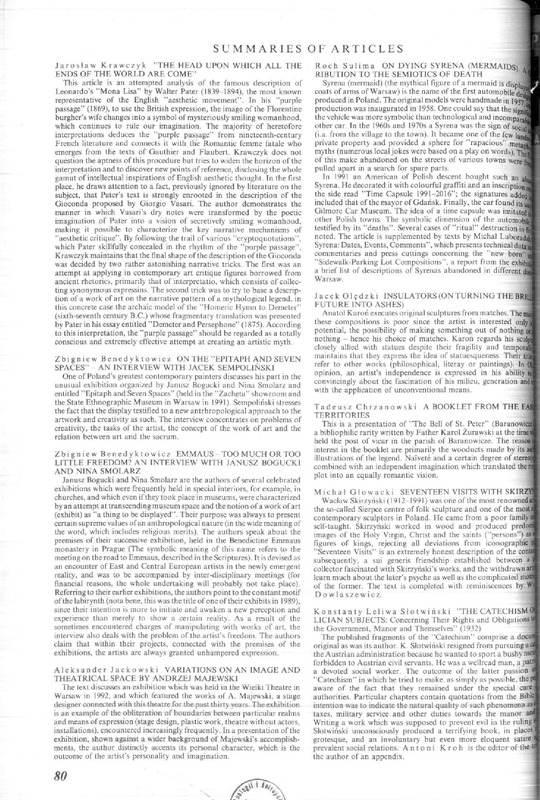
- extracted text
-
S U M M A R I E S OF
J a r o s ł a w K r a w c z y k " T H E H E A D UPON W H I C H A L L T H E
ENDS O F T H E W O R L D A R E C O M E "
This article is an attempted analysts of the famous description of
Leonardo's "Mona Lisa" by Walter Pater (1839 1894), the most known
representative of the English "aesthetic movement". In his "purple
passage" (1869), to use the British expression, the image of the Florentine
burgher's wife changes into a symbol of mysteriously smiling womanhood,
which continues to rule our imagination. The majority of heretofore
interpretations deduces the "purple passage" from nineteenth-century
French literature and connects it with the Romantic femme fatale who
emerges from the texts of Gauthier and Flaubert. Krawczyk does not
question the aptness of this procedure but tries to widen the horizon of the
interpretation and to discover new points of reference, disclosing the whole
gamut of intellectual inspirations of English aesthetic thought. In the firsi
place, he draws attention to a fact, previously ignored by literature on the
subject, that Pater's text is strongly enrooted in the description of the
Gioconda proposed by Giorgio Vasari. The author demonstrates the
manner in which Vasari's dry notes were transformed by the poetic
imagination of Pater into a vision of secretively smiling womanhood,
making it possible to characterize the key narrative mechanisms of
"aesthetic critique". By following the trail of various "cryptoquotations".
which Pater skillfully concealed in the rhythm of the "purple passage",
Krawczyk maintains that the final shape of the description of the Gioconda
was decided by two rather astonishing narrative tricks. The first was an
attempt at applying in contemporary art critique figures borrowed from
ancient rhetorics, primarily that of interprctatio. which consists of collec
ting synonymous expressins. The second trick was to try to base a descrip
tion of a work of art on the narrative pattern of a mythological legend, in
this concrete case the archaic model of the "Homeric Hymn to Demeter"
(sixth-seventh century B.C.) whose fragmentary translation was presented
by Pater in his essay entitled "Demeter and Persephone" (1875). According
to this interpretation, the "purple passage" should be regarded as a totally
conscious and extremely effective attempt at creating an artistic myth.
Z b i g n i e w B e n e d y k t o w i e / ON T H E " E P I T A P H A N D S E V E N
SPACES" A N I N T E R V I E W WITH J A C E K SEMPOLIŃSKI
One of Poland's greatest contemporary painters discusses his part in the
unusual exhibition organized by Janusz Bogucki and Nina Smolarz and
entitled "Epitaph and Seven Spaces" (held in the "Zachęta" showroom and
the State Ethnographic Museum in Warsaw in 1991). Sempoliński stresses
the fact that the display testified to a new anthropological approach to the
artwork and creativity as such. The interview concentrates on problems of
creativity, the tasks of the artist, the concept of the work of art and the
relation between art and the sacrum.
Z b i g n i e w B e n e d y k t o w i c z EMMAUS
TOOMUCHORTOO
L I T T L E F R E E D O M ? A N I N T E R V I E W WITH J A N U S Z B O G U C K I
AND NINA S M O L A R Z
Janusz Bogucki and Nina Smolarz arc the authors of several celebrated
exhibitions which were frequently held in special interiors, for example, in
churches, and which even if they look place in museums, were characterized
by an a ttempt at transcending museum space and the notion of a work of art
(exhibit) as "a thing to be displayed". Their purpose was always to present
certai n supreme values of an anthropological nature (in the wide meaning of
the word, which includes religious merits). The authors speak about the
premises of their successive exhibition, held in the Benedictine Emmaus
monastery in Prague (The symbolic meaning of this name refers to the
meeting on the road to Emmaus, described in the Scriptures). It is devised as
an encounter of East and Central European artists in the newly emergen!
reality, and was to be accompanied by inter-disciplinary meetings (for
financial reasons, the whole undertaking will probably not lake place).
Referring to their earlier exhibitions, the authors point to the constant motif
of the labirynth (nota bene, this was the title of one of their exhibits in 1989),
since their intention is more to initiate and awaken a new perception and
experience than merely to show a certain reality. As a result of the
sometimes encountered charges of manipulating wiih works of art. the
interview also deals with the problem of the artist's freedom. The authors
claim that within their projects, connected with the premises of the
exhibitions, the artists are always granted unhampered expression.
A l e k s a n d e r J a c k o w s k i V A R I A T I O N S ON AN I M A G E A N D
T H E A T R I C A L S P A C E BY A N D R Z E J M A J E W S K I
The text discusses an exhibition which was held in the Wielki Theatre in
Warsaw in 1992, and which featured the works of A. Majewski, a stage
designer connected with this theatre for the past thirty years. The exhibition
is an example of the obliteration of boundaries between particular realms
and means of expression (stage design, plastic work, theatre without actors,
installations), encountered increasingly frequently. In a presentation of the
exhibition, shown against a wider background of Majewski's accomplish
ments, the author distinctly accents its personal character, which is the
outcome of the artist's personality and imagination.
80
ARTICLES
R o c h S u l i m a ON D Y I N G SYR I N A (MERMAIDS) J
RIBUTION T O T H E SEMIOTICS O F DEATH
'
Syrena (mermaid) (the mythical figure of a mermaid is dispfi
coats of arms of Warsaw) is the name of the first automobile i
produced in Poland. The original models were handmade in 19
production was inaugurated in 1958. One could say that the si
the vehicle was more symbolic than technological and incompi
other car. In the 1960s and 1970s a Syrena was the sign of so
(i.a. from the village to the town). It became one of the few \qM
private properlv and provided a sphere for i apacious nietitTjjll
myths (numerous local jokes were based on a play on words). T}%M
of this make abandoned on the streets of various towns were
pulled apart in a search for spare parts.
In 1991 an American of Polish descent bought such an al
Syrena. He decorated it with colourful graffiti and an inscription^™
the side read "Time Capsule 1991-2016"; the signatures addcjiM
included that of the mayor of Gdańsk. Finally, the car found n J »
Gilmore Car Museum. The idea of a time capsule was imitateclH
other Polish towns. The symbolic dimension of the uulomoSfl
testified by its "deaths". Several cases of "ritual" destruction in |".J
noted. The article is supplemented by texts by Michat LuboraddS
Syrena: Dates, Events, Comments", which presents technical dataj
commentaries and press cuttings concerning the "new boitfM
"Sidewalk-Parking Lol Compositions", a report from [he exhibafl
a brief list of descriptions of Syrenas abandoned in dilTereiu csM
\\ arsav.
frSf
s
J a c e k O l ę d z k i I N S U L A T O R S (ON T U R N I N G T H E B R l J
F U T U R E INTO ASHES)
Anatol Karoń executes original sculptures from matches. Them^Ł
these compositions is poor since the artist is interested onlyL
potential, the possibility of making something out of nothings!
nothing
hence his choice of matches. Karoń regards his sculpM
closely allied with statues despite their fragility and tempotST
maintains (hat they express the idea of statuesqueness. Their n p B
refer to other works (philosophical, htcray or paintings). In ( S i
opinion, an artist's independence is expressed in his ability BP
convincingly about the fascination of his milieu, generation Smt
with the application of unconventional means.
T a d e u s z C h r z a n o w s k i A B O O K L E T F R O M T H E EAg
TERRITORIES
This is a presentation of "The Bell of St. Peter" (BaranowicafJ
a bibliophilic rarity written by Father Karol Żurawski at the timcBa
held the post of vicar in (he parish of Baranowicze. The reasotj
interest in the booklet are primarily the wooduets made by its i l l
illustrations or the legend. Naivete and a certain degree of sterMBa
combined with an independent imagination which (ranslaled the^J
plot into an equally romantic vision.
M i c h a ł G ł o w a c k i S E V E N T E E N VISITS WITH S K I R l H
Wacław Sk irzyński (1912-1991) was oneofthe most renow ned aB
the so-called Sierpce centre of folk sculpture and one of the mospfl
contemporary sculptors in Poland. He came from a poor farrnjafl
selT-taught. Skirzyński worked in wood and produced predonłj
images of the Holy Virgin, Christ and the saints ("persons") ( f j
figures of kings, rejecting all deviations from iconographif
"Seventeen Visits" is an extremely honest description of the COSH
subsequently, a sui generis friendship established between <J
collector fascinated with Skirzynski's works, and the withdrawajH
Icam much about the later's psyche as well as the complicated motlB
of the former. The text is completed with reminiscences by \W
Dowlaszewicz.
K o n s t a n t y L e l i w a S l o t w i r i s k i "THE CATEC'HISlajH
LIC1AN SUBJECTS: Concerning Their Rights and Obligation*] 1
the Government. Manor and Themselves" (I932)
The published fragments of the "Catechism" comprise a doctffj
original as was its author. K. Slotwihski resigned from pursuing*
the Austrian administration because he wanted to sport a bushy n*
forbidden to Austrian civil servants. He was a wellread man, a paBjj
a devoted social worker. The outcome of the latter passion
"Catechism" in which he tried to make, as simply as possible. thepJJ
aware of the fact that they remained under the special caflf™
authorities. Particular chapters contain quotations from the BiblM
intention was to indicate the natural quality of such phenomena asfl
taxes, military service and other duties towards the manor aitf]
Writing a work which was supposed to prevent evil in the rutin!
Slotwiriski unconsciously produced a terrifying book, in place^
grotesque, and an involuntary but even more eloquent satin*
prevalent social relations. A n t o n i K r o h is the editor of the^|
the author of an appendix.