http://zbiory.cyfrowaetnografia.pl/public/2775.pdf
Media
Part of Summary of articles; Noty o autorach / Polska Sztuka Ludowa - Konteksty 1995 t.49 z.1
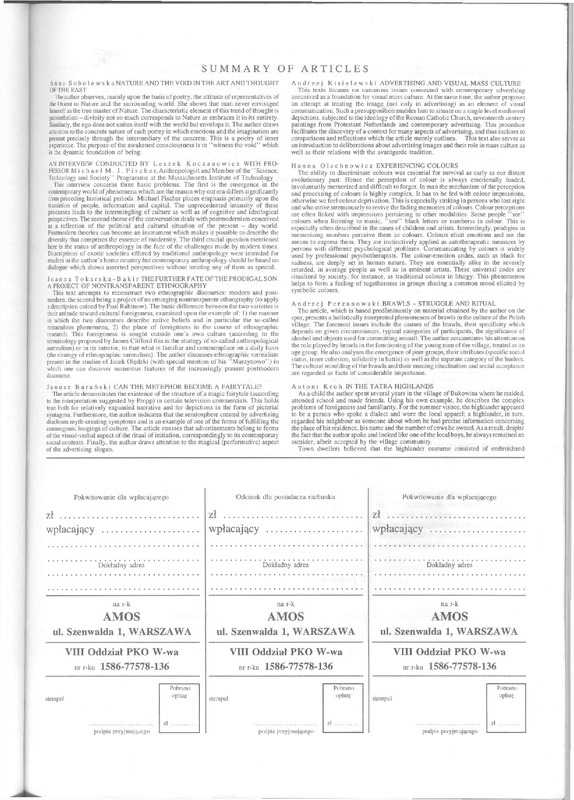
- extracted text
-
S U M M A R Y
O F
A R T I C L E S
Anna S o b o l e w s k a N A T U R E AND T H E VOID IN T H E ART AND THOUGHT
OF THE EAST
The author observes, mainly upon the basis of poetry, the attitude of representatives of
[he Orient to Nature and the surrounding world. She shows that man never envisaged
himself as the true master of Nature. The characteristic element of this trend of thought is
panentheism - divinity not so much corresponds to Nature as embraces it in its entirety.
Similarly, the ego does not unites itself with the world but envelops it. The author draws
attention to the concrete nature of such poetry in which emotions and the imagination are
present precisely through the intermediary of the concrete. This is a poetry of inner
experience. The purpose of the awakened consciousness is to "witness the void" which
is the dynamic foundation of being.
A n d r z e j K i s i e l e w s k i A D V E R T I S I N G AND V I S U A L MASS C U L T U R E
This texts focuses on numerous issues connected with contemporary advertising
conceived as a foundation for visual mass culture. At the same time, the author proposes
an attempt at treating the image (not only in advertising) as an element of visual
communication. Such a presupposition enables him to situate on a single level mediaeval
depictions, subjected to the ideology of the Roman Catholic Church, seventeenth century
paintings from Protestant Netherlands and contemporary advertising. This procedure
facilitates the discovery of a context for many aspects of advertising, and thus inclines to
comparisons and reflections which the article merely outlines. This text also serves as
an introduction to deliberations about advertising images and their role in mass culture as
well as their relations with the avantgarde tradition.
AN INTERVIEW C O N D U C T E D B Y L e s z e k K o c z a n o w i c z WITH PRO
FESSOR M i c h a e l M . J . F i s c h e r , Anthropologist and Member of the "Science,
Technology and Society" Programme at the Massachusetts Institute of Technology
This interview concerns three basic problems. The first is the emergence in the
contemporary world of phenomena which are the reason why our era differs significantly
from preceding historical periods. Michael Fischer places emphasis primarily upon the
transition of people, information and capital. The unprecedented intensity of these
processes leads to the intermingling of culture as well as of cognitive and ideological
perspectives. The second theme of the conversation deals with postmodernism conceived
as a reflection of the political and cultural situation of the present - day world.
Postmodern theories can become an instrument which makes it possible to describe the
diversity that comprises the essence of modernity. The third crucial question mentioned
here is the status of anthropology in the face of the challenges made by modern times.
Descriptions of exotic societies offered by traditional anthropology were intended for
readers in the author's home country but contemporary anthropology should be based on
dialogue which shows assorted perspectives without treating any of them as special.
H a n n a O l e c h n o w i c z EXPERIENCING COLOURS
The ability to discriminate colours was essential for survival as early as our distant
evolutionary past. Hence the perception of colour is always emotionally loaded,
involuntarily memorized and difficult to forget. In man the mechanism of the perception
and processing of colours is highly complex. It has to be fed with colour impressions,
otherwise we feel colour deprivation. This is especially striking in persons who lost sight
and who strive strenuousely to revive the fading memories of colours. Colour perceptions
are often linked with impressions pertaining to other modalities. Some people "see"
colours when listening to music, "see" black letters or numberss in colour. This is
especially often described in the cases of children and artists. Interestingly, prodigies in
memorizing numbers perceive them as colours. Colours elicit emotions and are the
means to express them. They are instinctively applied as autotherapeutic measures by
persons with different psychological problems. Communicating by colours is widely
used by professional psychotherapists. The colour-emotion codes, such as black for
sadness, are deeply set in human nature. They are essentially alike in the severely
retarded, in average people as well as in eminent artists. These universal codes are
ritualized by society, for instance, as traditional colours in liturgy. This phenomenon
helps to form a feeling of togetherness in groups sharing a common mood elicited by
symbolic colours.
J o a n n a T o k a r s k a - B a k i r T H E F U R T H E R F A T E O F T H E PRODIGAL SON.
A PROJECT OF NONTRANSPARENT ETHNOGRAPHY
This text attempts to reconstruct two ethnographic discourses: modern and post
modern, the second being a project of an emerging nontransparent ethnography (to apply
a description coined by Paul Rabinow). The basic difference between the two varieties is
their attitude toward cultural foreignness, examined upon the example of: 1) the manner
in which the two discourses describe native beliefs and in particular the so-called
miraculous phenomena, 2) the place of foreignness in the course of ethnographic
research. This foreignness is sought outside one's own culture (according to the
terminology proposed by James Clifford this is the strategy of so-called anthropological
surrealism) or in its interior, in that what is familiar and commonplace on a daily basis
(the strategy of ethnographic surrealism). The author discusses ethnographic surrealism
present in the studies of Jacek Oledzki (with special mention of his '' Murzynowo'') in
which one can discover numerous features of the increasingly present postmodern
discourse.
J a n u s z B a r a n s k i C A N T H E METEPHOR B E C O M E A F A I R Y T A L E ?
The article demonstrates the existence of the structure of a magic fairytale (according
to the interpretation suggested by Propp) in certain television commercials. This holds
true both for relatively expanded narrative and for depictions in the form of pictorial
syntagma. Furthermore, the author indicates that the semiosphere created by advertising
discloses myth-creating symptoms and is an example of one of the forms of fulfilling the
cosmogonic longings of culture. The article stresses that advertisements belong to forms
of the visual-verbal aspect of the ritual of initiation, correspondingly to its contemporary
social contexts. Finally, the author draws attention to the magical (performative) aspect
of the advertising slogan.
A n d r z e j P e r z a n o w s k i B R A W L S - S T R U G G L E AND R I T U A L
The article, which is based predominantly on material obtained by the author on the
spot, presents a holistically interpreted phenomenon of brawls in the culture of the Polish
village. The foremost issues include the causes of the brawls, their specificity which
depends on given circumstances, typical categories of participants, the significance of
alcohol and objects used for committing assault. The author concentrates his attention on
the role played by brawls in the functioning of the young men of the village, treated as an
age group. He also analyses the emergence of peer groups, their attributes (specific social
status, inner cohesion, solidarity in battle) as well as the separate category of the leaders.
The cultural moulding of the brawls and their ensuing ritualisation and social acceptance
are regarded as facts of considerable importance.
A n t o n i K r o h I N T H E T A T R A HIGHLANDS
As a child the author spent several years in the village of Bukowina where he resided,
attended school and made friends. Using his own example, he describes the complex
problems of foreignness and familiarity. For the summer visitor, the highlander appeared
to be a person who spoke a dialect and wore the local apparel; a highlander, in turn,
regarded his neighbour as someone about whom he had precise information concerning
the place of his residence, his name and the number of cows he owned. As a result, despite
the fact that the author spoke and looked like one of the local boys, he always remained an
outsider, albeit accepted by the village community.
Town dwellers believed that the highlander costume consisted of embroidered
Odcinek dla posiadacza rachunku
Pokwitowanie dla wpłacającego
zł
wpłacający
zł
wpłacający
Pokwitowanie dla wpłacającego
zł
wpłacający
Dokładny adres
Dokładny adres
Dokładny adres
na r-k
na r-k
na r-k
AMOS
AMOS
AMOS
ul. Szenwalda 1, WARSZAWA
ul. Szenwalda 1, WARSZAWA
ul. Szenwalda 1, WARSZAWA
VIII Oddział PKO W-wa
nrr-ku 1586-77578-136
VIII Oddział PKO W-wa
nrr-ku 1586-77578-136
VIII Oddział PKO W-wa
nrr-ku 1586-77578-136
slempel
stempel
stempel
podpis przyjmującego
podpis przyjmującego
podpis przyjmującego
trousers, a cape, a hat adorned with a feather, leather moccasins, a bodice and coral beads.
A highlander from the Bukowina of a hundred years ago would not even recognise the
present-day costume.
The author discusses a number of problems connected with the traditionally
acknowledged elements of highlander culture such as the embroidered trousers, the
leather moccasins or the brigands'dance.
J a c e k O l e d z k i G E S T U R E S O F KINDNESS
Similarly to his previous article: "Gestures of Hope"("Konteksty" no 1,1991), the
author concentrates his attention on the registration and analysis of the nonformalised
behaviour of football players. He examines and interprets the conduct of sportsmen of
various nationalities at such moments during the game as scoring or losing a goal, a fault
etc. He also discusses this specific domain of activity for which culture reserves the usage
of the leg instead of the hand.
W o j c i e c h D o h n a l T H E VISION O F PRIMITIVE S O C I E T Y IN T H E ANTH
ROPOLOGY O F A R. R A D C L I F F E - B R O W N
This article is an attempt at a critical approach to the theory of primeval societies
formualted by A. R. Radcliffe-Brown. Remarks concerning its epistemological dimen
sion are preceded by a brief presentation of the most important features of anthropology
envisaged by its author. The article concludes that the model of the tribe, construed by
Radcliffe-Brown as a functional organic entity is, to a considerable extent, the product of
the theory accepted by its author and not, as it would appear, the outcome of empiric
research. In an analysis of the conclusions proposed by Radcliffe-Brown pertaining to
such key issues as relations of kinship or primeval religion, W. Dohnal has tried to show
that their sources can be discerned in the vision of the world and man outlined by the
author of Structure and Function in Primitive Society; the concepts and models used by
Radcliffe-Brown for ethnocentric explanations ascribed to the subjects under ex
amination his own norms and values.
Noty o autorach
Małgorzata Baranowska - poetka, krytyk i historyk literatury. Autorka książek:
Pamiętnik mistyczny, Surrealna wyobraźnia i poezja, To jest wasze życie,
autorka wielu artykułów o wyobraźni symbolicznej i kulturze masowej m.in.
Pocztówka jako wyraz wyobraźni masowej w: Problemy wiedzy o kulturze.
(Ossolineum 1986), autorka dwu tomów poetyckich Miasto, Zamek w Pirene
jach. Ogłasza w „Twórczości" Prywatną historię poezji.
Janusz Barański - etnograf, filozof, absolwent UJ, doktorant w Instytucie
Etnologii UJ w Krakowie. Zajmuje się problemami antropologii polityki.
Zbigniew Benedyktowicz - antropolog kultury, redaktor „Kontekstów", kierow
nik Pracowni Antropologii Kultury, Filmu i Sztuki Audiowizualnej. Autor prac
o wyobraźni symbolicznej i antropologii współczesnej m.in. książki (z D.
Benedyktowicz) Dom w tradycji ludowej.
Wojciech Dohnal - etnograf, doktorant w Instytucie Etnologii i Antropologii
Kulturowej UAM w Poznaniu. Interesuje się kulturąludów Afryki (udział w trzech
wyprawach etnograficznych do Afryki Zachodniej), teorią i filozofią kultury,
a także antropologicznymi koncepcjami społeczeństw pierwotnych.
Michael M. J . Fischer - antropolog, profesor pracujący w programie „Nauka,
Technologia i Społeczeństwo" przy Massachusetts Institute of Technology.
Autor wielu publikacji z zakresu etnografii i antropologii między innymi: Iran:
From Religious Dispute to Revolution (1980), Cambridge Mass. Harvard
University Press), wraz z Georgem E. Marcusem Anthropology as Cultura
Critique. An Experimental Moment in the Human Sciences (1986, The
University of Chicago Press). Jeden z czołowych przedstawicieli antropologii
postmodernistycznej.
Aleksander Jackowski - antropolog kultury, krytyk sztuki, autor prac z zakres
sztuki ludowej i naiwnej.
Andrzej Kisielewski - historyk sztuki, pracuje w Zakładzie Wychowania Es
tetycznego, Wydział Pedagogiki i Psychologii. Filia Uniwersytetu Warszaws
kiego w Białymstoku. Wkrótce ukaże się jego książka Karny.
Na wszystkich częściach blankietu należy wpi
sać czytelni atramentem, długopisem lub pis
mem maszynowym jednakkowo kwotę cyf
rami, imię i nazwisko wpłacającego, jego ad
res, siedzibę oddziału banku w którym prowa
dzony jest rachunek oraz numer i nazwę tego
rachunku.
Leszek Koczanowicz - filozof zajmujący się głównie pragmatyzmem amerykań
skim. Pracuje w Instytucie Filozofii Uniwersytetu Wrocławskiego. Ostatnio
opublikował pracę: Jednostka - działanie - społeczeństwo. Koncepcje jaźni
w filozofii amerykańskiego pragmatyzmu (1994, Wyd. IFiS PAN)
Antoni Kroh - historyk kultury, etnograf, tłumacz literatury czeskiej i słowackiej.
Autor m.in. książki O Szwejku i o nas. Mieszka w Nowym Sączu.
Krzysztof Kubiak - etnograf, pracuje w Katedrze Etnologii i Antropologii
Kulturowej UW. Prowadzi badania w Beskidach i na Orawie. Zrealizował pięć
filmów dla Telewizji Polskiej i siedem filmów dla Katedry, kolejne filmy są
w realizacji.
Hanna Olechnowicz - psycholog; pracuje w Stołecznej Poradni Psychologicz
no-pedagogicznej. Specjalizuje się w problematyce upośledzenia umysłowego
dzieci. W Instytucie Psychiatrii i Psychologii kieruje projektami badawczymi
w ramach umów polsko-amerykańsklch.
Jacek Olędzki - etnolog na wydziale Geografii i Studiów Regionalnych UW.
Współpracownik naszego pisma od 1959 roku. Od kilkunastu lat łączy
szczególną i systematyczną pracę badawczą w Murzynowie, koło Płocka,
z szerszą refleksją obejmującą inne części Polski oraz znane mu z autopsji
miejsca w Europie, Azji i Afryce.
Andrzej Perzanowski - etnolog (studia UW). Kieruje biblioteką w Katedrze
Etnologii i Antropologii Kulturowej UW.
Anna Sobolewska - historyk i teoretyk literatury. Autorka wielu publikacji,
książek Polska proza psychologiczna 1945-1950 (1979) oraz Mistyka dnia
powszedniego (1992). Pracuje w Instytucie Badań Literackich.
Joanna Tokarska-Bakir - etnolog, adiunkt w Katedrze Etnologii i Antropologii
UW. Interesuje się heremeneutyką, tybetanistyką, ponowoczesnością. Tłuma
czy z francuskiego i angielskiego.
Terence Wright - wykładowca o mediach sztuki i antropologii wizualnej w szkole
filmowej w Bedfordshire.
P R E N U M E R A T A
P R E N U M E R A T A
„ K O N T E K S T Ó W "
„ K O N T E K S T Ó W "
I półrocze
I półrocze
II półrocze
II półrocze
roczna
roczna
i l o ś ć egz.
i l o ś ć egz.
Za skutki wynikłe z mylnego wypełnienia
blankietu ponosi odpowiedzialność
wyłącznie wpłacający.
WARUNKI
PRENUMERATY
1. Wpłaty na prenumeratę prowadzoną przez „Ruch" przyjmowane są na okresy kwartalne.
Cena prenumeraty wynosi 3 zt za numer (kwartał). Prenumerata ze zleceniem dostawy za granicę jest o 100%
droższa,
Wpłaty na prenumeratę przyjmują:
- na teren kraju - jednostki kolportażowe „Ruch"; istnieje również możliwość prenumeraty „pod
opaską". Wpłaty od osób i instytucji z miejscowości, w których nie ma jednostek
kolportażu „Ruch" należy wnosić do Ruch SA Oddz. W-wa, ul. Towarowa 28, konto jak
niżej.
- na zagranicę - Zakład Kolportażu Prasy i Wydawnictw 00-958 Warszawa, konto PBK, XIII Oddział
W-wa 370044-1195-139-11
Dostawa zamówionej prasy następuje:
- przez jednostki kolportażowe „Ruch" - w sposób uzgodniony z zamawiającym,
- przez urzędy pocztowe - pocztą zwykłą na wskazany adres, w ramach opłaconej prenumeraty z wyjątkiem
zlecenia dostawy na zagranicę pocztą lotniczą do odbiorcy zagranicznego, której koszt w pełni pokrywa
prenumerator.
Terminy przyjmowania prenumeraty na kraj i zagranicę - do 20 XI na I kwartał roku następnego, do 20II - na II
kwartał, do 20 V na III kwartał, do 20 VIII na IV kwartał.
2. Prenumeratę „Kontekstów" prowadzi także firma AMOS. Warszawa, ul. Szenwalda 1 (tel. 39 1752). Wpłaty
na okresy półroczne (dwa zeszyty lub jeden podwójny) i roczne przyjmowane są na konto:
AMOS, VIII Oddział PKO Warszawa Nr 1586-77578-136.
Dla ułatwienia zamieszczamy obok wydrukowany blankiet.
3. Cena prenumeraty rocznej przez „Ruch" lub AMOS wynosi 12 zł (dawne 120000 zł). Półroczna: 6 zł, numer
pojedynczy 3 zł.
4. Zeszyty bieżące oraz niektóre dawne można kupować w Instytucie Sztuki PAN, Warszawa ul. Długa 28 (hall)
lub tamże w Dziale Wydawnictw, tel. 31-32-71 w. 258. Sprzedaż także na rachunek, za zaliczeniem
pocztowym lub za gotówkę.
5. Prenumerata zapewnia otrzymanie pisma w cenie wyżej podanej, niezależnie od tego, o ile droższy będzie
w sprzedaży numer.
Wydawnictwo Instytutu Sztuki Polskiej Akademii Nauk publikuje książki i czasopisma z zakresu sztuki,
teatru, filmu, muzyki, folkloru
Stałą sprzedaż książek i czasopismk Wydawnictwa IS PAN, prowadzą następujące księgarnie:
Kraków
Warszawa
- Główna Księgarnia Naukowa im. Bolesława Prusa,
Krakowskie Przedmieście 7
- Księgarnia O R P A N , Pałac Kultury i Nauki
- Księgarnia Fundacji Pomocy Bibliotekom Polskim,
Marszałkowska 74
- Księgarnia Ossolineum, Jaworzyńska 4
- Księgarnia Uniwersytecka „Liber", Krakowskie Przedmie
ście 24
- Księgarnia w Centrum Sztuki Współczesnej, Pałac Książąt
Ujazdowskich
- Księgarnia „Gryf", Foksal 10
- Księgarnia „Reprint", Krakowskie Przedmieście 71
- Księgarnia „ O d e o n " , Hoża 19
- Księgarnia Zamku Warszawskiego, Świętojańska 2
- Antykwariat „Bibliofil", Szpitalna 19
- Księgarnia „Hetmańska", Rynek Główny 17
- Księgarnia O R P A N , Św. Marka 22
Lublin
-
Księgarnia O R P A N , PI. Marii Curie-Skłodowskiej 5
-
Księgarnia Ossolineum, Piotrkowska 181
-
Księgarnia Uniwersytecka, Zwierzyniecka 7
Łódź
Poznali
Wrocław
- Księgarnia Ossolineum, Rynek 6
Białystok
-
Księgarnia „ A k c e n t " , Kościuszki 4
Gdańsk
- Księgarnia Ossolineum, Łagiewniki 56
Ciągła, sprzedaż hurtowa publikacji Wydawnictwa IS P A N prowadzi
Skład Księgarski „ E W A "
ul. R o d z i e w i c z ó w n y 4, 45-951 Opole
lei. 374-28
Numer liczy 11 ark. drukarskich, 19 ark. wydawniczych
Fotoskład: „Iskra",
ul. Niska 18/6, tel. 39-90-83
Druk: mgr inż. Piotr Włodarski,
ul. Ksawerów 21; tel. 43-14-71 w. 240
Nakład 1300 egz.