http://zbiory.cyfrowaetnografia.pl/public/6073.pdf
Media
Part of The Alcmene Myth/ Polska Sztuka Ludowa - Konteksty 2014 Special Issue
- extracted text
-
A
number of complicated intrigues and conte
sts involving the Olympian deities preceded
- as Hesiod, Homer, Apollodoros, Theocritus,
Pindar, Diodorus and John Tzetzes harmoniously wro
te - the birth of Hercules, the out of wedlock son of
Zeus and Alcmene (the wife of Amphitryon), a repre
sentative of the human race. The whole issue was sen
sitive if only due to the ambiguous, at the very least,
situation of Hera, the rightful wife of Zeus, and thus
called for considerable tact. Zeus, on the other hand,
has never been known for excessive subtlety. When
the time of birth was nearing he started to loudly bo
ast of his fatherhood and promised that the prince to
be born in the family of Perseus before twilight would
become a great king. This was exactly what Hera had
been waiting for.
Hera went at once to Mycenae, where she hastened
the pangs of Nicippe, wife of Sthenelus. She then hurried
to Thebes and squatted cross-legged at Alcmene’s door
with her clothing tied into knots and her fingers locked to
gether; by which means she delayed the birth of Heracles
until Eurystheus, son of Sthenelus, a seven-months child,
already lay in his cradle.2
According to others,3 it was Eileithyia, who hindered
the travails on Hera’s behalf, and a faithful handmaiden of
Alcmene’s, a yellow-haired Galanthis, or Galen, who left
the birth chamber to announce untruly that Alcmene had
been delivered. When Eileithyia sprang up in surprise, un
clasping her fingers and uncrossing her knees, Heracles was
born and Galanthis laughed at the successful deception.4
One way or another, the birth of Hercules was suf
ficiently delayed for him to lose primacy for the sake
of Eurystheus, born before nightfall, for whom he was
also later compelled to perform his famous labours.
Magic spells cast by jealous Hera proved effective. Let
us, therefore, subject them to a more through analy
sis.
The cited myth contains two types of operations:
1) the tying of knots and crossing of fingers and legs
LUDWI K S T O M M A
The Alcmene Myth1
in order to prevent (halt) birth; 2) the uncrossing of
fingers and legs to cause (start) birth.
These operations are evidently identical with the
magic tricks applied during childbirth in Polish lands.
By way of example, provoking or accelerating labour
involved stretching hands,5 unfurling fingers,6 open
ing doors,7 windows,8 chests,9 and drawers,10 and even
dispatching messengers to a priest so that he may open
the pyx with the consecrated host11 or - in Russian
Orthodox Church terrains - the imperial gates,12 and
praying to God to open the heavens and hell, even
if for a short while.13 All possible knots are untied,14
holes are made in walls and the roof,15 rings and wed
ding bands are removed from the fingers of the wom
an in labour16 whose hair is unbraided,17 and local
fences are toppled and destroyed.18 The entire dura
tion of childbirth is also the time of a ban on sewing
and spinning.19 If someone were to maliciously wish
to halt labour he would have to perform the reverse
of the above-mentioned operations, and the most fre
quently encountered procedures are those applied by
Hera: the crossing of fingers and legs,20 the knotting of
clothes21 or (as in the case of Polish Jews) the closing
of drawers.22
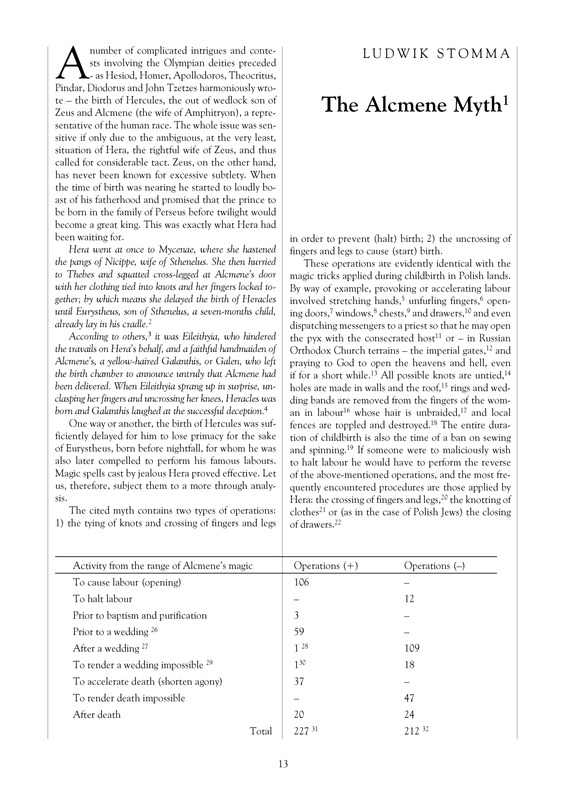
Activity from the range of Alcmene’s magic
Operations (+ )
Operations (-)
To cause labour (opening)
106
-
To halt labour
-
12
Prior to baptism and purification
3
-
Prior to a wedding 26
-
After a wedding 27
59
1 28
To render a wedding impossible 29
130
18
To accelerate death (shorten agony)
37
-
To render death impossible
-
47
After death
20
24
227 31
212 32
Total
13
109
Ludwik Stomma • THE ALCMENE MYTH
The purpose of undertaking particular operations,
which (together with their derivative forms) we shall
call in further parts of this article Alcmene’s magic,23
is sufficiently distinctive to permit an easy, individual
interpretation consisting of associating magical activi
ties with the physiological process of labour.24 The sit
uation grows complicated, however, when we notice
that Alcmene’s magic universally accompanies25 also
other rites of the family cycle; the conventional desig
nation of opening and tying, the prohibition of sewing
and spinning, the making of holes, the taking off of
rings and wedding bands, etc. - operations (+ ), and
the reverse marked as (-) and presented in the table
below as follows:
by negative magic. In an analogy to easily legible birth
practices one would be tempted to say that at the be
ginning family rituals are caused (opened) and at the
end - rendered impossible (closed). We may capture
the meaning of such activities only after accepting
the Van Gennep theory of rites de passage.34 Human
life is composed, according to this interpretation, of a
comprehension of time in folk cultures, a chain of as
sorted states (l’état). In order to alter state x (e.g. that
of a single person) - which takes place through the
intermediary of the ritual - into state y (e.g. marital)
it is first necessary to leave initial state x (connected
with a whole magic-ritual procedure) and then subject
oneself to the complete complex of the ritual period
of transition35 so as to be finally magically enclosed
within new state y. In this situation, Alcmene’s magic,
by referring not to rituals as a separate object but to
people subjected to its operations, would have to aim
at (+ ) opening, causing an exit from the initial state,
and (-) - in the new state of retention. Such an inter
pretation, concurrent with the third condition of the
Lévi-Straus construction of a model, presents all the
observed facts (see: table above).
The Van Gennep theory encompasses not only the
ritual nature of the family, but also the whole cycle.
While accepting the explanation of using Alcmene’s
magic based on the framework of this theory we should
consistently draw attention to the rites of passage of
If we were to eliminate for a while from our re
flections assorted malicious practices (bewitching - as
W. Abraham described them in contrast to ordinary
magic operations) and those intended to counter the
natural order of things concurrent with the ritual cycle
(such as rendering death impossible), we would gain a
consistent chain of sequences:
Alcmene’s magic operations (+ ) birth.
Alcmene’s magic operations (-) ... ( + ), purifica
tion and baptism . (-) ... ( + ) nuptials (-) ... ( + )
death ( + ) i (-).
Each family ritual33 is thus preceded by a positive
aspect of Alcmene’s magic, and the completed ritual -
Holiday (rite de passage)41
Actions ( + )
Actions (-)
St. Dmitriy 11 November42
6
6
St. Lucia 12 December
27
10
Christmas Eve 24 December
28
59
New Year’s Eve (31 December) 1
January
3
9
Our Lady of Candles 2 February
11
-
Shrovetide
14
4
Annunciation to the Holy Virgin
Mary 25 March
4
2
Easter
30
39
St. George 23 April43
8
7
Whitsuntide
4
1
St. Vit 15 June
2
1
Eve of St. Jonh the Baptist 23 June
7
14
Sts. Peter and Paul (Petropavel) 29
June
5
5
Transfiguration of the Lord 5 A u
gust
8
15
St. Michael (?) ca. 24-29 Septem
ber44
3
2
160
174
Total
14
Ludwik Stomma • THE ALCMENE MYTH
the annual cycle36 and the accompanying magic prac
tices (or rather those that comprise the basic core of
folk culture). Here, the magic of Alcmene occurs in
the same forms as in the family cycle37 but in their dif
ferent statistical intensification. In this manner, while
in the family cycle the most frequent were the open
ing and shutting of windows, doors, and drawers, the
crossing of fingers, the making of knots, or the comb
ing of hair or placing a headband, here pride of place
is given to the prohibition or, alternatively, injunction
concerning sewing and spinning,38 the use of chains to
bind tables and other objects, the tying up of scissors,39
and the tying up, and walking around40, of people,
animals, plants, household items or sacral items, the
making or filling of holes, etc. The most distinctive
symptoms of Alcmene’s magic are to be discovered on
the following holidays:
- 26 cases,48 is of special interest to us. W hat sort of a
change occurs in those instances?
In the case of the God-man relations the issue at
stake, while referring to the foundations of Slavonic
folk cosmogony, seems to be fairly uncomplicated.
God and man remain upon different cosmic levels, dis
tinctly separated. Regardless of the copious number of
conceptions and attempts at formulating this distinctness49 we may hazard declaring that it is sufficiently
outlined in folk culture for us to be able to recognise
the distinctness of the state of God (the state in which
God finds Himself) and the earthly state (in which
man finds himself). Since - as has been mentioned the prime condition for any sort of change of the exist
ing state is leaving the initial x it is not surprising that
man’s attempts at coming closer to the divine must be
accompanied by Alcmene’s magic (t ). A reference to
this comprehension and to the relation between people
and demonic creatures encounters, however, consid
erable difficulties. All researchers dealing with Polish
folk demonology50 agree that Slavonic demons do not
comprise (as Lelewel wanted) autonomous creatures,
being mere posthumous embodiments of people of cer
tain, specific categories; naturally, this could suggest
an obliteration of differences between their state z and
state v corresponding to particular phases of the family
cycle.51 This situation would, in turn, exert a negative
impact on the possibility and purposefulness of ap
plying Alcmene’s magic. In order to explain this lack
of clarity it appears to be necessary to establish these
“demon-creating” human categories. Who becomes a
demon after death? Solutions to thus formulated ques
tions are offered in the table52 presented below:
The enumerated detailed categories can be re
stricted with the least risk of logical invalidity to three
more extensive ones: those that broke the principle of
the succession of states (item 1 and 2 in the table),
those that carried out a change of the state with
out fulfilling the rite de passage obligatory (Alcmene’s
magic!) in this situation (item 3, 6-9). those that died
in the state of passage (item 1, 2, 4, 5).
This is by no means the end. The Van Gennep
conception of the “state” (despite the fact that the
author had not steered his reasoning in this direc
tion) cannot be limited only to the sphere of rituals.
All definition-oriented conditions for the “state”45 are
met also by such life situations as illness and, alter
natively, the state of being healthy, the state of good
fortune and natural calamity, etc. They too are ac
companied by typical symptoms of Alcmene’s magic.
Thus we come across the latter (operations + ) among
activities intent on ending an illness - 42 cases, in
creasing the growth of grain - 21 cases, and making it
possible to build a house, a bridge, or a road - 17 cases.
In turn, Alcmene’s magic (-) takes place in preventive
anti-sickness practices (the retention of the state of
being healthy) - 44, malicious magic intent on making
it impossible for the ill to get well (the retention of an
illness) - 26. It (-) is also applied for preserving the
security and prosperity of a home, a family or property
- 82, protection against contacts with demons and
spirits - 54 cases,46 etc. The latter example, proposed
by Alcmene’s magic ( + ) and employed to evoke de
mons - 20 cases47 or establishing contact with God
No.
"Demon-creating” category
1
Dead foetuses
30
2
Miscarried
47
3
Not baptised
79
4
Betrothed, died prior to wedding
12
5
Betrothed, died during wedding
35
6
Suicide victims
33
7
Hanged
29
8
Drowned
82
9
Victims of unnatural and violent death
35
Total
392
no. of cases
15
Ludwik Stomma • THE ALCMENE MYTH
Once again, those three categories can be summed
up in a single, most general one: - those who (in a
biological sense) departed and those who did not (in a
magic-ritual sense) from state x, and those who entered
(in a biological sense) and did not enter (in a mag
ical-ritual sense) state.53 In other words, after death
only those become demons who (regardless whether
unconsciously or not) broke out of the chain of the
succession of states, thus situating themselves outside
its constant links (or, from another point of view, sev
eral links simultaneously), i.e. in a permanent state of
transition. This partly explains the fact to which at
tention should be drawn already at this stage, namely,
that the formulas54 describing the period of temps de
passage and characterising the “demon-creative” state
of people who are supposed to turn into demonic crea
tures are totally identical.
Now, leave this issue for a while and return to the
question of the forms of Alcmene’s magic (compre
hended in a totally descriptive-mechanical manner).
They can be divided into two typical varieties:
A. Connected with opening and closing, and
thus the opening and shutting of doors, windows,
drawers, pyxes with the consecrated host, and impe
rial gates, the destruction of roofs, walls, and fences,
the making and plugging up of holes, etc.
B. Connected with tying up and untying, and
thus: assorted practices involving knots, fragments of
fishing nets, the belting, wrapping or tying of people,
animals, plants and objects, the encircling of a table
with chains and ropes, a forehead - with a wreath, fin
gers - with rings, the placing of a cap, injunctions and
prohibitions concerning sewing, spinning, etc.
This division, totally illegitimate and based on sub
jective and imprecise premises, does not possess any
sort of essential significance and was performed in or
der to make it easier to demonstrate that it is possible
to add to each of the distinguished categories A and
B a number of similar forms of activity pursued at the
same time and place, and thus semantically identical
with the enumerated ones. One of them is the crea
tion of the theme of a relatively copious ethnographic
bibliography,55 i.e. the so-called magic circle.56
According to K. Moszyński: The function of magic
enclosure is fulfilled by a belt, a chain, a magic circle, a
ring, a wreath, etc. [...] When, for instance, an inhabitant
of the Polesie region travelling during the Pentecostal week
across the local forests hears strange sounds announcing
the proximity of water sprites 57 he marks with an axe a
circle around the cart wide enough so that the demon could
not touch him. The women of Polesie walking in a forest
or working on land located in distant woodlands act in
the same way; instead of an axe they mark a circle on
the ground with a knife [...]. I selected particularly vivid
and typical examples; one could cite many less appealing
ones.58
Let us add immediately that Moszyński listed as
analogous to the creation of the magic circle also the
custom of ploughing around villages and fields or their
inclusion within a “metaphorical tangle”.59 The magi
cal circle in the form used by the peasants of Polesie
appears to be, however, the simplest example, and
thus the most useful for initial analysis.
What does the essence of the activity of Alcmene’s
magic in this form consist of? By enclosing (symboli
cally girding) a certain space, the peasant from the
Polesie region stops it at the initial (current) state x.
A t the time of drawing the circle this state of things
prevails on both its sides. A t the stage when the situa
tion on the outside is subject to change (e.g. an attack
launched by demonic creatures), the new, emergent
state could not encompass the magically enclosed
space60 and thus harm the objects within it. Naturally,
an obliteration of the circle or its part would immedi
ately produce a diametrically different effect - such as
the above-mentioned damaged fence or a hole made
in a wall or a roof. In all those cases we are dealing
with identical phenomena not only upon a semantic
level (Alcmene’s magic) but also on an instrumental
one. Just as the magic circle restricts arbitrary space
dependent on the requirements of the person apply
ing magic, so the walls, the threshold, and the roof or
the windows are elements limiting the inner space of
the home (wider: every building). Representatives of
the same category will also consistently include fences
or unploughed strips of land enclosing farmstead, vil
lage borders, cemetery walls, riverbanks, and roads61
as well as crossroads. All divide space and thus in suit
able conditions62 also states, and all may comprise the
subject of Alcmene’s magic. Are they, however, iden
tical? To what category should we ascribe the space
of a yet unploughed strip of land, the village border,
or the threshold? Books by theoreticians of magic,63
folk beliefs,64 and even numerous legal formulae65
concerning borders provide an unambiguous solution.
Borders are extra-territorial, i.e. objects from this par
ticular category belong to both divisible sequences of
transformation (here: states x and y) and, at the same
time, they do not belong to any of them. They can be
described, therefore, only by the following the Hege
lian sentence, incorrect from the viewpoint of formal
logic:
A = (x -i- y) and (- x + - y).
This sentence had already appeared to be indis
pensable upon two other occasions - for defining the
essence (specificity in relation to the “normal” state)
of periods of passage in annual and family cycles, and
for characterising demonic (“demon-creating”) crea
tures. This is a concurrence of essential significance.
If heretofore reasoning is correct and the essence of
the three discussed phenomena situated at levels os
tensibly remaining at a great distance, is identical,
16
Ludwik Stomma • THE ALCMENE MYTH
then they must demonstrate a distinct connection, in
cluding exchangeability and mutual exponentiation.
Take a closer look at the level of binary relations.
Theoretically, there exists the possibility of a relation
of the categories described in: A = = (x + y) i (-*x
+ —y) and arranged in three pairs: a - demonological
(“demon-creating”) creatures: spatial borders (thresh
olds, unploughed strips of land, fences, roads, etc.);
b - demonic (“demon-creating”) creatures: periods of
passage (as in the family, annual, and 24 hour cycle66);
c - spatial borders: periods of passage.
Each of those versions (a, b and c) corresponds to
particular relations in the tables presented below:
Let us start with the fact that each of the lat
ter possesses the ability to attain exponentiation via
an “intensification of features”. In other words, a
drowned non-baptised person will be a more mali
cious (or rather, more powerful) demon Y than an
ordinary victim of drowning or a non-baptised per
son who died of natural causes; the same holds true
for a groom who hanged himself in the course of the
wedding ceremonies, compared to an ordinary vic
tim of suicide by hanging, etc. Similarly, in the case
of spatial borders (Z) there are more demons at the
crossroads than along an ordinary straight road, while
plants growing next a fence have greater medicinal
powers if this spot is the meeting place of two or more
fences, etc. Such qualities become even more vivid
during times (periods) of passage (V). Ferns bloom
only at midnight before the feast day of St. John the
Baptist, while wolfsbane assumes aphrodisiac proper
ties at noon each day but its effectiveness is certain
only at noon on Whitsuntide and (in the case of dried
plants) on the day of St. Lucia. Such examples can
be multiplied, although it must be accentuated right
away that this sort of individual (single-category) ex
ponentiation is relatively rare in Slavonic folk culture.
As can be seen, in all three cases the existence of
correlation gains a distinctive numerical confirmation.
In this fashion, relation a69 achieves in the case of buri
als of “demon-creating” creatures as much as 98,9% of
co-dependence; those data are slightly lower in the case
of relation b (correspondingly: 96,4% and 92.5’%) and
relation c. This would confirm distinctly the legitimacy
of heretofore reasoning without, however, comprising
its ultimate proof, i.e. an ascertainment of the at least
relative identity of the analysed categories.
Relation a
village
borders
unploughed
land
fences
thresholds
roads
banks
others without
features A 67
Place of burial of de
mon-creating creatures
80
19
18
66
62
30
3
Place of appearance of
demonic creatures
65
55
11
21
26
30
7
Place of establishing
contacts with the devil
6
2
7
5
26
7
19
Place of witch sabbaths68
5
4
-
1
10
3
47
Total
156
80
36
93
124
70
76
crea
tures
in the
state of
passage
crea
tures in
not the
state A
Relation b
periods
of pas
sage in
annual
cycle
another
not A 69
in annual
cycle
periods of passages the daily cycle
12
24
east
west
total in the daily
cycle in the periods of passage
Periods of appear
ance of demons
146
7
-
-
59
79
38
33
209
Periods of possible
establishment of
contacts with demons
20
1
26
4
3
13
5
7
28
166
26
62
92
43
40
237
Total
17
Ludwik Stomma • THE ALCMENE MYTH
Relation c (1)
transition peri
ods in annual
cycle
other times
of annual
cycle
transition
periods of
day cycle
other times of
day, night
No
126
4
180
14
%
96,9
3,1
92,7
7,4
Relation c (2)
pregnant
women
young mar
ried people
cortege
with the
dead
others uncon
nected with
transition period
Ban on staying on borders or crossing
them
80
43
33
7
Ritual activities on village borders,
unploughed land, roads, etc.
Nowy Sącz, Przemyśl, Siedlce, Suwałki and Zamość. The
Magic folk prescriptions as a rule combine elements of
collected material also made it possible to ascertain the
all “Alcmene” categories (without, however, limiting
existence of the majority of the forms of Alcmene's
themselves to them).70 The "statistical”71 folk, para
magic kept alive in Poland up to this day.
medical “prescription” advising: “Take a thread from
2 R. Graves, Mity greckie, Warszawa 1974, p. 411.
the noose of a hanged man, add a%, a2, a3, and herb
3 Pausanias, Ovid, Aelian and Antoninus Liberalis.
aĄz picked at the crossing of unploughed strips of land
4 Graves, op. cit., p. 412.
5 W. Łęgowski, Zwyczaje i obyczaje. Stypy pogrzebowe,
at noon on St. George’s day...” is thus based on, i.a. an
obrzędy ślubne, chrzciny i inne zabawy ludowe, głównie pod
interchangeable exponentiation of “Alcmeniana” and
względem na hygiene, “Wędrowiec”, 1899, fasc. 2, p. 487;
ergo can be written down as:
J. Talko-Hryncewicz, Zarysy lecznictwa ludowego na Rusi
f = Yn X Zn X Vn X a J X a2 ... X an
Południowej, Kraków 1893, p. 77.
This formula ultimately confirms the legitimacy of 6 W. Łęgowski, Zwyczaje i obyczaje. Stypy pogrzebowe,
obrzędy ślubne, chrzciny i inne zabawy ludowe, głównie pod
our heretofore reflections (only identical categories
względem na hygienę, “Wędrowiec”, 1899, fasc. 2, p. 487;
can mutually exponentiate), and hence provokes their
J.
Talko-Hryncewicz, Zarysy lecznictwa ludowego na Rusi
temporary completion.
Południowej, Kraków 1893, p. 77.
I
would like to emphasise temporary completion
7 K. Moszyński, Kultura ludowa Słowian, Warszawa 1967,
particularly strongly. The presented sketch is not only
vol. II, part 1, p. 292.
an open entity but without a continuation it outright
8 J. S. Bystroń, Słowiańskie obrzędy rodzinne, Kraków 1916,
p. 20.
loses its raison d’être. (I bypass the explanation of par
9
Moszyński,
op. cit., vol. II, part 1, pp. 292-293; Bystroń,
ticular problems). The process of introducing order
op. cit., p. 20, 27.
into findings neglected or rendered vulgar by the theo
10 Bystroń, op. cit., p. 20, 28.
reticians of magic and Slavonic rites, and the demon 11 Ibid., p. 20.
stration of their close, integral union can become a
12 S. Poniatowski, Obrzędy rodzinne, "Wiedza o Polsce”,
point of departure for more correct studies on a whole
vol. 3, part: Etnografia Polski, Warszawa 1932, p. 328;
Bystroń, op. cit., p. 20; Talko-Hryncewicz, op. cit.,
range of aspects of Polish folk culture. In this respect,
p. 73.
I would be inclined to consider the important message
13 Talko-Hryncewicz, op. cit., p. 76.
of this article to be as follows:
14 J. Swiętek, Lud nadrabski od Gdowa po Bochnię, Kraków
The recognition of the impossibility of a separable ex
1893, p. 599; Bystroń, op. cit., p. 20; Frazer, op. cit., p.
amination of questions linked with the comprehension
216; Moszyński, op. cit., vol. II, part 1, 292.
15 D. Lepkiy, De yaki verovania pro detinu, ”Zorya”, VII:
of space and time in folk culture. Its structures, after all,
1886, p. 269.
develop in three parallel dimensions: temporal, spatial
16 Bystroń, op. cit., p. 20.
and theognostic-cosmic,72 if one can thus describe the
17 Moszyński, op. cit., vol. II, part 1, p. 291.
Earth (man)-heaven (God) axis together with all its
18 N. Z., Z Opatowa, ”Gazeta Radomska”, 1888, no. 57,
cosmosophic aspects. Sidestepping any of those levels
p. 3.
not only impoverishes but, even more, remarkably falsi
19 Bystroń, op. cit., p. 15, 35.
20 L. Marcewicz, O zabobonach i gusłach przy narodzeniu
fies the image of the products of folk spiritual culture,
dziecka, Kraków 1876, p. 29; Frazer, op. cit., p. 217.
turning it into a flat and barren caricature.
21 K. Wójcicki, Klechdy, starożytne podania i powieści ludu
Polski i Rusi, Warszawa 1972, pp. 220-221; Marcewicz,
op. cit., p. 30; A. Fischer, Zwyczaje pogrzebowe ludu pol
skiego, Lwów 1921, p. 112; S. Ciszewski, Żeńska twarz,
Kraków 1927, pp. 20-24.
Endnotes
1 The bibliography used in this text has been verified
rather extensively in the course of research conducted
in the following voivodeships: Białystok, Chełmno,
18
Ludwik Stomma • THE ALCMENE MYTH
22 Marcewicz, op. cit., p. 28.
23 The symbolic name of the phenomenon (and not “the
magic of knots”, e.g. as Witort described certain activi
ties of this sort) is necessary to underline: 1) the fact
that the same range of phenomena will include opera
tions differentiated as regards their form), 2) such forms
can have totally dissimilar meanings in various ritual
contexts, i.e. not every knot is an element of Alcmene's
magic and not always will it be connected with the tying
and untying of knots.
24 An association universal in nineteenth-century ethno
graphic literature. See also: Talko-Hryncewicz, op. cit.,
p. 75.
25 All numerical data pertain to a representative sample of
fifty selected publications. Importance is, therefore,
attached not to the absolute value of the data but to the
proportions between them.
26 A typical example of the prenuptial magic performed by
Alcmene (+ ) is the ceremony of rozpleciny (unbraiding).
See: L. Stomma, Analiza strukturalna słowiańskich obrzę
dów weselnych (typescript at the disposal of the Chair of
Ethnography at Warsaw University), Warszawa 1973,
pp. 7-12.
27 Typical activity - the oczepiny ceremony (covering the
bride's hair with a cap). Stomma, op. cit., pp. 23- 29.
28 In accordance with the recommendations made by LéviStrauss I regard individual cases unconfirmed by compa
risons as deviations and exclude them from my reflec
tions.
29 Here, a classical example is "tying up the potency” of the
groom, encountered all across Poland, in order to render
him unable to consummate the marriage. B. Baranowska,
Zycie codzienne wsi między Wartą a Pilicą w XIX wieku,
Warszawa 1969, p. 100; F r a z e r, op. cit., pp. 217-218;
Talko-Hryncewicz, op. cit., p. 203.
30 See: note 27.
31 Apart from the above-mentioned, other relatively com
mon forms include: untying horses, damaging the thre
shold, taking covers off pots, etc.
32 Additional mention is due to: tying a chain or a rope
around a tree, shutting doors, a metaphorical closing of
the world (?) with a key moved about in the air, etc.
33 I intentionally bypassed the role of the dual nature of
posthumous operations since it is difficult determine
which comprise an element of the burial ceremonial and
which, focused on the future, are supposed to facilitate
the return (rebirth) of the deceased; they are thus rather
connected with birth.
34 A. Van Gennep, Rites de passage, Paris 1909, pp. 14-18,
271-279.
35 The period of transition is situated between two separa
te states, thus linking simultaneously the elements of
both. This process can be described as: A = (x + y) and
(-x -\y). Note: this formula is not a logical sentence.
36 It must be stressed that we regard as rites de passage only
those that separate differentiated time categories. Not
every annual festivity, therefore, is a rite de passage.
37 I have in mind a general tendency, since there exists a
certain small collection of forms of Alcmene's magic
specific for particular ritual cycles.
38 Operations + occur in the case of all the saints in the
table. See, i.a. R. Tomicki, Wierzenia i obrzędy związane
ze śmiercią w tradycji społeczności wiejskich (typescript at
the disposal of the Chair of Ethnography at Warsaw
University), Warszawa 1972, pp. 84-85, 129-130; W.
Kosiński, Materyały etnograficzne zebrane w różnych okoli
cach Galicyi Zachodniej, Kraków 1903, p. 62, 63, 66, 78,
84; W. Klinger, Doroczne święta ludowe a tradycje greckorzymskie, Kraków 1931, p. 77; Baranowski, op. cit., p. 80;
Swiętek, op. cit., p. 558; Bystroń, op. cit., p. 15.
39 This is a splendid example of enhancing magic by clo
sing an object that by the very nature of things possesses
opposite properties. W Szuchiewicz, Huculszczyzna,
Lwów 1904, vol. III, p. 248 and p. 12, 14, 18, 221, 224,
226, 243, 246, 248-250, 268, 294.
40 Moszyński, op. cit., vol. II, part 1, pp. 318-324.
41 It should be stressed that all rites de passage enumerated
in the table possess a distinctive solar nature. They do
not, however, include rites de passage of the economic
cycle.
42 This holiday is celebrated predominantly in regions
inhabited by a Russian Orthodox population.
43 See above.
44 The application of Alcmene's magic is rather clearly
associated with the autumn equinox, while its connec
tion with the feast day of St. Michael is presumably
rather late (nineteenth century?).
45 V a n Gennep, op. cit., pp. 271-279.
46 Świetek, op. cit., pp. 539-540; Tomicki, op. cit., pp.
82-84.
47 K. Koranyi, Czary i gusła przed sądami kościelnymi, “Lud”,
vol. XXVI, fasc. 2, p. 11, 17.
48 I.a. M. El i a d e, Sacrum - mit - historia, Warszawa 1970,
p. 89.
49 F. Gajczyk, Teodulja, Kraków 1900, pp. 112-132.
50 Ł. Gołębiowski, Lud polski, jego zwyczaje i zabobony,
Warszawa 1830, p. 150, 170-171; R. Lilienthalowa, Święta
żydowskie w przeszłości i teraźniejszości, Kraków 1919, p.
26; Baranowski,op. cit., p. 106; Klinger, op. cit., p. 58;
Kosiński, op. cit., p. 11; Moszyński, op. cit., vol. II, part 1,
passim; Tomicki, op. cit., pp. 77-81, 83, 88-90, 100-102.
51 For example, a phase in the family cycle between death
and rebirth.
52 The table takes into account only 91,22% of the general
set (see: note 24) of cases owing to the fact that the
remaining 8,78% are scattered across as many as 17
categories and possess the features of disturbances.
53 In accordance with the previously accepted terminology
we thus write down the phenomenon as: (x + y) and (-x
H
y).
54 A = (x + y) i (-x+ -y).
55 I. a. T Seweryn, Ikonografia etnograficzna, “Lud”, vol.
XXXIX, p. 340; S. Gansiniec,Pas magiczny, Kraków
1934.
56 It occurs not only in folk culture but also in the “profes
sional” magic of yore (F. Ribadeau-Dumas, Histoire de la
magie, Paris 1965, pp. 80-156).
57 For an explanation of the demonic nature of water nym
phs see: Tomicki, op. cit., p. 81.
58 Moszyński, op. cit., vol. II, part 1, p. 319, 322.
59 Ibidem, p. 323.
60 K. Baschwitz, Czarownice, dzieje procesów o czary,
Warszawa 1971, p. 15, 17, 21.
61 Owing to insufficient space I shall not cite proof legiti
mating the addition of the category of paths - this will
be the topic of a separate article.
62 Certain ethnographers, such as Moszyński, accepted
implicitly that due to the differentiated evaluation in folk
culture of particular fragments of space, village borders,
fences, the threshold, etc. always divide the states.
19
Ludwik Stomma • THE ALCMENE MYTH
63 Mentioned by Theophrastus Bombastus aka Paracelsus,
and Johannes Trithemius.
64 Moszyński, op. cit., vol. II, part 1, p. 202, 322; Swiętek,
op. cit., p. 459.
65 T Łętocha, Granice i spory terytorialne wAfryce, Warszawa
1973, pp. 19-26.
66 The passage periods in the 24hr cycle are: midnight (24.
00), noon (12. 00) and the setting and rising of the
Sun.
67 Here, naturally, meaning: under the fence, under the
threshold.
68 Obviously, witches as living creatures do not belong to
the category of demons. < » A = (x + y) and (-x +
-y).
69 I have in mind burials and sites of revelations since the
remaining are mentioned in the table only for the sake
of comparison.
70 “All” means “all enumerated in the article” since there
exist other ranges of the presence of Alcmene's magic.
71 The number of such formulae subjected to analysis
totals 200, with the exception of four cases, i.e. 98%
confirmed the observations presented here.
72 N. Mastret described this dimension simply as cosmic,
which appears to excessively restrict its meaning.
ru-rui
u ._ i,
n ! ,,H
, . H
KONTEKSTY
W I.O IV1M I.
20