http://zbiory.cyfrowaetnografia.pl/public/3921.pdf
Media
Part of Summary of articles / Polska Sztuka Ludowa - Konteksty 1959 t.13 z.3
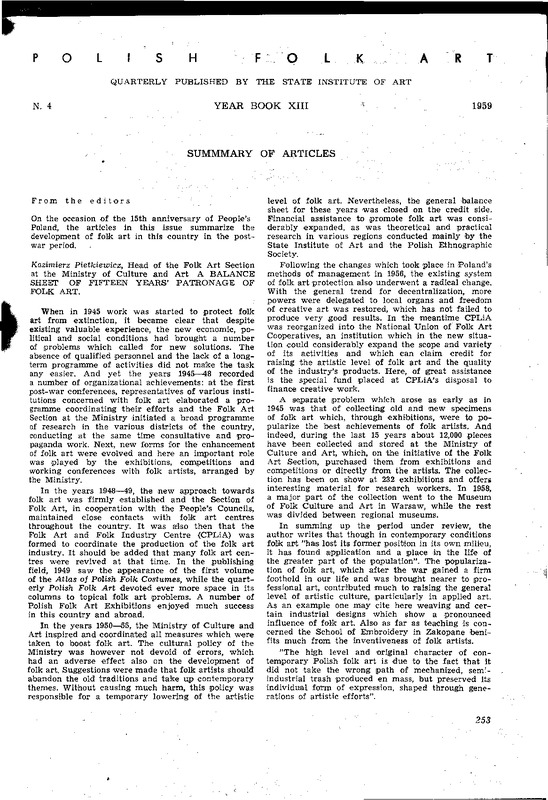
- extracted text
-
•
O
L
I
S
QUARTERLY
N. 4
H
F
PUBLISHED
O
L
K
A
R
T
B Y T H E STATE I N S T I T U T E OF A R T
Y E A R BOOK X I I I
ri
1959
SUMMMARY OF A R T I C L E S
From
the
editors
On the occasion o f the 15th anniversary of People's
Poland, the articles i n this issue summarize the
development of folk a r t i n this country i n the postwar period.
Kazimierz Pietkiewicz, Head of the Folk A r t Section
at the M i n i s t r y o f Culture and A r t A B A L A N C E
SHEET OF F I F T E E N Y E A R S ' P A T R O N A G E OF
FOLK A R T .
When i n 1945 w o r k was started to protect folk
art from extinction, i t became clear that despite
existing valuable experience, the new economic, political and social conditions had brought a number
of problems w h i c h called for new solutions. The
absence of qualified personnel and the lack of a l o n g term programme of activities d i d not make the task
anv easier A n d vet the vears 1945—48 recorded
a number of organizational achievements: at the first
Dost-war conferences reoresentatives of various i n s t i tutions concerned w i t h folk art elaborated a p r o srammp coordinating t h e i r efforts and the Folk A r t
Section at the M i n i s t r y i n i t i a t e d a broad Programme
conducting at the s l m e time w n ^ t a t l v r a n a ^ D r o ^
naaanda w o r k N e x n e w f o ^ f T f e e enha^cein^Qt
1
I v d b v the exhibitions competitions and
workinJ conference w i t h fn k â r H s T n i
Sv
the M i n i s t r y
arranged by
I n the years 1948—49, the n e w approach towards
folk art was f i r m l y established and the Section of
Folk A r t , i n cooperation w i t h the People's Councils,
maintained close contacts w i t h folk art centres
throughout the country. I t was also then t h a t the
Folk A r t and Folk I n d u s t r y Centre (CPLiA) was
formed to coordinate the production o f the folk a r t
industry. I t should be added that m a n y folk art centres were revived at that time. I n the publishing
field, 1949 saw the appearance of the first volume
of the Atlas of Polish Folk Costumes w h i l e the a u a r t erlv Polish Folk Art devoted ever more sDace i n its
columns to topical folk a r t nroblems A number of
Polish Folk Art? ExhUDitLns enioved' much success
m this c o u n t r y a n d a b r o a d
I n the years 1950—55, the M i n i s t r y of C u l t u r e and
A r t inspired and coordinated a l l measures w h i c h were
taken to boost f o l k art. The c u l t u r a l policy of the
M i n i s t r y was however not devoid of errors, w h i c h
had an adverse effect also on the development of
folk art. Suggestions were made that folk artists should
abandon the old traditions and take up contemporary
themes W i t h o u t causing m u c h h a r m this roolicv was
responsible for a temporary l o w e r i n g of the artistic
level of f o l k art. Nevertheless, the general balance
sheet for these years was closed on the credit side.
Financial assistance to promote folk a r t was considerably expanded, as was theoretical and practical
research i n various regions conducted m a i n l y b y the
State Institute of A r t and the Polish Ethnographic
Society.
Following the changes which took place i n Poland's
methods of management i n 1956, the existing system
of folk art protection also underwent a radical change.
W i t h the general t r e n d for decentralization, more
powers were delegated to local organs and freedom
of creative a r t was restored, which has not failed to
produce v e r y good results. I n the meantime C P L i A
was reorganized into the National U n i o n of Folk A r t
Cooperatives, an institution w h i c h i n the new situation could considerably expand the scope and variety
of its activities and w h i c h can c l a i m credit for
raising +hp artistic level of folk a r t and the mialitv
of the i n d u s t r y ' s o r < X t s Here of great as sitl nee
is the special fund Placed a C P L I T disposal to
finance creative w o r k
P
A separate problem which arose as early as i n
1945 was that of collecting old and new specimens
of folk art which, through exhibitions, were to p o pularize the best achievements of f o l k artists. A n d
indeed, during the last 15 years about 12,000 pieces
have been collected and stored at the M i n i s t r y of
Culture and A r t , which, on the i n i t i a t i v e of the Folk
A r t Section, purchased them from exhibitions and
competitions or d i r e c t l y f r o m the artists. The collection has been on show at 232 exhibitions and offers
interesting m a t e r i a l for research workers. I n 1958,
a m a i n r Dart of the collection went to the M n w i i m
of F o l k C u l t u r e a n d A r t inWaTsaw while the rest
was divided between regional museums.
I n summing up the period under review, the
author writes that though i n contemporary conditions
folk a r t "has lost its former position i n its own milieu,
it has found application and a place i n the life of
the greater p a r t of the population". The popularization of folk art, w h i c h after the war gained a f i r m
foothold i n our life and was brought nearer to p r o fessional art, contributed m u c h to raising the general
level of artistic culture o a r t i c u l a r l v i n anolied art
As an example one may cite here weaving and cert a i n i n d u s t r i a l designs w h i c h show a pronounced
influence of folk a r t Also as far as teaching is concerned the School of Embroidery i n Zafcooanebenefits ™ c h f ^
of folk artists
"The high level and original character of contemporary Polish folk a r t is due to the fact that i t
did not take the w r o n g p a t h of mechanized, semiindustrial trash produced en mass, but preserved its
i n d i v i d u a l form of expression, shaped through generations of artistic efforts".
253
Roman Retn/uss, Head of the Section for Research in
Folk Sculpture, State I n s t i t u t e of A r t . F I F T E E N
Y E A R S OF W O R K
Research in Polish folk art, however unsystematic, was started as far back as the 19th century. I t
was not u n t i l the formation soon after the w a r of
the Polish I n s t i t u t e of Folk A r t that planned and
coordinated research began to be conducted a l l over
the country. I n 1950, the Polish Institute of Folk A r t
was merged w i t h the State I n s t i t u t e of A r t . A f t e r
a few years of w o r k i t was deemed expedient to isolate
two of the Institute's sections and Knk t h e m up d i r e r t l v w i t h t h e i r nwn Institutes Thus the Section
of F o i k M u s i c L m e under 1he Institute of Music
History and Theory and1 the Folk Sculpture Section
fame under the Institute for the h i s t o r y and Theory
of Plastic A r t s ™i
the headouarteVs in Cracow at
Chief oTthe Section
K
e
]
n
f
u
s
s
w
a
s
appointed
The research conducted by the Section embraces
every genre of folk sculpture. I n addition, a sister
section at the State Institute of A r t engages in special
research into folk art which borders on professional
art, ecncentrating also on the w o r k of " p r i m i t i v e "
painters.
I n the i n i t i a l period, the methods of research were
not devoid of methodological errors and organisational shortcomings. Yet, in principle research developed along the lines mapped out by the First Conference of A r t , held in 1951, namely, the study of the
historic, social and economic aspects of folk art. The
section developed successfully bibliographic w o r k and
also succeeded i n photographing a l l the most remarkable folk art relics and now has at its disnosal
rich.archives of valuabte d ^ o c u W t a t i o n .
Most important of a l l however was research on
the spot in various regions of the country. W a r destruction and the rapid transformations taking place
in the very character of folk art called for the utmost
efforts and such methods of work as w o u l d allow the
collection of as much information as possible w i t h i n
the shortest .period of time. Particular care was paid
to the less k n o w n regions. Thus, research started i n
the most distant districts, covering gradually the
whole country.
I n the years 1946—48, w i t h the then existing shortage of transpcrt facilities (to carry groups of research
workers and equipment), research was mostly done by
i n d i v i d u a l workers, but this later proved to be insufficient. At present i n d i v i d u a l research is only conducted as a study supplementing scholarly w o r k . Then
came group research, including ethnographers, art
historians sketchers and Dhotoeraphers
who did
reconnaissance w o r k followed by research proper
if justified by the discoveries of the advance gnu*
The year 1050 w i t n « 4 d another ^
form of research k n o w n in this country as the "annual camp
^ s e a r c h ' Grouos of L many a 30 « « « a T h
w o S
travel deen ^ntn the country w l ™ U ^ f e n c a l i n
some nlace and? from t h ^ Z ^ t h ^
J ^ k e ^ e
ditTonrto
of the area
^ f ^ Z
H ^ l l S n
fill nn
ffal L S m n n i r M '
t
¿ « 1 « nfinformation t £ v
P
n
S
i f <h n W
J
of the colouring.
Descript ons of sculptures in wood and stono and
of paintings are supplemented by photographs.
"The camp" methods proved to be the most f r u i t ful. The Section now has in its archives 50.000 items.
;
254
including descriptions, drawings, diagrams and 16,000
photographs. The collection is v e r y useful to research
workers, and numerous publications, including essays,
albums and articles, have been based on material
collected by the Section.
The archives are open to other institutions concerned w i t h folk art, such as the M i n i s t r y of Culture
and A r t , the People's Councils and other k i n d r e d
institutions.
Janina Orynzyna
RY L I F E
FOLK ART I N CONTEMPORA-
A r g u i n g w i t h the c l a i m that folk art is doomed
to extinction, Miss Orynzyna writes that "even today,
at the beginning of the atom era and interplanetary
communication, a hand-made folk art object has lost
nothing of its c h a r m and freshness". I t is true that
as i t no longer serves the needs of the countryside,
folk art has departed from the m i l i e u it was o r i g i n a l l y intended to serve, b u t it has gained instead
admirers and a ready market i n the urban milieu.
I n the new conditions folk art has many i m p o r tant functions to f u l f i l — i t can be v e r y useful in
raising the standard of the aesthetic taste of the population, being a valuable interior decoration element, and folk art goods sold as souvenirs to tourists
v i s i t i n g this country or exported abroad can be an
excellent means of popularizing the Polish national
style.
I t is from this point of view t h a t Janina Orynzyna
discusses the activities of CPLiA, the Centre for Folk
A r t and Folk Industry, which not only coordinates
the w o r k of folk art cooperatives and sells their p r o ducts, taut also caters for folk dance and song ensembles.
Aleksander
PRESENT
Jackowski
FOLK ART
PAST A M )
I n Poland folk art is s t i l l a l i v i n g r e a l m of a r t
even though the process of its gradual e x t i n c t i o n has
been observed since the end of the 19th century.
Continuously rising standards of social consciousness
and demographic changes t a k i n g place in the c o u n t r y side, are responsible for the irreversibility of this
process. The isolation from the urban w o r l d impressed
i n the oast the stamp of originality on folk art- at
isolated e n t i t y and urban c u l t u r e is M n e t r a t i n r f r e e i v
i n t o r u r a l life chane'n " the tastes S I the needTof
the r u r a l Population M K h i a l - m a d " o r o d u " are
oustine a r t i s t * h a X r a f t s and folk . H i t
tra
.Optional f o r m is g r a d u a l l y d i s a p p e a r i n g from' thl.scene"
Sculpture and painting are particularly affected
by the urbanization process, since deformation and
other means of expression w h i c h were moulded by
generations of folk artists, are no lonqer acceptable
to the contryside, the tastes of which are strongly
•influenced by photography, chromolitography and
mass produced figurines of v e r y poor artistic standards. This realm of folk a r t is thus definitely dying
out.
But folk artists who have abandoned old t r a d i tions and resort to modern means of expression often
show much inventiveness and t h e i r products, i f more
of an artisan character, present genuine artistic v a lues, gaining an ever stronger foothold in the towns.
This is i n particular true of decorative arts (tapestry) w h i c h pay from the point of v i e w of f i n a n c i a l
considerations and for which there is a demand both
in town and country. I n contrast, regional costumes
and i n t e r i o r decoration are changing their character
under the impact of new bourgeois trends m a k i n g their
way into r u r a l homes.
Under these circumstances protection of folk art
to save it from e x t i n c t i o n assumes special signifi
cance. I n summing up the results of State support
for folk art d u r i n g the past fifteen years, the w r i t e r
points to such beneficial measures taken by the aut
horities concerned as competitions, exhibitions the
w e l l thought-out policy of prizes, organized purchases
of folk art products and scholarships, and expresses
the opinion that i n the present situation more forms
of encouragement shauld be evolved. The need arizes
to suoDort artists who though thev a » not r-nntiniii n g o > d t r a d i t i o n , cre^
style and here not a s" « l l X d w r 4 , n should b l
d e r i v e d of
^
Timrot
to
sal taiuosine old nattems should hi
abandoned A m o n s Z
m e a s u r e of a ^ k L n c P i f
P
of profe.sicnal p l a . t c artists I t goes w i t h o u t saying
that the most nnportant problem here is the raising
of the general standards of culture in the c o u n t r y
side.
"The downfall of popular art, Which is already an
accomplished fact, not only uprooted it, but it under
l i n e d the whole system of aesthetic views of the
r u r a l population, b r i n g i n g about a radical change
in the function folk a r t played i n this milieu'.
Newspapers, books, radio, films and television
have brought the coutryside nearer to towns and to
day we no longer divide art into "educated" and
"popular", b u t into eleiarian and mass art, the latter
heing m a i n l y of an entertaining character, incapable
of fulfilling the function formerly performed by folk
art. Mass culture reduces the recipients to the role
of consumers whereas folk a r t insriired creative Drocesses c o n t r i b u t i n e to man's development I t was an
expression o ' m a n ' s u r g e t o create d u t i f u l things
wh'ch embellished1 t h - s u r r o u r ^ n K s andI w h ch wa*
PartancjTform of lifof
"
The question arises w h a t support should be given
to fill the gap, w h a t can today become an equivalent
of those values w h i c h i n the past folk art contributed
to the countryside. I t seems that the only way out
of the situation is to broaden support to embrace not
only the few conttimutors o f old trends, but also the
broad movement of amateur artists, encouraging
them to take part in the creation of art and culture.
S
U
r
r
Q
Ewa
Jeczallk
EXHIBITION
GLASS P A I N T I S G
U
n
i
OF
n
g
5
&
M
OLD
SILESIAN
I n the opinion or Miss Jeczalik, the classification
is very helpful i n that " i t casts some l i g h t on the
period, the origin of the designs and the mil.eu wh'cn
adapted them, leading gradually to the discovery of
Lhe artistic geneology of glass p a i n t i n g i n Silesia".
Following p r e l i m i n a r y research, the authoress
arranged an e x h i b i t i o n of some hundred paintings
she had selected from the collections of the W r o c ł a w
Ethnographic Museum and the Museum i n Jelenia
G ó r a . The e x h i b i t i o n was on view i n October 1958
in W r o c l a w and in July this year i n Warsaw. The
exhibits were divided into the following five groups:
11 the oldest Silesian painting on glass, representing
the highest artistic values 2) background decorations
3) thematic division (votive offerings, Silesian images
of the Mother of God, Saints, etc), 4) p a i n t i n g tech
nique and 5) painting on ' mirrors.
The article explaining the mode of the exposition,
contains an analysis of the various groups of paintings,
with interesting inferences made by the authoress
from her research. Thus, for example, there is the
observation that "the oldest paintings on glass date
back to a period where this type of painting was not
yet practiced cn mass, as was the case later, i n the
19th centurv when on the occasion of religious re
mission processions iconoeraphic compositions painted
on glass were produced i n series.
A n analysis of the paintings on mirrors leads the
authoress to the conclusion that this type of painting,
which was believed to have been the oldest i n Silesia,
did not originate u n t i l after 1880, when the c o u n t r y
side was invaded w i t h petty bourgeois fashions.
The few signatures on the serial paintings point
to the region of Kłodzko, which was the m a i n centre
of remission ceremonies, as the place of their origin,
justifying the assumption that serial Silesian paintings
on glass was linked up w i t h pilgrimage and remission
places rather than w i t h Silesian glass industry
centres.
Maria Przezdziecka — FOLK SCULPTURES I N T H E
18TH CENTURY
The article discusses three 18th century sculptures
n wood preserved in the parish Church i n the village
of Kraszewo ( C i e c h a n ó w district). The most recent
among them — the c i b o r i u m dates back to 1726.
Next comes the p u l p i t carved out of a tree t r u n k
and supported by a seperately carved figure. M a i n t
ained i n the mature baroque style, it shows a tendency
towards moderation of the contorted forms inherent
in th s stv'e The t h i r d dating back to 1755 is an
l a r l v Renafs'sancl Style plaque on Jan Franciszek
Kucharski** tomb A l l the three sculptures show an
ffftitv
s t v t e w h ich i u s t i f r t h e assumotion that
thev were the w o r k of
r a n d V « T M t e t o r
T h Y f M t that th^DuloU is carved out of T tree t r u n k
shows that t h . s c Ł
w a s a W k artist and the
f r m s show the e r a d u ś o c r f o c t on
of his crtftsmanship
pcrtectlon
:
:
o £
n f
With the wealth of preserved Silesian glass p a i n
ting, the establishment o f i t s geneology is a com
plex oroblem, since the painting shows a great v a
riety of artistic forms, thematic material and formal
features.
I n her attempt to trace the origin of this type of
art in Si1es a, the authoress divides the material
under examination into three groups: the paintings
in the first group are classified according to the
technique used by the artist i n drawing, painting and
decorating the w o r k ; a thematic division of paintings
is made in the second group, where the authoress
observes a recurrence of a certain type of iconograohic comoosit'ons and i n the t h i r d group, the o a i n Tines are segregated according to background decofo„
;
r a t
s
0
Ewa Fryś — S T U D Z I A N Y L A S POTTERY
Studziany Las was u n t i l quite recently an active
pottery centre and its ware was characterized b y the
primitivetiess of its form and technique. The vessels
were made either of red or grey clay w i t h some sand
content to diminish the fatness of the clay. The
earthenware was very simple i n its shape and its dark
brown colour turned into shining black after long
usage. This earthenware was i n great demand be
cause o f its high fire-proof quality.
I n describing the process of production, Miss F r y ś
writes that a s i m i l a r production technique was used
in the potterv centres i n Pieszczanka, near Grodno,
255
r
and as Studziany Las is situated nearby i t could be
inferred that its pottery is genetically l i n k e d up w i t h
the Byelorussian region. This seems also to be con
firmed by the fact that the first potter who settled
i n Studziany Las was said to be a Byelorussian called
S o b ó t k a , f r o m near Grodno.
Anna Kunczyńska
— F R O M T H E REPORT O N T H E
E X I B I T I O N OF C O N T E M P O R A R Y F O L K A R T I N
THE L U B L I N AREA
O n the 15th anniversary of Poland's liberation, an
e x i b i t i o n of contemporary folk art was opened i n the
L u b l i n Museum, w h i c h is w e l l k n o w n for its artistic
displays. This time too the Museum could c l a i m credit
for the fine arangement of the e x h i b i t i o n , the apt
selection of the exhibits and their setting, w h i c h
brought into sharp relief the various kinds of folk
art, their artistic centres and the artists themselves
m a i n l y of w 6 l l established r e n o w n .
A m o n g the new discoveries, the authoress calls
attention to A n d r z e j Wieleba (from the village of
Godziszów, Janow-Lubelski region), whose bas-relief
of St. Nicolas, could be singled out from among the
works of other sculptors.
I
I
4
C Z A S O P I S M A PAŃSTWOWEGC I N S T Y T U T U S Z T U K I
wydawane przez
P P . WYDAWNICTWA A R T Y S T Y C Z N E I FILMOWE
B I U L E T Y N H I S T O R I I S Z T U K I , kwartalnik, ponad 100 str. dużego
formatu, około 100 ilustracji. Cena 24 zl, prenumerata półroczna 48 zj,
roczna — 96 zł.
P O L S K A S Z T U K A L U D O W A , kwartalnik, 64 str. duiego formatu,
bogaty materiał ilustracyjny. Cena 18 zł, prenumerata półroczna 36 zl,
roczna — 72 zł.
PRZEGLĄD
ARTYSTYCZNY, kwartalnik
p o ś w i ę c o n y nowoczesnej
twórczości plastycznej, 80 str. dużego formatu, bogata szata ilustra
cyjna w technice rotograwiurowej. Cena 18 zł, prenumerata półroczna
36 zł, roczna — 72 zł.
P A M I Ę T N I K T E A T R A L N Y , k w a r t a l n i k , ponad 170 str. druku,
100 ilustracji. Cena 18 zł, prenumerata p ó ł r o c z n a 36 zl, roczna -
około
72 zl.
K W A R T A L N I K F I L M O W Y , około 100 str. druku, k i l k a n a ś c i e
Cena 10 zł, prenumerata p ó ł r o c z n a 20 zł, roczna — 40 zł.
ilustracji.
M U Z Y K A , k w a r t a l n i k , około 130 str. druku, liczne p r z y k ł a d y
Cena 18 zł, prenumerata p ó ł r o c z n a 36 zł, roczna — 72 zł.
nutowe.
PRENUMERATA
Z a m ó w i e n i a i p r z e d p ł a t y na p r e n u m e r a t ę przyjmowane są w terminie
do dnia 15-go miesiąca p o p r z e d z a j ą c e g o okres prenumeraty — przez:
Urzędy Pocztowe, listonoszy oraz O d d z i a ł y i Delegatury „ R u c h u " .
Można r ó w n i e ż zan/*wić p r e n u m e r a t ę d o k o n u j ą c w p ł a t y na konto
PKO nr
1-6-10002U — Centrala K o l p o r t a ż u Prasy i Wydawnictw
„ R u c h " — Warszawa, u l . Srebrna 12.
Cena prenumeraty za g r a n i c ę jest o 40V» droższa od ceny podanej w y
ż e j . P r z e d p ł a t y na t ę p r e n u m e r a t ę przyjmuje na okresy p ó ł r o c z n e
i roczne P r z e d s i ę b i o r s t w o Eksportu i I m p o r t u „ R u c h " w Warszawie,
Wilcza 46, konto 2-6-71 w Narodowym Banku Polskim w Warszawie,
u l . Warecka 10.
SPRZEDAŻ
Aktualne numery czasopism P a ń s t w o w e g o Instytutu
bycia:
w kioskach „ R u c h u " ,
w w i ę k s z y c h k s i ę g a r n i a c h miast w o j e w ó d z k i c h .
Sztuki s ą do
na
Egzemplarze zdezaktualizowane m o ż n a n a b y ć w sklepie „ R u c h u " przy
u l . Wiejskiej H w Warszawie. Z a m ó w i e n i a spoza Warszawy należy
k i e r o w a ć do Centrali K o l p o r t a ż u Prasy 1 Wydawnictw „ R u c h " , W a r
szawa, ul. Srebrna 12.
Stołec.-ne Z a k ł a d y Graficzne.
Zakład Wydawniczy. W-wa,
Podchorążych
Z a r a , «37.
P a p . i l u s t r . k l , U l , 100 g B I + k a r t o n b i a ł y k i . I I I , 220 g.
N a k ł a d 1S5C egz, C-82. D r u k u k o ń c z o n o w l u t y m 1980 r .
39.
BI.