-
Title
-
Notes on Authors / Polska Sztuka Ludowa - Konteksty 2014 Special Issue
-
Description
-
Polska Sztuka Ludowa - Konteksty 2014 Special Issue s.429-431
-
Creator
-
PSL Konteksty - redakcja
-
Date
-
2014
-
Format
-
application/pdf
-
Identifier
-
oai:cyfrowaetnografia.pl:6148
-
Language
-
ang
-
Publisher
-
Instytut Sztuki PAN
-
Relation
-
oai:cyfrowaetnografia.pl:publication:6577
-
Rights
-
Licencja PIA
-
Subject
-
PSL Konteksty - czasopismo
-
Type
-
czas.
-
Text
-
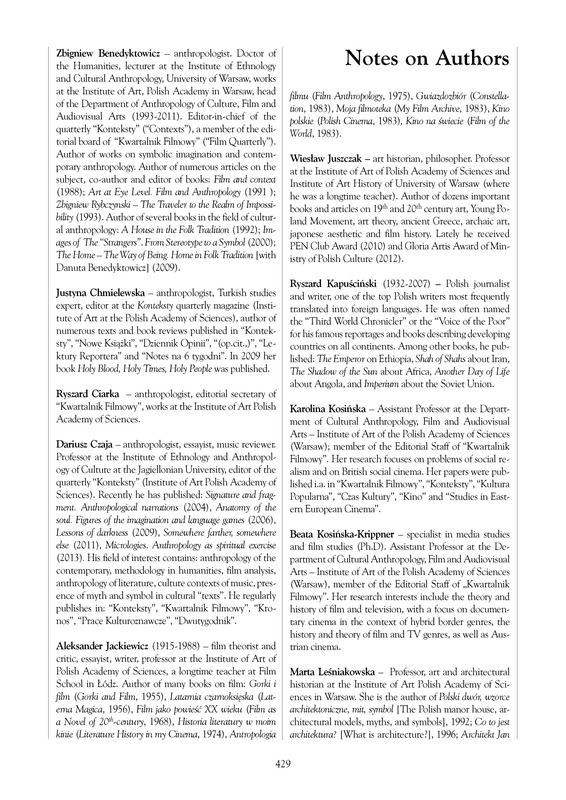
Zbigniew Benedyktowicz - anthropologist. Doctor of
the Humanities, lecturer at the Institute of Ethnology
and Cultural Anthropology, University of Warsaw, works
at the Institute of Art, Polish Academy in Warsaw, head
of the Department of Anthropology of Culture, Film and
Audiovisual Arts (1993-2011). Editor-in-chief of the
quarterly “Konteksty” (“Contexts”), a member of the edi
torial board of “Kwartalnik Filmowy” (“Film Quarterly”).
Author of works on symbolic imagination and contem
porary anthropology. Author of numerous articles on the
subject, co-author and editor of books: Film and context
(1988); Art at Eye Level. Film and Anthropology (1991 );
Zbigniew Rybczynski - The Traveler to the Realm of Impossi
bility (1993). Author of several books in the field of cultur
al anthropology: A House in the Folk Tradition (1992); Im
ages of The “Strangers". From Stereotype to a Symbol (2000);
The Home - The Way of Being. Home in Folk Tradition [with
Danuta Benedyktowicz] (2009).
Notes on Authors
filmu (Film Anthropology, 1975), Gwiazdozbiór (Constella
tion, 1983), Moja filmoteka (My Film Archive, 1983), Kino
polskie (Polish Cinema, 1983), Kino na świecie (Film of the
World, 1983).
Justyna Chmielewska - anthropologist, Turkish studies
expert, editor at the Konteksty quarterly magazine (Insti
tute of Art at the Polish Academy of Sciences), author of
numerous texts and book reviews published in “Kontek
sty”, “Nowe Książki”, “Dziennik Opinii”, “ (op.cit.,)”, “Le
ktury Reportera” and “Notes na 6 tygodni”. In 2009 her
book Holy Blood, Holy Times, Holy People was published.
W iesław Juszczak - art historian, philosopher. Professor
at the Institute of Art of Polish Academy of Sciences and
Institute of Art History of University of Warsaw (where
he was a longtime teacher). Author of dozens important
books and articles on 19thand 20th century art, Young Po
land Movement, art theory, ancient Greece, archaic art,
japonese aesthetic and film history. Lately he received
PEN Club Award (2010) and Gloria Artis Award of Min
istry of Polish Culture (2012).
Ryszard Kapuściński (1932-2007) - Polish journalist
and writer, one of the top Polish writers most frequently
translated into foreign languages. He was often named
the “Third World Chronicler” or the “Voice of the Poor”
for his famous reportages and books describing developing
countries on all continents. Among other books, he pub
lished: The Emperor on Ethiopia, Shah of Shahs about Iran,
The Shadow of the Sun about Africa, Another Day of Life
about Angola, and Imperium about the Soviet Union.
Ryszard Ciarka - anthropologist, editorial secretary of
“Kwartalnik Filmowy”, works at the Institute of Art Polish
Academy of Sciences.
Dariusz Czaja - anthropologist, essayist, music reviewer.
Professor at the Institute of Ethnology and Anthropol
ogy of Culture at the Jagiellonian University, editor of the
quarterly “Konteksty” (Institute of Art Polish Academy of
Sciences). Recently he has published: Signature and frag
ment. Anthropological narrations (2004), Anatomy of the
soul. Figures of the imagination and language games (2006),
Lessons of darkness (2009), Somewhere farther, somewhere
else (2011), Micrologies. Anthropology as spiritual exercise
(2013). His field of interest contains: anthropology of the
contemporary, methodology in humanities, film analysis,
anthropology of literature, culture contexts of music, pres
ence of myth and symbol in cultural “texts”. He regularly
publishes in: “Konteksty”, “Kwartalnik Filmowy”, “Kro
nos”, “Prace Kulturoznawcze”, “Dwutygodnik”.
Aleksander Jackiewicz (1915-1988) - film theorist and
critic, essayist, writer, professor at the Institute of Art of
Polish Academy of Sciences, a longtime teacher at Film
School in Łódz. Author of many books on film: Gorki i
film (Gorki and Film, 1955), Latarnia czarnoksięska (Laterna Magica, 1956), Film jako powieść XX wieku (Film as
a Novel of 20th-century, 1968), Historia literatury w moim
kinie (Literature History in my Cinema, 1974), Antropologia
429
Karolina K osińska - Assistant Professor at the Depart
ment of Cultural Anthropology, Film and Audiovisual
Arts - Institute of Art of the Polish Academy of Sciences
(Warsaw); member of the Editorial Staff of “Kwartalnik
Filmowy”. Her research focuses on problems of social re
alism and on British social cinema. Her papers were pub
lished i.a. in “Kwartalnik Filmowy”, “Konteksty”, “Kultura
Popularna”, “Czas Kultury”, “Kino” and “Studies in East
ern European Cinema”.
B eata Kosińska-Krippner - specialist in media studies
and film studies (Ph.D). Assistant Professor at the De
partment of Cultural Anthropology, Film and Audiovisual
Arts - Institute of Art of the Polish Academy of Sciences
(Warsaw), member of the Editorial Staff of „Kwartalnik
Filmowy”. Her research interests include the theory and
history of film and television, with a focus on documen
tary cinema in the context of hybrid border genres, the
history and theory of film and TV genres, as well as Aus
trian cinema.
M arta Leśniakowska - Professor, art and architectural
historian at the Institute of Art Polish Academy of Sci
ences in Warsaw. She is the author of Polski dwór, wzorce
architektoniczne, mit, symbol [The Polish manor house, ar
chitectural models, myths, and symbols], 1992; Co to jest
architektura? [What is architecture?], 1996; Architekt Jan
�NOTES ON AUTHORS
Koszczyc Witkiewicz (1881-1958) i budowanie w jego cza
sach [Jan Koszczyc Witkiewicz (1881-1958): architect and
building in his times], 1998; series of books Architektura
w Warszawie [The Architecture in Warsaw], 1998-2005.
She published many texts among other in “Teksty Dru
gie”, “Konteksty”, “Modus”, “Biuletyn Historii Sztuki”,
“Rocznik Historii Sztuki”.
Czesław Robotycki (1944-2014) - anthrpologist, eth
nographer. Professor at the Institute of Ethnology and
Anthropology of Culture at the Jagiellonian University in
Cracow, former chief of this Institute. Member of the Edi
torial Staff of “Konteksty”, chief of based in Cracow “Pi
wnica pod Baranami” Association. Author of many texts
and books on problems of contemporary anthropology,
methodology of history, ethnography, popular culture.
W ojciech M ichera - professor in the Film and Visual
Culture Section at the Institute of Polish Culture, Uni
versity of Warsaw; member of the editorial board of the
academic journal “Konteksty”; lecturer at the Academy
of Dramatic Art in Warsaw. He is primarily interested in
narratology applied to film and visual images; and theo
ries of image and representation. Author of two books:
Anti-Daniken, 1994, and recently: Piękna jako bestia. Przy
czynek do teorii obrazu [Beauty as the Beast. Contribution
to the Theory of Image], 2010; and more than 40 aca
demic publications (including papers in magazines such
as “Konteksty”, “Kwartalnik Filmowy”, “Teksty Drugie”,
“Kinowiedczieskije zapiski”, “Literatura ludowa”, “Bien
dire et Bien Aprandre. Revue de Médiévistique”). Trans
lator of many important texts into Polish (by authors such
as Roland Barthes, Jacques Lacan, Jaś Elsner) and author
of numerous TV shows and educational movies (for TVP
and TV Arte).
Grzegorz Nadgrodkiewicz
Tragicomedy dell’arte, or Pierrotade a la Godard
Nadgrodkiewicz reflects on the phenomenon of the dura
bility of a cultural model, i.e. commedia dell’arte with its
central characters - Pierrot and Columbine. He detects
this cultural pattern in Jean-Luc Godard’s Pierrot le fou
(1965). In Godard’s film this model takes on the form of
a peculiar tragic-comedy dell’arte. Ferdinand, the main
hero, and his lover Marianne hide their true faces under
masks isolating them from the world. They permanently
get involved in absurd and grotesque situations, and a
series of circumstances leads them inevitably towards the
tragic end. Their flight from Paris, car thefts, gunrunning,
assaults and unhappy love lead towards death, their final
fate. The film is strongly placed in Mediterranean tradi
tion and the pop culture of the 1960s, and its heroes are
young people of their time. They have no illusions, are
witty and smart, ruthless and self-ironic but desperately
helpless in the face of society-imposed commands. Their
clownish revolt is doomed to disaster.
M aria Poprzęcka - art historian, essayist. Professor at
the Institute of Art History, University of Warsaw, former
director of this Institute, she leads Art Historian’s Asso
ciation. She is an author of many books and articles on
modern art, 19th century art, methodology of art history,
academism, feminine art. In 2009 she received Gdynia
Literary Award for her book Other images. From Alberti to
Duchamp.
430
A leksandra Rodzińska-Chojnowska , M.A. degree at the
Historical Faculty (Warsaw University), 1972 (thesis on
John of Salisbury). In 1978 granted Ph.D. degree for dis
sertation: Anglo-Norman Intelectuals of the Twelfth Century,
and began translating into the English texts on history, his
tory of art, philosophy and law. Cooperated, and collabo
rates up to this day with: History Meeting House, Arkady
Publishing House, National Museum, Fryderyk Chopin
Institute, Sejm Publishing House and DiG Publisher, as
well as with periodicals: “Acta Poloniae Historica”, “Dzieje
Najnowsze”, “Konteksty. Polska Sztuka Ludowa”, “Kwar
talnik Historyczny”, “Muzealnictwo”, “Teatr Lalek” and
“Quaestiones Medii Aevi Novae”. Since 2000 translated
into the English, i.a. Iwona Taida Drózd, The Buddist King
dom of Lo, Warszawa 2001; Anna Masłowska, Chronicle of
Exhibitions at National Museum in Warsaw 1862-2002vol.
1. 1862-1962, Warszawa 2002; vol. 2. 1963-1982, War
szawa 2006; The History of Polish Diplomacy X-XX c. (eds.
Gerard Labuda, Waldemar Michowicz), Warszawa 2005;
Federalism in the History of Poland: “The Free with the Free,
the Equal with the Equal", Warszawa 2008; The Lebenstein
Code: Poland during the Twentieth Century along the Traces of
Drawings by Jan Lebenstein, Warszawa 2010; Andrzej Rottermund, Warsaw, Warszawa 2000; Wojciech Fijałkowski,
Wilanów Vademecum, Warszawa 2011; Mariusz Karpow
icz, What the Façades of Wilanów Tell Us, Warszawa, 2011.
Teresa Rutkowska - editor-in-chief of „Kwartalnik Fil
mowy” („Film Quarterly”). Her research interests centre
on the narrative strategies in fiction and non-fiction film.
Published in “Kwartalnik Filmowy”, “Konteksty” and
“Nowe Książki”.
Sławomir Sikora - Assistant Professor at the Institute of
Ethnology and Cultural Anthropology, University of War
saw. His main research interests cover: visual anthropolo
gy, anthropology of death, urban anthropology and meth
odological issues connected with anthropology. Author of
Fotografia. Między dokumentem a symbolem [Photography.
Between Document and Symbol, 2004], Film i paradoksy
wizualności. Praktykowanie antropologii [Film and Paradox
es of Visuality. Practicing Anthropology, 2012], co-editor
of Zanikające granice. Antropologizacja nauki i jej dyskursów
[Disappearing Borders. Anthropologisation of Science
and Its Discourses, 2009, with Adam Pomieciński]. He
has also published numerous articles in, among others,
“Kwartalnik Filmowy”, “Kultura Współczesna”, “Kontek-
�NOTES ON AUTHORS
sty”, “Lud”. Co-author of the film Zeby to byb ciekawe... O
mediatyzacji obrzędów weselnych [Making it interesting... A
film on mediatization of wedding rituals, 2009, with Karo
lina Dudek].
A nna Sobolewska - professor, historian of literature, a lit
erary critic and an essayist. Since 1970’ s she has been work
ing in the Institute of Literary Studies of the Polish Acad
emy of Sciences in the department of contemporary litera
ture and literary communication. She has also classes with
students of film studies at the Cardinal Stefan Wyszyński
University in Warsaw. Her main research sphere is the rela
tion of literature and mysticism and the poetics of inner
experiencies. She is specially interested in the lay mysticism
of everyday life in the works of poets and writers of the 20th
c. Her other spheres of interest embrace transformations
of narrative forms, comparative literature, film studies and
the new media of today. She is the author of books: Polish
Psychological Prose 1945-1950 (1979); The Mysticismn of
Everyday. The Poetics of Inner Experiences (1992); Maximally
Successful Existence. Essays on the Life and Creative Work of
Miron Białoszewski (1997); Masks of God. Essays on Writers
and Mystics (2004); Spiritual Maps of Today. What Has Been
Left for Us after New Age? (2009). Her book Cela. A Reply
to Down Syndrome” (2002) is a autobiographical narrative
about her daughter Cecylia with Down Syndrome. She is
a member of many associations promoting mentally handi
capped people, of educational and literary associations as
well as social platforms of religious dialogue and reconcilia
tion of Christians and Jews.
K uba Szpilka - ethnologist (graduate of the Jagellio-
nian University, then studied in the Institute of Art at
the Polish Academy of Sciences). Mountaineer, alpinist.
Author of numerous articles, published in “Konteksty”
and in “Tatry” (a magazine of the Tatra National Park).
His texts have been published in numerous compilation,
such as Mitologie popularne (edited by D. Czaja, 1994).
Author of the books: Bóg się rodzi (along with M. Krupa
and J. Mikołajewski, with illustrations by J. Wilkoń),
Zakopiańczycy. W poszukiwaniu tożsamości (along with
M. Krupa and P Mazik, 2011) and Ślady, szlaki, ścieżki
(along with M. Krupa and P Mazik, 2013). Curator of
numerous museal exhibitions: Zakopiańczycy. W poszuki
waniu toższamości (2011), Wyprawa. Pośród tatrzańskich i
zakopiańskich idei (2013), PRL pod Giewontem (2013). Co
organizer of the conference titled Ekstremalnie (2013). Co
founder of „Zakopiańczycy. W poszukiwaniu tożsamości”
foundation. Lives in Kościelisko.
Ludwik Stom m a - anthropologist, writer, essayist. Pro
fesor at EPHE and Sorbonne in Paris, former researcher
at the Jagiellonian University and Institute of Art, Polish
Academy of Sciences. Author of dozens books and articles
on anthropology and history. He is also author of popular
commentaries published in “Polityka” weekly.
431
Tomasz Szerszeń - anthropologist, art historian, pho
tographer. A graduate of the Inter-faculty Individual
Studies in the Humanities at the University of Warsaw
and the Photography Department of National Film, Tel
evision and Theatre School in Łódź, recently granted
a Ph.D. degree in Humanities. Researcher in Institute
of Art, Polish Academy of Sciences. Granted a stipend
of Ministry of Culture (2007, 2013), French Govern
ment (2006, 2008, 2012), Foundation of Polish Science
(2010), City of Warsaw Artistic Scholarship (2010). He
is a member of editorial board of quarterly “Konteksty”
and “View. Theories and Practices of Visual Culture”.
He is an author of dozens of texts published in books
and in such a reviews like “Konteksty”, “Literatura na
Świecie”, “Tygodnik Powszechny”, “Res Publica Nowa”,
“Dwutygodnik.com”. His artistic projects were presented
in Archeology of Photography Foundation in Warsaw,
in Exchange Gallery in Łódź, Asymetria Gallery, Nowy
Teatr in Warsaw and in Paris Photo 2012 and 2013. His
book Voyagers without map and passport. Michel Leins and
Documents will appear soon in Słowo / obraz terytoria
editions.
M onika Sznajderman - anthropologist, publisher. She
graduated from the Warsaw University, Faculty of His
tory, Department of Ethnography and the postgraduate
studies at the Institute of Art of Polish Academy of Sci
ences in the Department of Film History and Theory. She
obtained her doctorate in 2000. Her doctor’s thesis con
cerned the figure of the jester in culture; she was also en
gaged in the anthropology of the present (especially in the
problems of the visual popular culture) and in the forms of
today’s popular devoutness and religiosity. She wrote the
following books: The Pest. Mythology of Plague, Cholera and
AIDS (Warsaw 1994), Biblia pauperum. Essays on the video
and popular culture (Cracow 1998) and The Jester. Masks
and Metaphors (Gdańsk 2001, Warsaw 2014); also many
articles published in the scientific press and cultural maga
zines. Since 1996 she runs the Czarne Publishers (www.
czarne.com.pl), which she founded with her husband, the
writer Andrzej Stasiuk.
Jacek Waltoś - painter, sculptor. Professor at Academy of
Fine Arts in Cracow. He also writes on art. In the sixties
he was a co-founder of artistic group Wprost, in the eight
ies he was linked with artistic independent movement. In
2002 he received Jan Cybis Award.
Jerzy Sławomir Wasilewski - Professor at the University
of Warsaw, Institute of Ethnology and Cultural Anthro
pology. Main areas of interest: peoples of Central Asia and
their symbolic culture; long-term ethnographic fieldwork
in Mongolia, Siberia, penetrations in Inner and Eastern
Asia. Books on shamanism and taboo, articles on symbol
ic language in ritual and belief, ethnography of travel and
globalization.
�