-
Title
-
Różne/ LUD 1957 t.44
-
Description
-
LUD 1957 t.44, s.599-632
-
Date
-
1959
-
Format
-
application/pdf
-
application/pdf
-
Identifier
-
oai:cyfrowaetnografia.pl:150
-
Language
-
pol
-
Publisher
-
Polskie Towarzystwo Ludoznawcze
-
Relation
-
oai:cyfrowaetnografia.pl:publication:174
-
Text
-
598
WYKAZ WYDAWNICTW
Budownictwo
Architektura
(Warszawa)
Filmowa
Agencja
Wydawnicza
(Warszawa)
IHKM
Instytut
Historii
Kultury
Materialnej
(Warszawa)
Instytut
Zachodni
(Poz:lań)
Iskry (Warszawa)
Ks. i W. Książka i Wiedza (Warszawa)
Nasza Księgarnia
(Warszawa)
LSW Ludowa Spółdzielnia
Wydawnicza (Warszawa)
Oss. Zakład im. Ossolińskich (Wrocław)
PAN Polska Akademia Nauk
PIW Państwowy
Instytut
Wydawniczy (Warszawa)
PTL Polskie
Towarzystwo
Ludoznawcze (Wrocław)
I ICH SKRO TY
R
o
z
N
E
PWG Polskie Wydawnictwo
Gospodarcze (Warszawa)
PWM Polskie
Wydawnictwo
MuzYcZ::le (Kraków)
PWN
Państwowe
Wydawnictwo
Naukowe (Warszawa)
JAN CZEKANOWSKI
PWR i L Państwowe
Wydawnictwo
Rolnicze i Leśne (Warszawa)
PZWL Państwowy
Zakład Wydawnictw Lekarskich
(Warszawa)
BALTIKUM
PZWS Państwowy
Zakład Wydawnictw Szkolnych (Warszawa)
Śląsk przy Wydawnictwie
Górniczo-Hutniczym
(Katowice)
Sp. i T. Sport i Turystyka
(Warszawa)
Wiedza Powszechna
(Warszawa)
Wyd. Praw::l. Wydawnictwo
nicze (Warszawa)
Praw-
'.,
UND SKANDlNAVIEN
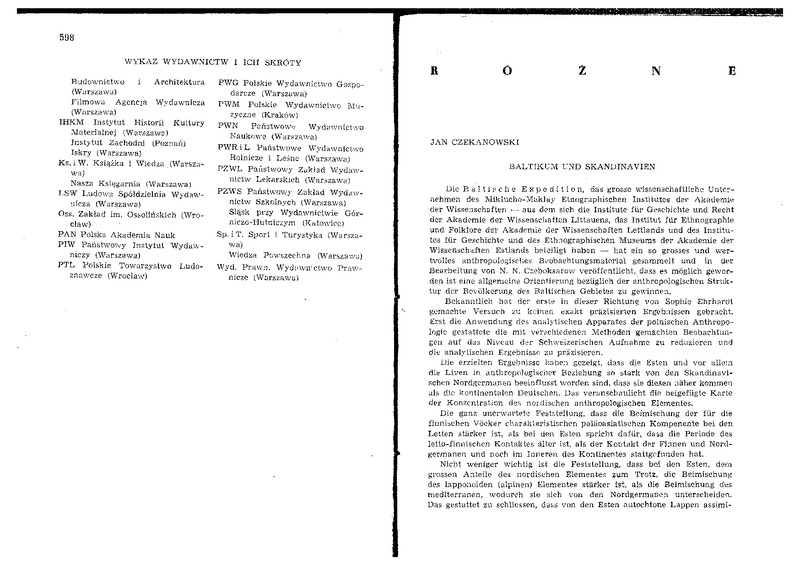
Die B'; l t i s c h e E x p e d i t i a n, das grosse wissenschaftliche
Unternehmen des Miklucho-Maklay
Etnographischen
Institutes
der Akademie
del' Wisse::lschaften - aus dem sich die Institute fur Geschichte und Recht
der Akademie der Wissenschaften
Littauens, das Institut fUr Ethnographie
und Folklore del' Akademie del' Wissenschaften
Lettlands und des Institutes fur Geschichte und des Eth::lographischen
Museums del' Akademie d~r
Wissenschaften
Est1ands beteiligt haben - hat ein so grosses und wertvolles anthropologisches
Beobachtungsmaterial
gesammelt
und in del'
Bearbeitung
von N. N. Czeboksarow veroffentlieht,
dass es moglich geworden ist eine allgemeine Orientierung bezuglich der anthropologisehen
Struktur der Bevolkerung
des Baltisehen Gebietes zu gewinne::l.
Bekanntlich
hat del' erste in dieser Richtung von Sophie Ehrhardt
gemaehte
Versuch
zu keinen exakt prazisierten
Ergeb::lissen gebracht.
E::st die Anwendung des analytisehen
Apparates del' polnisehen Anthropologie gestattete
die mit versehiedene:l
Methoden gemach ten Beobachtungen auf das Niveau der Schweizerischen
Aufnahme
zu reduzieren
und
die analytisehen
Ergebnisse zu prazisieren.
Die erzielten Ergebnisse habe:l gezeigt, dass die Esten und Val' allem
die Liven in anthropologischer
Beziehung so stark von den Skandinavischen Nordgermanen
beeinflusst worden sind, dass sie diesen :lahel' kommen
aIs die kontinentalen
Deutsehen. Das veransehaulieht
die beigefugte Karte
der Konzentration
des nordisehen
anthropologisehen
Elementes.
Die ganz unerwartete
Feststellung,
dass die Beimisehung
del' ftir die
fillllisehen Voeker charakteristisehen
palaoasiatisehen
Kompenente bei den
Letten starker ist, aIs bei den Esten sprieht dafi.ir, da ss die Periode des
letto-finnisehen
Kontaktes alter ist, aIs der Kontakt der Fi:lnen und Norclgermanen und noch im Inneren des KO:ltinentes stattgefunden
hat.
Nieht weniger wiehtig ist die Feststellung,
dass bei den Esten, dem
grossen A:lteile des nordisehen
Elementes
zum Trotz, die Beimisehung
des lapponoiden
(alpinen) Elementes starker ist, aIs die Beimischung
des
mediterranen,
wodurch
sie sic h von den Nordgermane::l
unterscheiden.
Das gestattet zu sehliessen, dass von den Esten autachtone Lappen assimi-
�600
liert wurden, we:1n auch die Hauptmasse
dieser Autochthonen
in slidlicher Richtung abgedriingt wurde.
Das Vorhandensein
der fruher
nicht priizisierten
anthropologischen
Unterschiede zwischen Littauer:1, Letten, Esten und Liven, und der enge
Zusammenhang
der letzteren mit den Skandinaviern
veranschaulicht
das
beigefUgte Diagramm. Es wird dart gezeigt, dass die Esten von de:1 Inseln
und die Letten aus der Umgebung von Libau sich in anthropologischer
Beziehung von den Liven :J.icht unterscheiden.
Die Ekspansion der Liven hat
sehr stark die west1ichen Letten und westlichen
Littauern
beeinf1usst.
Es unterliegt keinem Zweifel, dass die Lette:1 eine von den Finnen beeinflusste Randformation
des letto-littauischen
(baltischen) Volkes darstellen.
Die Anwendung der Methode der quantitativen
a:1thropologischen Analyse hat gezeigt, dass die anthropologische
Gegenwart des Baltikums aIs
ein Ergebnis des Zusammenprallens
der Fin:1en mit den Balten und Germanen aufgefasst werden muss, wobei die Ostseekuste von den Letten vor
den Littauer:J. und spiiter aIs von den Finnen erreicht wurde. Die strittige
Frage ob' die Finnen an der Kuste vor den Gennanen
erschienen sind;
werden erstei:1gehende
kraniologische Untersuchungen
entscheiden konnen.
..
WACŁAW PETSCH
THE VISTULA-DELTA
AND THE PROBLEM OF EAST PRUSSIA
THE PEACE CONFERENCE IN 1919
AT
The aim of this work is to show that a rigorous application of the
theoretic theses of the Peace Conference concerning the State frontiers
(principle of ethnographic
borders) can evoke catastrophic
conseque:1ces
and to draw attention to the faults of the method applied for a realization
of those. principles in practice.
The errors of the method consisted in the fact that data falsely repre~
se:1ting the demographic state of relations have been used as a basis. The
interpretation
of these data also evoked many doubts.
A typical example of a great political meaning (because it has been
connected with the problem of Gdańsk) was the question of the VistulaDelta.
The actual work gives details of the German demographic registration
in 1910 in the following districts: Kwidzyna, Susz, Malborg and Sztum interpreted in the light of the scientific conceptio:ls of Polish ethnography
between the two World Wars. (W. Wakar, K. Smogorzewski). The Commission for Polish Affairs (Cambon's Commission) which had to present the
High Council a project of the solution of above question calculated the total amount of Germa:lS in this territory to be about. 200.000 people. This
figure has no confirmation even in official statistics. Thus, the amount of
Poles in the Kwidzyna and Susz districts has been evaluated only as 700\l
agai:1st 73000 Germans. whereas the German registration
of 1910 gave an
amount of about 30.000 Poles, i. e. 23,291; of the whole population. A school
registration of 1911 quoted by the Polish Delegation evaluated the number
of Poles in that territory to be 37,000 people, i. e. 29,4:[; of the population.
A very important thing to form a proper idea of the demographic statistics
of that territory is th'e percentage of German population which was r:mplayed 1:1 the administration
service and therefore could not be considered
as permanent population. For the territory of Pomerania this percenb6e
umounted to 22,7 of the whole German population.
As we see, the interpretation
of statistical data plays a very important
role. We must also remember that the demographic registration
of 1910
�603
602
was tendentious and carried out in conditions of severe oppression of the
Polish population, as it has been known to the whole world. That is why
the author allows himself to quote the opinion of a scholar of world reputation, prof. dr Eugene Rome"r, representative
of the Polish Delegation at
the CO:lference: ••...all the above mentioned quantities
of Poles and Germans are based on official registrations
being more or less falsified .. "
Another expert, prof. dr Kazimierz Nitsch made the following statement: the war being lost by Germany the eleme:1tary justice requested to
joi:1 to Poland the Sztum district without any formalities ..."
Thus, a paradoxal
situation arose, both contradictory
suggestions in
1hc question of Vistula - Delta made at the Conference by the Commission
for Polish Affairs (supported three times) - to adjudge the 'listula-Delta
to Poland and by Lloyd George to make out of it a plebiscite territoryconcerned
an area vvith quite a different
demographic
configuration
thtact with everyday life requests. The range of such a structure
of exhibitions depends of the special plan, the latter being not an improvisation but a product of a long creative work ..
This plan regulates the possibilities of fulfilling the fundamental
problems of the museum, the rational circulation of the public in the premises of the museum the social function of the storages which should be
accessible not only for the scientists, the best administration
of the space;
the avoiding of improvised lavishness in dislocation of exhibits etc. In the
realization of exhibitions all sorts of problems are combined: the style of
work of the museum staff divided into working sections and the participation of country manufactures
in the arrangement
of exhibitions,
e. g.
such as joiners, potters, fullers, ove:1- fitters, oilmakers etc.; the Skansen
type exposition fitted in the museum building and performed by the conservator, architect and joiner a:J.d the exposition of folk-dances
made by
the sculptor, costumer and choreographer;
appeal to the sense of sight
and to the sense of smell in the perception of the objective truth of the
expositions as well as problems of light and of engagbg naturalistic
elements (pulled out of nature) to modern exposition- to say the truth in a definite proportion - to the space occupied by the cultural products. An important problem IS the question of exposition of folk costumes. The series
.~
�617
11. IiI.
(1937) -
Ay:lb
C OCTpOBa BOp~IC.
12. H. rll:Ib
BBII)l;y
Jl Hoca,
IlPHBA:ITHK_-\
Bn:I'I'I1ll:cKaH
m!.
rp.aq)l1J{
c
SriCn8;\HlIlIfl,
II aH'rpOrrO::IOrIlII
H.
H.
Mya88M
peay:IbTaTbl
AllTpono.'IOrlneCKlBl
cllIH B
.il WT
18
OB II e n
HepeTCI\O~I,
512,
aa)l;a'lH
II Be.1IOpYCOB
Pa60Ta
Tome
100,
CTO n
COiflllH
(1939),
JlIITepaTypLl,
TbllliCKllX
)l;OBoeHrrJ,IX rry6mUWI.\llit,
12
1.
cJle.lYJOIl\IlX
IiI.
EP
°
npIIBO;{II'T
cepllit
H H a OII
516,
B
pafloHax:
He
HO nil
IlcKOBCI\oJt
06:IacI'1l
BHalOll\OH: rrOt[bCKott
HeMellIOlX,
aHTpOrrO:lO-
aCTOIICHIIX II ;;Ia-
;1J\HJlble nOBBO,LRIOT lIcnO.Lb30BaTh
ua6:IIO;:{OHlItl:
(188:1) -.60
:mTOJJlle13
Hono-Ai1eHCaH;:\p013CIWrO
yea!!;a.
2. Bo6ep
(1810) - 60 :r,n-blllieH
3. H. Hepy}l
II '1'. _\1. BIlTO:IbC
H3 OIipeCTlIOCTeit
(HJ28)
-
143
JI1l6aDhl.
:IUTMlIlett
H3 3eCBereH
B BeH ;::(eHcriO}1 yc:qo.
4. II.
5. C.
Clwro
6.
BII:Ib;.{O
Srprap;\T
Renno.
(DC.TIllJ['
820 :)CTOlIql'H (DC.L:llIHCI:Ofl) ~'c:ua.
114,) ;)eI'OHIIOH (:'ly;'j"IHll Il ;~ieHLlIIlH)
aHulIa
OCTpOll'\
KO
rJIa3a
13 -16
-O.
T.
II
AY:lL
(1n:32)-
]:38.i
SC':'I:nllil
(.\I.\';'.h'IHH
II
ai'.'JIIl\IlH)
OCf1I1'JH
II. P.
Bll.L,Ll'\IC
(192(j) -
(q'W,LO ]:LjO
:lCT')IICliIlX
nplDbIBHI>IX
c
~[;lTt'-
10. P.
B][:I:InIc
(1~)2Il)
_. 1.ifl ::Wf(l][Ch][X
IlI'Jl:ibIJJllhIX
e l'CTpOBOB.
Ta6.
'ITO
Ba:ITHi"ICIW.fl
II IIBeT
a
c.2:30),
B a Uli C,
'ITO Bu:r'rniicliaH
pa60Ta:III
1J1lleill\orrpe):leJle.
06p,:V10~1 YTocIlIHIOIl\IlX
HaCOi1CIllUl
(I) II III e p
D TO~I, 'ITO CBe·
a,
onpeilo.LeHHblx
nO'-ITn rrOJlnurr
3TIlX
onpo):\e.1Ill:la
IllHa:rO
coc'rom'
nplI
onyÓJH1-
IIO OT IIa3IlOHa.
:'ITO OTTeH!>1l A -
npOJleHllO
TO
HLUle
(1928)
6bI.~U 1I0,Ly'-IeHbl peay.l.bTC(TbI,
oECIDlal\l!eH
paape-
CpanHeHllc
1\1apTlIH
nIl,aabl
;:I.o BaHll tt,
C'he~IKa
C'beJu.;H
BapeHCJ{oro,
cTapott
6ponot!,
nepe·
HCIIO:Ih30BaIl0
II
C'bihmot'l
16
nepnoH
IlOJIY'IOHHaH
cml):\eTe:lLC'TnYCT,
TaM
S Kcne;VlllllH
nOJIOC no
lipaR
12 -
no.'IOCLl
HeO;J;IUIanOBIDI
I.
Gbemm.
COCTaBa
" nonpoc
;~BYX nCCJle·
CIW li X
u IlOJII,CKaH
nepenoilU
paapPIlICIl
BnO:lHe
Ha6:l10-
AHTporro-
IlX cIIlC:rOBblX
Y.lOn:IeTBOpIl-
I'e:'IbHO.
Tao.
IV
II VII
Ha
Haill -
'l'.
l~eIlTb['
;:{aHbl ]H~ay.Lf,T,\Tbl
OCIlOnalIlllIl!
;J;eiflOp~IIlpoBaHhl
npJDICCIl
I,ll J\ i.l.
no-
AII'I'pOnO:lornqec·
HH Mhl!!;;;IHpcr;lIit
II liInollllapCI;ott
annp
rrpIIBbIBnblx.
:l,~eCb Ha
.\Iooll.
no-
aTIIX pe.lYhl\IIll
-BelllfeHCliOrO
OT HIl;RHero
(1954,
Ha
Ha
:JTa p T II H OM
tITO Tpy;{HbIM: nonpoc
AIITpOnO:lOrlI'leclioH
:'IT)' paaHIIl~r,
BhI'lIIC:lenhl
:rorIl'IeCIiaH
pCIlleHlle
HCC:l8;::(onalllI(1
npOlpeccopOM
Hurt C(IITpOnO;JOrI-I'IeCHOro
.leHllii,
PC3YJlb'
'Yil.a'lHOe
AIlTporrO;;IorlltleCliOll:
SClIeilHlIlloll.
B y Ha E a
CBeT,LhIe
'IeliaHoDcRoro
CHIlX
V.
II IIO:lbCIWioi
JIBJlHeTCJl
paltoHOB
IloJlbcKoi1
IIo:Ihcfioit
'YqUTbIBaH
OHU
):\JlH
nepBOM: :'ITO HO:'Iepa
IllBCiIl1apIl"I3
II.
qTO
CXeJ'le
Melli;!;y
VIble
BbICO'!'Y :llllla
n BO:'lOCLI, nplllliJlOCb
Bcex
Toro,
S[;CnejJ;IlllIlIl
mBCIIl~apCnOii:
JIIII.\a 1[:J}lcpR:Ia
H3Be;l;CIlHhlX
;) le:ll>.
8.
.;
B
(103;») -AY:I l> (H12fl)
ypoBellb
BaJITlIttcJ{ot\:
no
II
2/5).
amTe:IeiI
Ha6:I10;::(eHIl(r.
D Ta6.
pe3Y:lbTaTbl
):\OIiaaaTeJlbCTBO~1
OC:'IO;'KHeHO TeM,
rJIf\a
BhlCOTy
;r8,llHbIX
(1924) - 189 II:YP:IHIU:CnllX i1HBOB.
(1!):~:1)- lO! ,)CTOlllpn npllxoJ,,\
B.
y03"a.
H. AY:lb
'i. II.
a
FhIXBI1CKOM II IlJIp-
pai10He
peayJlbTaTbl
lIB8T
SCTOI!-
r:laaa
HUO:IJO,J;PHlltt. PeayJILTaThl
BaJlTHitcKot-i
JWBafl
,Il;eJle-
TeH;(eHl\I1I1.
):(pyruM
BOCTO'lIIOtt
IlpYCCUI1
MlIpa
C ee
lIymJ:H)1
THBOf!:
He
CMorna
OTBe'la:'l1{
al>oaomncc-
ObI,
IIH'IeCEOe
BeHHhl~I
•
HI1X
'ro
'ITO
rrpUBHJIbHOe
npHHI.\UrraUJlbHOe
II ):lJJR oeaorraCHOCTlł
TyT
HOT II Me.\IOpHa:JOD,
rrO;J;'1epnHBąJlOCb,
aa.IlU'IaM,
MMeeT
Il0JIbCKOM:
D
HOTopble
pa3-
rrpOTUBOrrOJIOm-
pa:JpemeHl1e
3Ha'leHHe
EDponbI,
He.}lel\J;Oro
II Il0J\lOpbll
)lllJlJlllOHOD
rropaOOIl\eHlIe
KOHTpO:JeM
C"aH;:J;I1HaDUH,
Ae:Jeral\HI1
KOMrrpO~IlICCB,
rrpuHflTHeM
25- 30
B
crropHblM
B \popMe
I)
r.
IlpyCCllH,
B plIAe
rrp06J1eMbI
).J;JIfI coxpaHeHHII
a ;::InR Il0JlblllH
CBflaaIIO
rrplI-
cyIl\eC'!'BOBaHHe}1.
MHeHlIlO
HOf! IlpyCCIUI
BOCTO'IHOtl
rrocTyJlaTbl
1917
C
BOCTb BceM
llhIBąfl
B IluplIiHe
I>OTOpble
Bonpoca
cnoll
PUOUTbIBaJlHCb
Ilo
hOHll>EPEH~l1H
HeJlIl\aMII.
rrpo\p.
'ITO BOrrpel;I1
Obf:JO aKTO~1 a::Ie)leIITapHOn
ceÓlI
CTaTHCTlI'IeCI>lIe
Ila
óe30rOBOpO'lHOe
yea;::la
C'łlITalll
\f>eoAaJlbHoti
HaTo..-rIlKaM
n
Bel.;a
'l'aKUM
u
3anl1CaHHOM
c COLllaCllf1
paHbme
CrrHCJ-;O-
113-3a
rrpOTeC1'aHTclwl1
::JTHM npeMeHe:lo1 ;:(a'rłlpyeTcfl
npeJ(aHlIrt
cnoeR
pemeH
~l:ea;;:(y
XVII
3TY
~lHpaac.
BOPhE.A
II HaShInaC~l:blt'l:
ITOJIbllie,
Obl'£h
y EOTOpOt'I
OU;I Ila6pOllIeH
B03HIIHUIIIX
u
ObD
3aMaryma
pacrrpl1
Hace..-reHl1fl
rrpe;:(aIUUl:,
npe;:(aHIIIO,
OTpaa;eHIIe
rOT L,eBlI'l
Kpan,
MeiRiJ;y
Tanme
rrO.lOBlllIe
C
OÓplI)J;OB.
:noMy
paClIo.lomelllloit
BTOpOr'ł
B
BepOllcnOBe;:(aHRfl
..-rIlUIl3~L HMeHIlO
-
ITo
CTopOHa,
CJ-;O~IY HaCe:IellIllO
H HyJlh-
TIo;:(gepmKoR
ó:rarOrrpl111TCTBOBa;IO
Hame:I
~leCTJlOCTH,
l.\eplCOBHhIX
Mel.l\allCTBO
C'laCThe
'laCTblO
rrpHHa;:(:Iemal.l\er'ł
;:(O:ImeH
AJlTarOIIH3M
II OTClo;:(a B IIPyrue
rrplI
Ha
II
r.),
;J;e rpa;:(cą
i(epeBHflX
B03HIIr-;aJIH
na1'O:'Iu'1ecJ-;ofl
01'pameHUe
3a~IarYiRe,
3apasy
rro;::\ B;rHR.HHe~l
ua AuI':rHll
n
CTaHXIlTcon
C rpa-
nhI3LlBae'r
(cI>oHT0HenJIb)
Ma,rU'1eCKIlX
CW1IIlA
Bal.\Eotl
6ypll
cDpaHlIHIl
B XlVII
II ~larllH
HOHlpeCCIIOna:I
nony:IlIpHaal(HH
PEJIl1rI103HAfI
Toro,
no
Rpe~llIaxIl,
HpO-
Hallf.'Tl1
BrrOCJIe,:{CTnl1e
TO :'II{ OCTaBll21a
MeCTO.
BeHrplI1I
Mea;;:ly
KOTopafl
aBTOXTOHaMU,
B HeJ-;OTopblX
Tor;la
rrO:IbaOBaBLIlIIXCfl
oTHoureHlHl
rrOJIa·
cI>paHlIHIO
HHfla;eCHlIX
co !:lCCyl HC'le3
rrog
B ;lpyroe
l';OH1'ppetllOIHlaUIIII
r-;OC1'e:Ia~lH
rrp Ił LIIe:'I hl.\e B,
C nO:lbCJ-;I{MH
rrplllla;:(.-lea;aBLIlero
npOTCCTaHTOB,
Hanaa;AeHllfl
DhI3hIBae1'
r-; TIHI.l\C oneI'
OTCIO)];a pacrrpoC'rpaHlIIOl.l\ell:Cfl
rrpeI,paweHUfł
Jl
rrO~lel.l\eHHafl
C'IIlTaeTCrr
OIiYJIbTl1aMa
HHKBII3I1l(HH
COOCTBOBa:lH
rrpIFlp;lI>JI
..-rem,oBcrmx
nepeCe:IIIBWIICb
B..-ra;leHIllI
opOllleHHafl
lWJI;~YHblr.
C rrOflB:IeUIIell1
THBllpoBaHHotl:
Jl EO:I;:(YHLfl~lll:
n' rropolllor.;,
,mc"pe~leJll'On
Hanpan21eHIUl,
(EenIWp,
1'0,
aTU
rrec'rrrHO~1
rpynna
aCCIIYlll.1UjJ0l3a;TUCL
)J;epeBHIO,
HcrraHHK
n rrpe;:(aHlIflx.
lW:I;:(oBcTnax,
paHlIHFl).
I'IIX
'lapo;:(eitcTBe
B pa3:III'lHhIX
B ra;:(aIlllflX
1'al,ale
5.
rrOC:Ie
~leCTax
Jl:IJl
a
Bpe~lfl
EBXapJlCTlllI
B orOHh
a;:la,
B :r1060BHO~1
HaCTOfll.l\ee
::JTHorpa~UI1
rrO'lTII
a
}HleHHO,
OOhI'1au.
BhIllleyHa3aHHhIMU
COCTaB:IIIIOT,
onpe;a;eJIeHHyLO
OOl.l\eCTBeHHyIO
He06xop;uMO
aaIlIlTcpeCOBaHłIOCnl:,
aTHorpa(pllll
C
oecrrpeTeH):(eHTHO
Tar-;iRe
rrolleaayR,
a
l1p;eOJIOrJlIO:
nOp;'lepKHyTb,
caMhlll:
npUMeHfleMhIe
;J;O~llnmpYIOI.l\YIO
p021b
p;peBHHll:
MeTO):(hI
B
3To/ł
�627
626
h
p;HCl.(rllIRHHaM,
J-WTopble
'leCIiI1X
HCC;re)l;OBaHlitt,
rrpHHa)l;ReamT
B OTHOIlleHlm
ił